For twenty years, starting in the 1940s, a powerful Jewish energy infused American fiction. Gone were Steinbeck and Fitzgerald; in their place, a warmer, looser tradition, urban and sensual, had taken root. It flaunted Jewish memories, Jewish conflicts, athletic feats of talk, the music of streets. “Believe me,” says a Malamud character, “there are Jews everywhere.” It certainly felt that way. Playing the roles of both trendsetter and trendspotter was Philip Roth. In 1968, an odd question nagged at him: How were Gentile writers reacting? With jealousy? Wounded pride? “These guys have contempts and hatreds and rages about which we don’t know anything,” he mused. He was desperate for an honest report. What was it like “being overrun by these Yids”? Before long, he had his answer. Roth’s friendly rival, John Updike, conjured Henry Bech, a Jewish-American author, with an audacity that even Roth might have envied. After visiting Bulgaria, Bech sets out for Romania and Czechoslovakia—the European bloodlands. “If I could write two more Bech stories I’d call it a day,” Updike told Malamud. That was the plan. It didn’t work. Bech was Updike’s creation, yet Updike couldn’t quit Bech. It wasn’t until 2000 that Bech took his final bow. Bech was—and remains—an audacious gambit: a major American writer’s shape-shifting experiment. When the first Bech stories appeared, readers were intrigued: Who was Bech based on? Was this satire or homage? Clearly, Updike was enjoying some mischief. But what exactly was he getting away with?
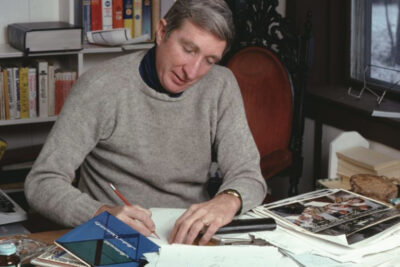
: John Updike, 1978. (Photo by Jack Mitchell/Getty Images.)
Gradually, such questions faded, as one would expect. But now, like one of his fictional alter egos, Updike is back: More than seven hundred of his charming, gossipy letters were recently published in the 912-page Selected Letters of John Updike, and a four-day Roth/Updike Conference recently drew the faithful to New York City. A broad reconsideration is in progress, and, indeed, there is much to consider. Over his long, prolific career, Updike wrote provocatively about sex (the 60s), the Vietnam War (the 70s), and radical Islam (the 2000s). With equal chutzpah, throughout this period, he wrote about Jews. Bech wasn’t just a Jewish writer. He was the Jewish writer. And, in some sense, he was Updike’s statement on Jewishness. Having fallen for Updike in college, I planned to continue my Updike education later. Somehow, later never arrived. When the COVID-19 pandemic struck, I had been procrastinating for seventeen years, and after another four, I still hadn’t cracked another novel. Slowly, shame overcame resistance. This past summer, I began a serious Updike binge. Plenty was familiar: Updike’s lavish gifts for description, his stunning fluency, his debts to Nabokov and Proust, his refusal to simply call a thing by its name. His elegant, filigreed prose, betraying his mission “to give the mundane its beautiful due.” And, of course, all that sex, an epidemic of horniness afflicting the too-tranquil suburbs. I was surprised at how much I had forgotten. There was a strange blend of sensibilities and styles. On one hand, a delicacy, a quite lovely appreciation for small, beautiful things. But also something darker. It’s easy to forget, while picturing Updike, that charm and cheer weren’t his only qualities. That twinkle: What might it conceal? A hint of mischief, perhaps—even malice. To be sure, he had a writer’s necessary ruthlessness. “I drank up women’s tears and spat them out,” he once wrote. In fact, Updike’s fiction is often spiked with cruelty and insult. His characters are often crass, even Archie Bunkerish, and one wonders, unavoidably, about their creator. For Updike is present everywhere: the careful syntax, the easy lyricism, the insights into politics, marriage, and religion. What about the comic malice, the cheerful scorn? Was that Updike? Or just an ingredient in his fiction? Exploring Updike’s letters—including hundreds not included in James Schiff’s excellent volume—offers some clues. “I seemed to be talking . . . like a fag with hiccups,” he writes a journalist in 1966. In another letter, he suggests that only Jews can understand Russians. “What a pathetic sinister funny bunch,” he smirks. Along with the charming, affable Updike was an edgier Updike, an insult comic. “Jesus, those Arabs,” says a character. “Wouldn’t it be bliss just to nuke ’em all?” He later told the publisher Herb Yellin, “We’ll be beloved throughout the Arab world, once we make Iraq the 51st state.” A joke, but Updike was clearly vexed: “We rescued these jerks so they could slash their heads and beat their chests for Mohammed’s son-in-law who died around 750? Give us (U.S.) a break.” Updike’s inner churl often fixed on critics (“Parasites, I call them,” he told the writer Ian McEwan), but it repeatedly circled back to Jews. In 1988, Brandeis University offered Updike an honorary degree, requesting he appear on campus. “Brandeis is determined to extract its pound of flesh,” Updike complained to his wife. Poking around Updike’s archives, I couldn’t shake a very unliterary question: Did John Updike have a Jewish problem? If so, did it matter? Perhaps some tolerance, some Christian grace, was warranted. Still, it felt important to see Updike—esteemed, canonized Updike—without illusions. Were the Bech stories, that larky experiment, really so innocent? Updike was thirty-two, an aging wunderkind, when he invented Bech. At first, the stories were a surprise: Updike wrote tender, nostalgic fiction about small-town America, stories churned out at remarkable speed. “He’s always writing and he’s gifted,” Roth told a friend, marveling at Updike’s industry (“He works like a dog”). Over the years, Updike’s fiction, reviews, and poetry comprised an enormous, multifarious oeuvre. Eventually, the Bech stories filled three volumes—Bech: A Book, Bech Is Back, and Bech at Bay.
JRB collection.
At a glance, Bech seems like a vacation from Updike’s serious realist fiction. Bech is clever but hapless, a schlemiel, “the author of one good book and three others.” He’s fortyish and cranky (“Bech didn’t trust anyone under 30”). He’s a Jewish New Yorker, a creature of concrete and subways. As Updike puts it, “He had the true New Yorker’s secret belief that people living anywhere else had to be, in some sense, kidding.” So far, so charming. Yet Bech is also pathetic, and, like most losers, he attracts abuse. “You’ve lost all your principles,” his mistress says. Bech suffers writer’s block, a clinical case. Coasting on past success, he travels and lectures—the writing life minus the writing. “What do you do, hit the spacebar once a day?” the mistress quips. As a consolation, Bech receives the Melville Medal, “awarded every five years to that American author who has maintained the most meaningful silence.” Again, charming. But the jokes grow increasingly barbed. “I hate the ‘pity me’ in all your books,” a reader snipes. The comedy of abjection always runs dark, and so it does throughout the Bech stories. Updike’s cheeky introduction suggests several models for Bech: silent Salinger; conceited Mailer; and “glamorous Bellow, the King of the Leprechauns.” Funny, perhaps, unless you’re Bellow. Still, the point is clear: Updike knows his Jewish rivals. “At the time it seemed he might have been a tad tense on the subject,” Herbert Gold noted. Indeed, Updike was hyperconscious of his Protestantism. When he published Midpointand Other Poems (1969), he inscribed a copy to Roth with a new title: Poor Goy’s Complaint. By that point, Updike had wearied of the “New York-Jewish literary establishment,” as he called it. Writing to the literary scholar Warner Berthoff, he deplored the “righteousness” of Jewish critics: “It is this note which often poisons Kazin’s and Howe’s reviews, which saturates Podhoretz’s, and the peculiar absence of which is so tonic in Edmund Wilson.” By that point, he was gunning for such critics. A sharp early poem, “A Vision,” names six Jewish critics, all literary commissars who declaim on American fiction. The poem’s narrator is tired of their pompous pronouncements. The poem ends sarcastically: “American fiction wept, and gave thanks.” By this point, Updike had all but abandoned subtlety. In 1967 he mused about “a harsh Providence” that might “obliterate, say, Alfred Kazin, Richard Gilman, Stanley Kauffmann, and Irving Howe.” Updike grew up in Pennsylvania, a clever, charming youth, a small-town boy. His early world was monochrome—“all Protestant, all white, all Gentile.” To the teenage Updike, Jews were exotic, and, to a degree, they remained so. He was taken with “the mystery of being Jewish,” Updike told Karl Shapiro, whose collection Poems of a Jew was a landmark. During the Six-Day War, Updike watched Israel repel its Arab enemies. “I was rather pro-Israel,” he told his family. In 1968, he published Couples, a major success, and a book with a surprise up its sleeve. “Summers I was sent to Camp Ramah,” a character says. Couples is about wife swapping; what is Camp Ramah doing there? As it happens, Updike’s old classmate, Jacob Neusner, a prolific historian of ancient Judaism at Brown, was tutoring him in matters Jewish. (“We rejoice more in joy, we scream more in anger, we shout in wrath.”) From then on, with Neusner’s blessing, Jews appeared regularly in Updike’s fiction (including a character named Neusner). Which perhaps isn’t surprising. Updike was chronicling “the America all around me,” and Jews were evermore conspicuous. By the late 1960s, the Jewish rise in literature was so conspicuous, it was almost comical. “To Phil Roth, member of the Jewish mafia,” William Styron wrote on the copy of The Confessions of Nat Turner he gave Roth, signing the book “Bill Styron—member of the Cracker Renaissance.” Jokes about Jewish success obscured a real anxiety: Jews were rising, winning awards, claiming the American tradition as their own. As a Bellow character says, “Last week I saw a book about Thoreau and Emerson by a man named Lipschitz.” This was precisely what Updike feared. But he also feared exclusion. “I came to writing at a time when American-Jewish writers dominated,” he once said, recalling his distress: “It seemed almost as if you had to be a Jew to be a real American writer. And here was I, stuck with being a rural Lutheran.” For years, he felt like “the last non-Jewish writer in America,” banished to “an unfashionable corner” of American literature. “But I persevered,” he added. So he did, writing prolifically and exactingly. Yet his Bech stories can seem curiously awkward. Bech, highly literate, should write beautifully. Apparently not: “There was something diffuse and eclectic about [English] that gave him trouble.” Beyond that, “he tended to open books and magazines at the back and read the last pages first.” Bech reads English like it’s Hebrew. That is, like a Jew. This ridiculous conceit slipped into Updike’s criticism. In one review, he criticized Saul Bellow’s English grammar. “Shall I write my next book in Yiddish?” Bellow joked. In truth, Bellow was furious. Even Updike’s praise felt condescending: “Isn’t it wonderful that he can use English so well considering that it’s not his native language?” Bellow wasn’t paranoid. Many distinguished Gentile authors saw Jewish writers as usurpers. “They hate English and are trying to destroy it,” Gore Vidal fumed, while Katherine Anne Porter, who resented Bellow, accused him of “bastardizing” literature. Jewish writers, she said, employed “a deadly mixture of academic, guttersnipe, gangster, fake-Yiddish.” Updike wasn’t nearly so strident, but his antipathies were similar. It wasn’t just how Jews wrote; it was howloudly. He couldn’t stand Mailer’s “fulminations” or Bellow’s “aggressive breathlessness.” “Such a wealth of words,” he complained of Salinger’s stories. Of all the noisy Jews giving Updike migraines, the noisiest was Roth. “His characters seem to be on speed,” Updike complained, “. . . talking until their mouths bleed.”
Philip Roth in 1979. (American Photo Archive/Alamy.)
Clearly, this wasn’t really about literature. “What is disliked in the Jews,” the sociologist E. A. Ross once wrote, isn’t their religion but “certain ways and manners.” This was “genteel” antisemitism. It wasn’t violent or paranoid, but it was laced with disgust. In TheNew Yorker, Brendan Gill once dismissed “a hell of gross, talkative, ill-dressed nonentities, offensive to look at, offensive to listen to, offensive to touch.” He was describing Bellow’s characters. A similar disgust creeps into Updike’s fiction when Jews appear. At first it’s surprising, but soon the pattern is obvious. Updike’s Jews are grotesque, the men hairy and hunched, the women dumpy and frizzy-haired. Couples features a “terrifyingly hirsute but gentle Jew.” Rabbit at Rest refers to “the hunchbacked little Jewish guy.” With so many Jews running around, you’d think one fair-haired, light-skinned specimen would turn up. No such luck. “Horny, Jews are,” thinks Rabbit, who’s been pondering Hollywood Jews (“They went crazy out there with the . . . Midwestern shiksas”). In Rabbit at Rest, his golf partner has “that hunched back and awkward swiftness Jews often seem to have.” He notices Jewish wives “with big dyed hair and thick bangles and fat brown upper arms who can’t stop talking.” It’s hard to avoid an ugly conclusion. Updike, who exalted beauty—and thought beauty revealed divine grace—found Jews hideous. Of course, that includes Bech, with his large nose, “criminal lips,” and deep wrinkles—“the shocking face of a geezer, of a shambler.” One of Updike’s mischievous tricks is to make Bech repellent to himself: “a genuine male intellectual Jew, with hairy armpits and capped molars.” At a glance, Bech is “little more than a nose and a cloud of uncombable hair,” precisely as he appears in Arnold Roth’s big-nosed cover illustration for Bech: A Book. Might Updike’s hideous Jews possess some inner light? Hardly. In an early story, “Sunday Teasing” (1956), a Christian couple invites a man named Leonard to lunch. But Jewish Leonard is insufferable. The host’s wife interrupts him, “only to keep Leonard from running on and on and eventually embarrassing himself.” At one point, Leonard calls himself a “second generation American.” That does it. The host loses his cool. “Now take me,” he retorts, “I’m an American. Eleventh-generation German. White, Protestant, Gentile, small-town, middle-class. I am pure American.” Here, perhaps, we get to the heart of things.
Saul Bellow in 1975. (Amerika Haus/Süddeutsche Zeitung Photo.)
The question of “real America” mattered greatly to Updike. After graduating from Harvard in 1954 and spending a year at Oxford, he moved to Greenwich Village and was hired by TheNew Yorker. But Updike wasn’t content. His new city was “overrun with agents and wisenheimers,” he later said. “The real America seemed to me ‘out there.’ . . . Out there was where I belonged.” Updike’s “real America” is alien territory for Bech-the-Jew. When he moves there, it’s the premise for an extended joke. In his sprawling suburban manse, Bech feels “like a hermit crab tossed into a birdhouse.” He can’t fathom basements (“He had lived in the air . . . like the hairy sloth, Manhattan sub-genus”). Overwhelmed, he flees upstairs to a stuffy, cramped garret—effectively, a tenement. If Bech forgets his Jewishness, others will remind him. “You thought you could [abandon] . . . yourself and write American,” a critic scolds him. Silly Bech! He can imitate anyone, but he’ll always write Jewishly. And he’ll always be adrift, out of place, in real America. In the suburbs, Bech is a “one-man ghetto.” How, one wonders, did these attitudes develop? With certain exceptions, like Leonard, the Jewish characters in Updike’s early stories are clumsily if sympathetically drawn. “The Christian Roommates” (1964) features Jewish students, Silverstein and Koshland. The story’s protagonist thinks of Jews as “a sad race, full of music, shrewdness, and woe,” yet he likes these Jewish New Yorkers, “always clowning, always wisecracking.” And Updike leaves it at that. Something changed, however, in the mid- to late 1960s. One of Updike’s early stories, “Ace in the Hole,” featured a Jewish character, Friedman, sketched rather benignly. Years later, Updike revised the story. Friedman becomes Goldman, and the light spirit curdles. “He just wanted too much for his money,” a character complains. “That kind does.” Updike’s biographer, Adam Begley, flags “what looks like an anti-Semitic streak” here. It’s not just Jews who are mocked and disparaged. In Updike’s fiction, Italians are wops; gays are fairies; women are mutts (and worse). There is an insult compulsion, a stand-up comic’s reflex toward transgression, a pleasure in shedding inhibitions, in being crass. Sometimes that reflex bled into Updike’s life. In a letter, Updike cited the word “kike” in a Mailer story. Just one problem. Mailer hadn’t written “kike.” Soon Updike realized it. Embarrassed, he told Philip Roth “that some neo-Nazi in my reptile brain supplied the word ‘kike’ where Mailer’s hero had uttered the word ‘Jew.’” When Bech: A Book first appeared, most critics cheered. They loved its chutzpah, its lightness, its snappy prose. The Bech stories were woven with “precisely the right blend of curiosity, affection, [and] satire,” the New York Review of Books said later. Meanwhile, Bech: A Book made the New York Times best books list. Riding high, Updike couldn’t resist mailing copies to the very Jewish writers he lampooned. “Dear Phil—to add to your research library on Great American Gentiles,” he scribbled in Roth’s copy. Another copy went to Mailer, who seemed bemused. (“My lucky heirs,” he replied, suggesting they might sell it someday.) Even Malamud was impressed. “A good book,” he told Updike. As for the character, “I am happy to say I like him.” Over the years, Bech received myriad blessings. The critic William Deresiewicz hailed “a convincing mordant gloomy Jewish wit.” Martin Amis thought Updike “became a great Jewish novelist” with Bech. John Banville, no fool, thought Updike “portrayed a Jewish sensibility so convincingly that it must make Philip Roth grind his teeth.” Sure enough, Roth was seething, but not from envy: He found Bech offensive and unpersuasive. And he was hardly alone. Critics from Joseph Epstein to Hilton Kramer to Sanford Pinsker have noted hostility behind Bech. Summing up such criticism, Adam Kirsch accused Updike of “repeating the old exclusionary trope” of Jewish exoticism. He took Updike’s message to be that “[Jews] cannot in their bones understand [the] American experience.” The most cogent critique ran in Commentary. To Cynthia Ozick, Bech was a thin soufflé, one that failed to rise. “Being a Jew is something more than being an alienated marginal sensibility with kinky hair,” she wrote. A Jew without God, without memory, without knowledge? “Ah Bech! In your uncles’ backrooms in Williamsburg you learned zero: despite your Jewish nose and hair, you are—as Jew—an imbecile to the core.” After so many subtractions, what remained? Mainly cliches. To Ozick, Bech seemed spawned by “an Appropriate Reference Machine.” And she’s right. Today, Bech reads like something ChatGPT might concoct. Enter “Jewish author” and voilà: frizzy hair, large nose, clever irony. Even Jacob Neusner, a reliable booster, complained that “Bech has no Jewish past or memories to speak of.” Why had Updike invented this de-Judaized Jew? “I find myself, in what should be an uncompetitive field, terribly jealous,” Updike said in 1966. In a later interview, Updike was frank: All the attention paid to Jewish rivals annoyed him. “Out of that unease, I created Henry Bech to show that I was really a Jewish writer also.” Reading the Bech stories, one senses another motive. “Your ideas are the product . . . of spite,” a character tells Bech. “There is somebody you want to get even with.” Bingo. Bech was a way of “working out various grudges,” Updike confessed.
Indeed, the Bech stories seethe with complaint—mainly, about the literary life. Dreary readings. Endless junkets. All those ridiculous prizes. “Who else but Updike could take fame so for granted as to endow it with exhaustion?” Ozick wondered. Then there were critics, the worst pestilence. “We shouldn’t write just for those bastards,” Updike once wrote. And so, in a weird picaresque, Bech turns vigilante, hunting those cranky critics. Down they go, one by one, poisoned, strangled, and mangled. Clearly, Bech was doing Updike’s dirty work, and one isn’t surprised. In Updike’s fiction, Jews are disinhibited (“Neusner, Prichard—they were both free in a way Ken wasn’t,” thinks the narrator of Couples). For Updike, Bech was an escape from WASP decorum. Which suggests Bech’s larger purpose. “Bech, being an intellectual, an artist and a Jew, allowed Updike to flesh out his fanciness,” the critic Anatole Broyard wrote. He could abandon “those queasy, pastoral towns that time forgot” for the wider world. Philip Roth noted something similar. Updike was “very hung up on his background,” Roth said in 1968. “He’s locked up. He’s in prison.” Apparently it took a Jewish character, Bech, to liberate him. What might liberate Bech? From early on, he seeks “to reach out from the ghetto of his heart . . . across the Hudson.” Bech, raised by Jews, finds them clannish and small-minded. As he miserably admits, “I’ve spent my whole life trying to get away from them, trying to think bigger.” Alas, there’s no escape, except, oddly, to Hollywood. Bech adores “those gargantuan, crass contraptions whereby Jewish brains project Gentile stars upon a Gentile nation.” It’s an interesting notion of success: (a) shedding Jewishness and (b) entertaining Gentiles. That’s Bech talking, but it was also Updike. “Kafka,” Updike once wrote, “however unmistakable the ethnic source of his ‘liveliness’ and alienation, avoided Jewish parochialism.” Through his writing, Kafka transcends Jewishness. He escapes his heart’s ghetto. Indeed, his stories “take upon themselves the entire European—that is to say, predominantly Christian—malaise.” To the ever-alert Ozick, this chutzpah—Christianizing Kafka—was too much. “Nothing could be more wrong-headed than this parched Protestant misapprehension of Mitteleuropa’s tormented Jewish psyche.” You have to give Updike some credit. He had a genius for poking Jewish sensitivities. Of course, if you really want to rattle Jewish nerves, you have to discuss Israel. And so, Bech tramps off to Jerusalem. There he pities Palestinians, grumbles about “this Zionist state,” and declares Israel “a mistake long deferred.” If anything, these vague, ignorant complaints are a smoke screen. Updike’s real issue, one suspects, isn’t the occupation; it’s Israel’s pride and self-sufficiency. It doesn’t need WASPs. It doesn’t feel itself parochial. It isn’t ashamed of Jewishness. But to Bech, “it’s just a ghetto with farms.” If you squint, Bech resembles Bellow (an angry Bellow certainly thought so). But he more closely resembles Mailer, who, like Bech, mainly ignored his Jewishness. Was there also a secret muse? In the 50s, Malamud created Arthur Fidelman, a New Yorker, struggling artist, and melancholic. If that weren’t enough, he’s a peripatetic Jew in Europe and a schlemiel. “Without the examples of Fidelman + Pnin,” Updike told Malamud, “I wouldn’t have perpetrated this book.” What virtues Bech slowly acquired, he owed mainly to Jews. “With Cynthia’s admonitions in mind, I’ve tried in subsequent episodes to give him more [Jewishness],” Updike once said. Still, a cold look at Bech—and Updike’s gallery of Jewish grotesques—mainly inspires annoyance. This was hostile Updike, at ease with his crudeness. “For all his erudition and style—for all his going everywhere—he never transcended the attitudes of Shillington in the Depression,” writes Christian Lorentzen. “He never really wanted to.” Writing is seduction, and Updike’s charm, his outward glow, has acted like a forcefield. “Updike was not, of course, a racist, a sexist, or a militarist,” Louis Menand insisted. Another Updike fan, the writer Adam Gopnik, cheered the “resolutely well-wishing” Updike. How did sharp minds miss so much? Some smart critics did sharpen their axes on Updike. He was called “a minor writer with a major style” (Harold Bloom) and, infamously, “a penis with a thesaurus” (David Foster Wallace). “It seems to be easier for John Updike to stifle a yawn than to refrain from writing a book,” the critic James Wood wrote. In recent years, the criticism slowed, then ceased. “This may be because, beyond his early work, he is not actually being read,” Patricia Lockwood ventured. Perhaps. But other explanations seem likely. Those who project good will tend to have it projected back, and self-love is a powerful drug. “When you feel irresistible, you’re hard to resist,” says an Updike character. There were, in fact, two minor contretemps. In 1999, Updike dismissed a “relentlessly gay” novel set in England. (“It really feels like an attack,” Tony Kushner said.) In a 2003 review, Updike called a character “a rich Jew,” which raised eyebrows. The phrase was “loaded with historical anti-Semitism,” the New York Observer noted, wondering how it passed TheNew Yorker’s copy editors. Admirers rushed to Updike’s defense. “It seems a little excessive that the New York Observer has so dramatically libeled John Updike,” England’s Independent fumed. “John Updike is no anti-semite,” Slate decreed. And that was that. Updike’s charm has outlived him. In the popular imagination, he shines angelically, a modest, cheerful writer whose winsome smile could defuse a bomb. Rabbit Angstrom had the same talent, employed while mocking Black and Latino people. “Naa, it’s all in fun,” he chuckles. “I love everybody, especially with my car windows locked.” Even Updike’s detractors generally come around. “Long ago I wrote a nervous review of Bech for Commentary,” Cynthia Ozick told Updike, offering apologies and congratulations (“Mazel tov!”) on Updike’s Pulitzer Prize. Indeed, why not forgive? In every era, great writing springs from poisoned minds. Trollope disliked “low, disgusting Jews.” Thackeray resented “sheenies.” “What is bad about Jews is that they are not only conspicuous, but go out of their way to make themselves so.” The author? None other than fair-minded George Orwell. A writer, Updike once said, is entitled to his bigotries. And so he was. Does that vitiate his art? Can we reject a novel’s morality but admire its beauty? I’ve always thought so, but now I’m not sure. On some level, reading entails submission to an author’s way of seeing. When we’re swept away, we become, for that moment, the author’s partner. In such complicity are the risks and rewards of great literature. If nothing else, we might confront—without flinching—an author’s darker self. One can read innocently, but only to a point. Innocence ends where biography begins. Once we know an author’s bigotries, there is a moral obligation not to look away. “Rabbit,” Updike once said, “more or less thinks like I do.”
 For twenty years, starting in the 1940s, a powerful Jewish energy infused American fiction. Gone were Steinbeck and Fitzgerald; in their place, a warmer, looser tradition, urban and sensual, had taken root. It flaunted Jewish memories, Jewish conflicts, athletic feats of talk, the music of streets. “Believe me,” says a Malamud character, “there are Jews everywhere.” It certainly felt that way. Playing the roles of both trendsetter and trendspotter was Philip Roth. In 1968, an odd question nagged at him: How were Gentile writers reacting? With jealousy? Wounded pride? “These guys have contempts and hatreds and rages about which we don’t know anything,” he mused. He was desperate for an honest report. What was it like “being overrun by these Yids”? Before long, he had his answer. Roth’s friendly rival, John Updike, conjured Henry Bech, a Jewish-American author, with an audacity that even Roth might have envied. After visiting Bulgaria, Bech sets out for Romania and Czechoslovakia—the European bloodlands. “If I could write two more Bech stories I’d call it a day,” Updike told Malamud. That was the plan. It didn’t work. Bech was Updike’s creation, yet Updike couldn’t quit Bech. It wasn’t until 2000 that Bech took his final bow. Bech was—and remains—an audacious gambit: a major American writer’s shape-shifting experiment. When the first Bech stories appeared, readers were intrigued: Who was Bech based on? Was this satire or homage? Clearly, Updike was enjoying some mischief. But what exactly was he getting away with?