The 10 Enduring Ideas of Plato That Still Shape Our World
The Death of Socrates by Jacques-Louis David, 1787. Source: Metropolitan Museum of Art, New York
If the concerns of Classical Greek philosophy could be reduced to three words, they would be truth, beauty, and goodness. To contemplate these ideals with sincerity is to approach what Plato believed to be the intelligent order behind the universe, a realm the human soul is meant to rediscover. A disciple of Socrates, Plato developed ideas that gave birth to Platonism and later Neoplatonism. These traditions shaped early Christian thinkers such as St. Augustine and influenced Western thought for centuries. Plato and Socrates were concerned with The Good, The Beautiful, truth, justice, the higher self, and the nature of the soul. These themes appear throughout the Socratic dialogues. In The Republic, Plato discusses the organization of states, but he begins with the interior life of the human soul, linking the harmony of the individual to that of society. Above all, he emphasizes the importance of seeking eternal truth within oneself. Below are ten of Plato’s most significant philosophical breakthroughs.
1. Justice Is the Sum of All Virtue
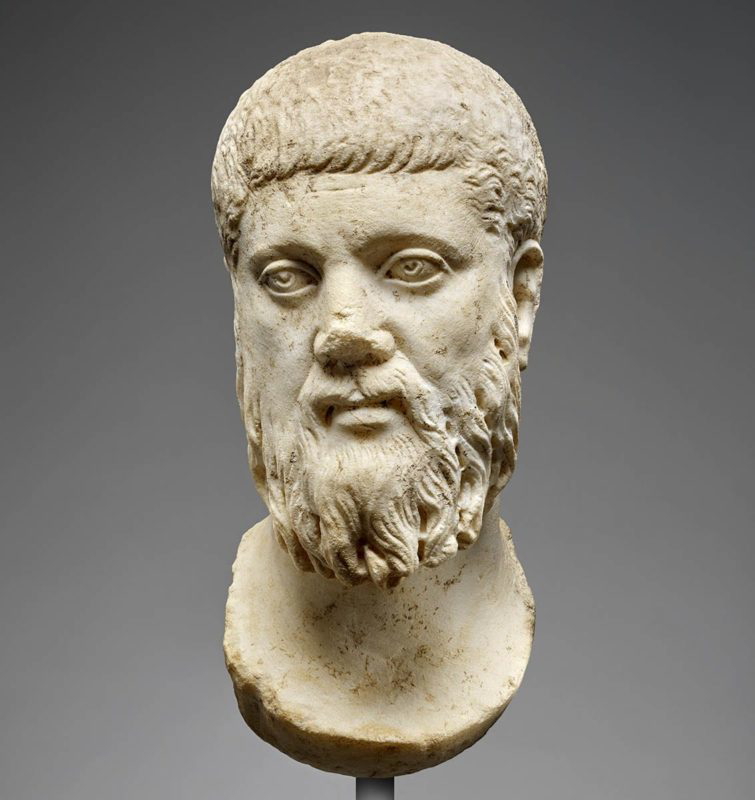
Head of Plato, mid-3rd century CE, Roman Empire. Source: J. Paul Getty Museum, Los Angeles
Plato believed that a just person enjoys inner order, while the unjust person is divided within himself. This inward harmony is essential to the pursuit of justice. To live a just life, one must pursue virtue, for virtue prepares the mind for true knowledge. Real knowledge, rather than mere belief, is humanity’s closest link to the divine. Because of this, Plato was skeptical of democracy and preferred rule by philosopher-kings. These rulers, shaped by study and reflection, would pursue justice for its own sake and inspire citizens to do the same. The philosopher king does not consult public opinion, which Plato famously calls the Great Beast. His mind is fixed on truth alone. Plato taught that pursuing justice is more profitable than pursuing injustice. The just know genuine pleasure, while the unjust mistake relief from pain for happiness. Knowledge of The Good allows one to understand what life is worth living for, and virtue is the doorway to that knowledge.
2. On the Nature Of the Divine
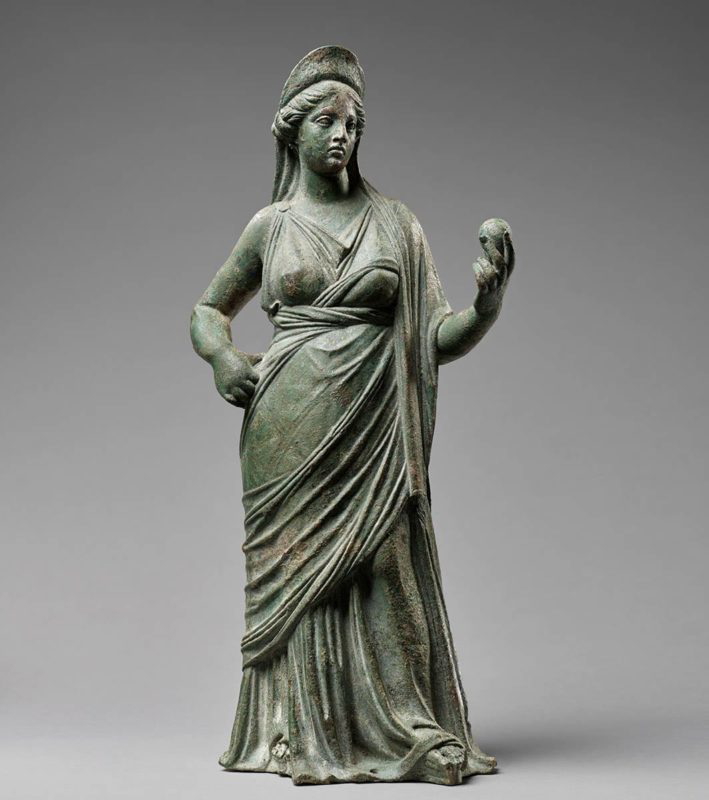
Statuette of Aphrodite, 2nd century BC, Eastern Mediterranean. Source: J. Paul Getty Museum, Los Angeles
During Plato’s lifetime, many educated Greeks no longer believed in the literal existence of gods and goddesses such as Apollo or Aphrodite. Greek religion required no faith, and Plato often used the names of the gods, God, and the universe interchangeably. He had many breakthroughs regarding the divine. One of the most interesting is his belief in reincarnation. He refers to a wheel of birth that the purified soul can escape in order to dwell with the gods forever. He also argues that God is not responsible for evil in the world. Evil arises from human ignorance and misdirected will, not from a divine source. God possesses immunity to change because He is already perfect. This view contrasts with the anthropomorphic gods of Greek tradition, who frequently intervened in human affairs. Plato’s divine principle is unchanging, benevolent, and concerned with the order of the world.
3. On the Equality of Women
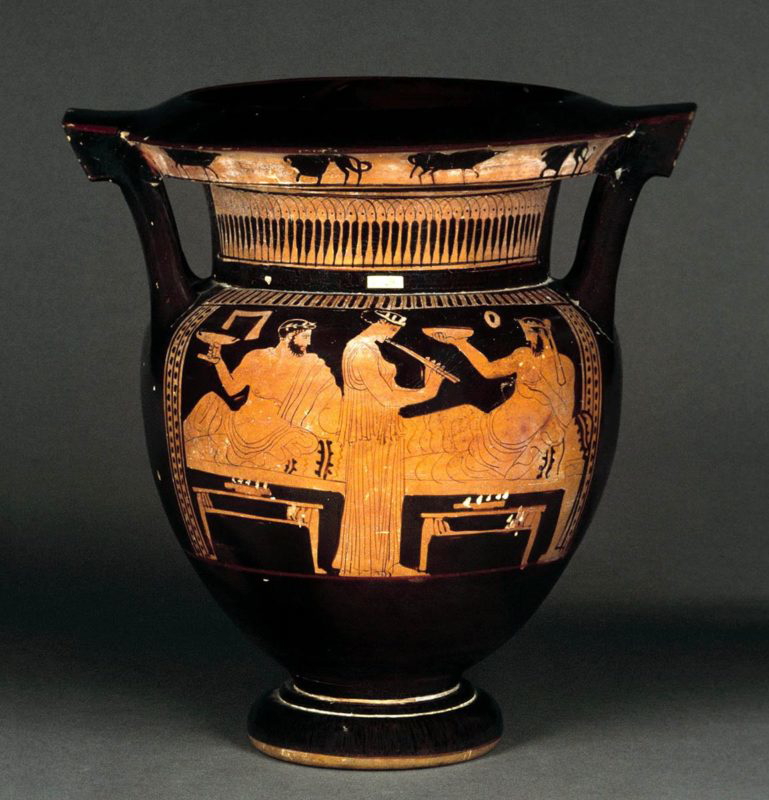
Painted pottery depicting a Greek woman, 450–40 BCE, Attica. Source: British Museum, London
Plato acknowledged physical differences between men and women, yet in all other respects, he believed women to be the equals of men. No opportunity, he argued, should be denied to a woman on the basis of sex. In his description of the ideal state, Socrates concludes that the same natures must be allowed the same pursuits. Although obvious to modern readers, this claim was radical in the ancient Mediterranean world, where egalitarian societies were nearly nonexistent. Greco-Roman women had little representation, so Plato’s argument stands as a significant breakthrough in the philosophical treatment of gender.
4. Three Parts of the Soul
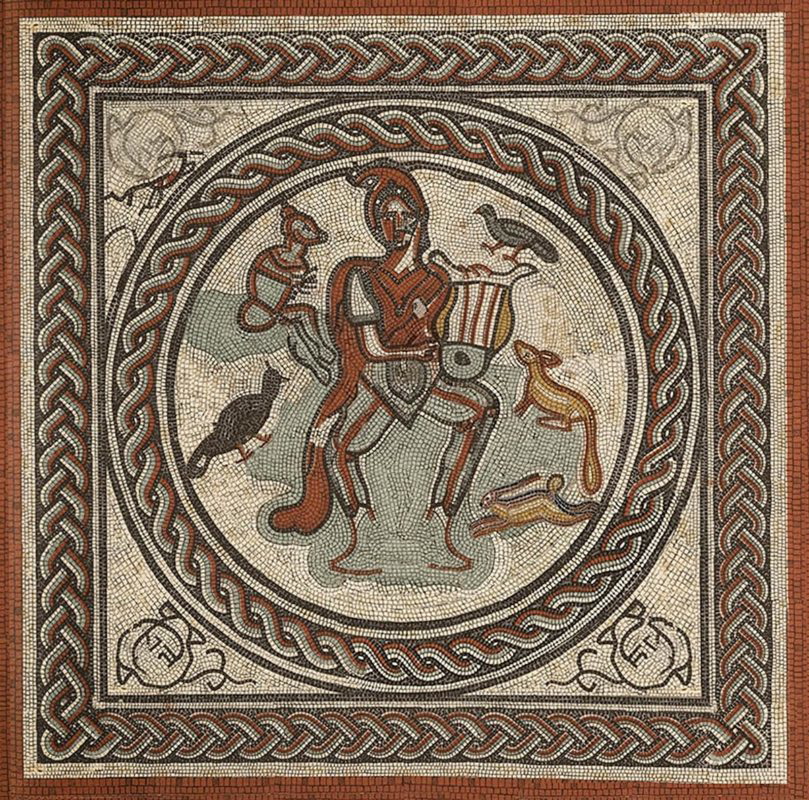
Orphic mosaic, 4th century CE, Isle of Wight. Source: Brading Roman Villa
Influenced in part by Orphism, Plato believed every human being possesses a soul with three parts: the rational, the spirited, and the appetitive. The rational part seeks knowledge and order through reflection. The appetitive part concerns impulses and desires, such as hunger, passion, or the pursuit of pleasure. The spirited part animates either of the other two and ideally becomes the ally of reason, directing the soul toward discipline and integrity. A well-ordered soul maintains harmony among these three parts. When appetite overpowers reason, the soul becomes disordered. When spirit supports reason, a person becomes capable of virtue.
5. Essential Forms of Greek Philosophy
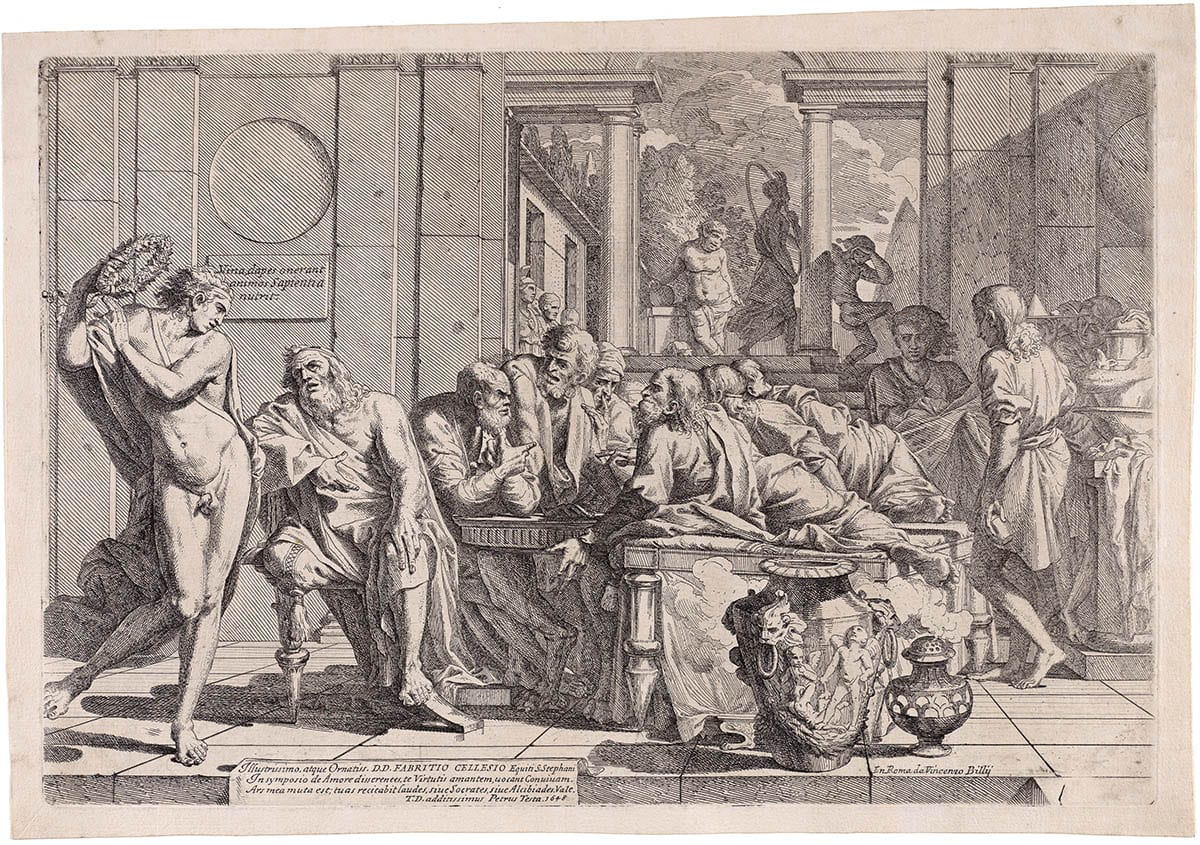
Sketch of Plato’s Symposium by Pietro Testa, 1648. Source: Metropolitan Museum of Art, New York
In Plato’s philosophy, the world perceived through the senses is the realm of doxa, or appearance. It is always changing and, therefore, cannot be the object of true knowledge. Beyond this visible world lies the realm of essential Forms. These Forms are unchanging, eternal, and the only true realities. An essential Form is an invisible yet intelligible principle. A useful analogy is a mathematical law: it is undeniably real, though not visible, and remains constant long after particular things have vanished. Plato explores the Form of Beauty in The Republic, emphasizing that individual instances of beauty are merely manifestations. The Form itself is unified, eternal, and unchanging. To mistake a beautiful object for Beauty itself is to live in a dream. The Form is the true essence, and all beautiful things merely partake in its character.
6. “The Good” as the Highest Object of Knowledge
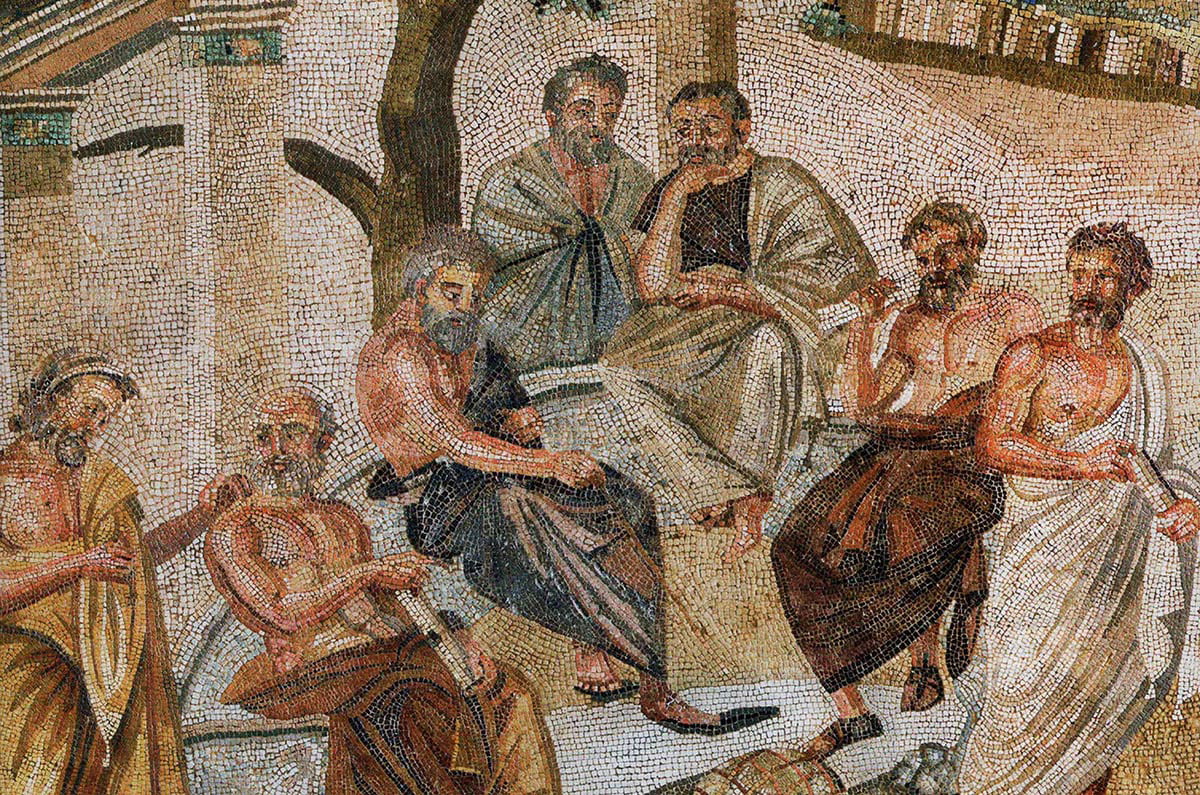
Academy of Plato Mosaic, 1st century BCE. Source: Roman National Archaeological Museum, Naples
Plato identifies The Good as the highest of all Forms. Without knowledge of The Good, one cannot recognize the true value of anything else. The Good makes the world intelligible, much as the sun enables sight. The objects of knowledge are nourished by Goodness in the same way the world is illuminated by sunlight. Plato admits that The Good is difficult to describe. Its essential form is the last to be perceived, and only with great effort. Yet it surpasses all other realities because it gives them life. The Intelligible World consists of essential Forms and mathematics, corresponding to the higher states of knowledge and thought. The World of Appearances consists of visible things and images, corresponding to belief and imagination. Belief is detached from The Good and therefore limited to fleeting semblances of reality. Knowledge is rooted in the enduring Forms that The Good brings into clarity.
7. The Allegory of the Cave
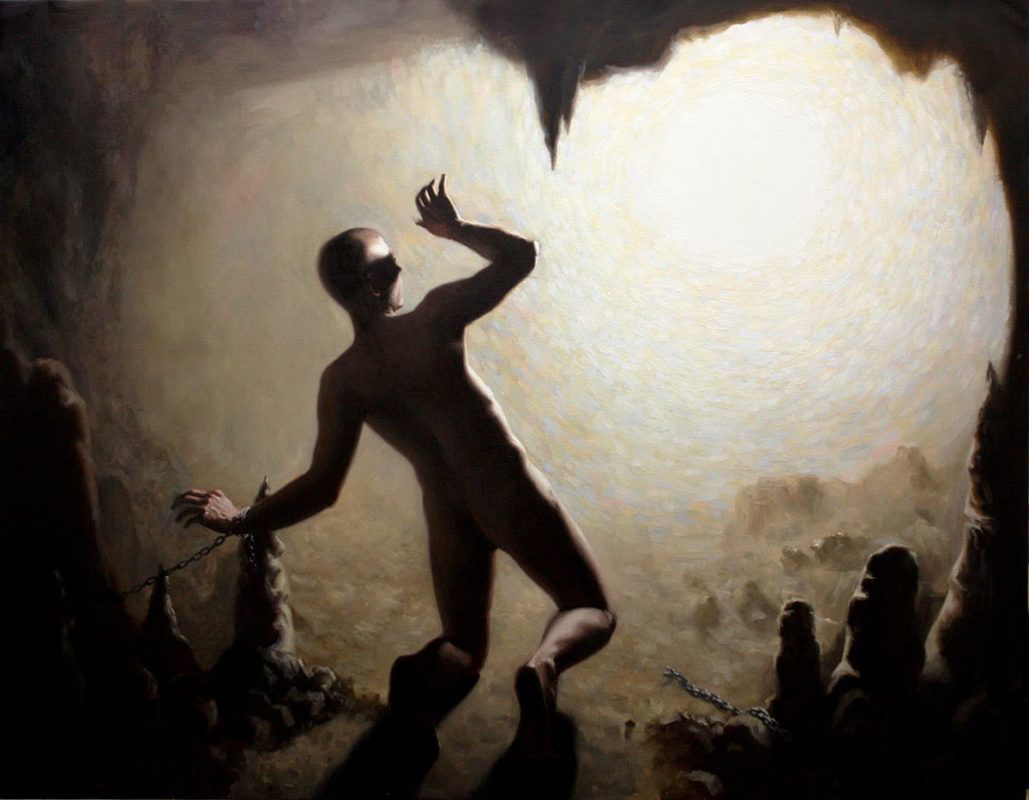
The Allegory of the Cave by Anton Dymtchenko, 2016. Source: Anton Dymtchenko Art
In his famous allegory of the cave, Plato imagines a group of prisoners chained inside a cave from birth. They see only the shadows on a wall created by figures passing before a fire behind them. These shadows form the whole of their reality. The allegory illustrates the difference between the World of Appearances and the Intelligible World. Most people, Plato suggests, are like the prisoners, mistaking shadows for truth. Beyond the cave lies the real world, which the prisoners have never known. If one prisoner were freed, he would struggle at first. The light outside the cave would overwhelm him, and he would need time to adjust. In the same way, the philosopher requires study and reflection before he can perceive the Forms. Once enlightened, the freed prisoner would return to the cave to help others, even if they resisted his attempt. This image reveals the philosopher’s duty and the difficulty of bringing truth to those accustomed only to shadows.
8. On the Ideal State
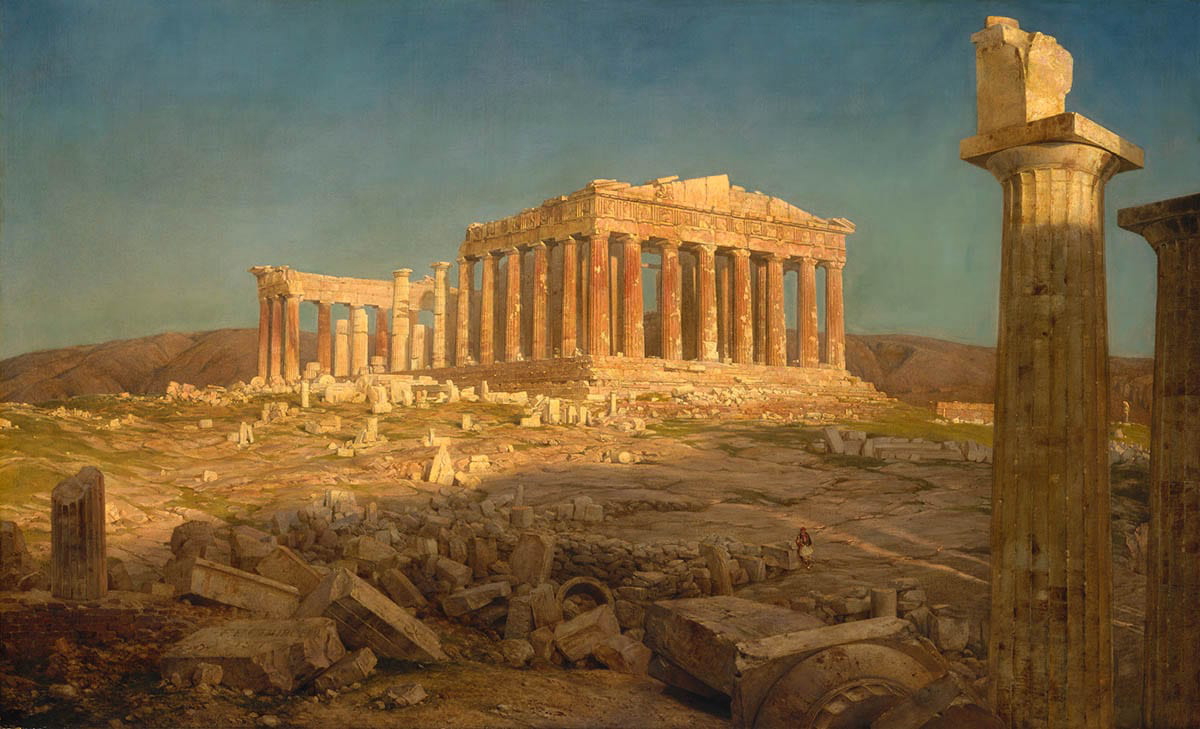
The Parthenon by Edwin Church, 1871. Source: Metropolitan Museum of Art, New York
Plato devotes several chapters of The Republic to describing the ideal state. As noted earlier, it is ruled by a philosopher king, and advancement is based on merit rather than inheritance. The state must also avoid extremes of wealth and poverty, which weaken unity. Luxury breeds idleness, and poverty breeds instability. Both have a subversive effect. Unity is essential to the health of the state, and citizens should be bound together so closely that they desire the same things. Socrates compares this unity to the human body. When one part suffers, the whole organism feels the pain. Plato urges that society function in the same way, with mutual concern and shared purpose.
9. On the Importance of Studying Mathematics
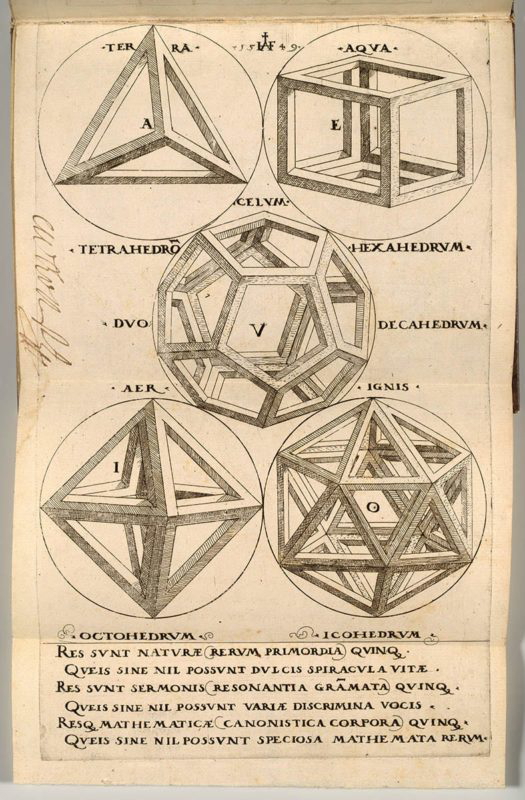
Sketch of Plato’s Geometric “Platonic Solids” by Augustin Hirschvogel, 1543. Source: Metropolitan Museum of Art, New York
For Plato, the objects of pure thought are numbers and Forms. Therefore, mathematics belongs to the Intelligible World. There is no truth in what constantly changes, yet mathematical truths remain eternal. Geometry is the knowledge of what exists independently of the senses. Natural sciences, by contrast, study things that come to be and cease to be. Mathematics prepares the mind for the Forms. Plato even suggested that learning is a kind of recollection from the soul’s former lives. Mathematical study awakens the power of thought and draws the student toward reality.
10. Proof of the Immortality and Indestructibility of the Soul
In the Phaedo, death is described as the soul’s separation from the body. In The Republic, Plato offers a justification for the soul’s immortality. Everything has a peculiar evil that corrupts and destroys it. The body is destroyed when external harm acts upon an internal weakness. Yet the soul is not destroyed by moral corruption. It remains in its condition until it is released from the body. Because no evil, internal or external, can destroy it, the soul must exist forever. For Plato, the soul’s immortality is a natural conclusion of its nature. Plato’s philosophy invites us to look beyond appearances and examine the deeper realities that shape human life. Through his reflections on justice, the soul, the divine, and the structure of an ideal state, he sought to show that truth, beauty, and goodness are not abstractions but guiding forces meant to draw the soul upward. His ideas continue to influence theology, politics, ethics, and education, reminding us that the search for wisdom begins within and leads toward a more ordered, meaningful life.via The Collector