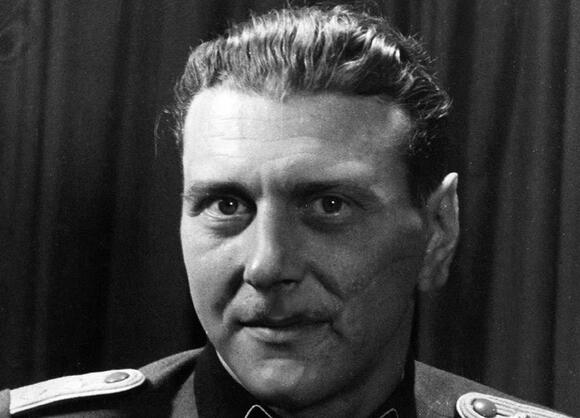
Heinrich Hoffmann/ullstein bild/Getty Images SS Lieutenant Colonel Otto Skorzeny.
SS Lieutenant Colonel Otto Skorzeny was a fearsome military man who specialized in guerrilla warfare and commando-style raids during World War II. He mounted numerous operations with varying degrees of success that involved either the rescue, kidnapping, assassination, or defense of numerous wartime leaders in Europe.
As a result, he became Adolf Hitler’s favorite Nazi commando and was dubbed “the most dangerous man in Europe” by the Allies.
Skorzeny certainly looked the part. He was an imposing figure who stood 6’4″ and sported a deep scar on his left cheek from a fencing duel.
Though loyal to Hitler and a staunch Austrian Nazi, Skorzeny would eventually turn on his former compatriots and become a hitman for Israel.
Otto Skorzeny’s Introduction To The Nazi Military
Otto Skorzeny was born on June 12, 1908, into a middle-class Austrian family. He became a Nazi early on and joined the Austrian branch in 1931. When World War II broke out in 1939, Skorzeny’s military career got off to a bumpy start when his application to join the Luftwaffe was denied. He was told he was too tall and too old at the age of 31.
So he decided to join the SS and became an officer-cadet in the Liebstandarte, Adolf Hitler’s bodyguard regiment. From 1940 to 1942, he fought on the battlefield in Holland, France, and the Eastern Front.
But in December 1942, Skorzeny nearly died on the Eastern Front after shrapnel struck him in the head. He carried on fighting until his wounds incapacitated him and he was hospitalized. He was later awarded his first Iron Cross.
While recovering in Berlin, he became interested in commando operations, reading everything he could on unconventional warfare and guerrilla tactics. He soon formulated his own ideas, which eventually attracted the attention of SS-Brigadeführer Walter Schellenberg, the head of the SD (the SS foreign intelligence service).
Schellenberg made Skorzeny the head of the newly formed Waffen Sonderverband z.b.V. Friedenthal. Now with a team of commandos, he got to test out his ideas of unconventional warfare. His first mission, Operation Francois, did not go according to plan, but his next was successful.
A Dramatic Rescue Of Benito Mussolini
In July 1943, the Italian government toppled Benito Mussolini. Outraged, Hitler vowed to rescue him and initiated Operation Eiche (Oak). He assembled a line-up of Germany’s best operatives, including Skorzeny. It soon became apparent Skorzeny was the best man for the job.
First, Skorzeny had to find Mussolini. The Italians were moving him from one secret location to the next, and a game of cat and mouse ensued. Finally, after weeks of searching, Skorzeny tracked him down to the Campo Imperatore Hotel, which was located some 6,500 feet above sea level on the Gran Sasso mountain in the Abruzzo region of Italy.
The hotel was accessible only by funicular. So on Sept. 12, 1943, Skorzeny led a daring airborne raid on the hotel by gliders, but not without incident.
As the gliders approached the hotel, Skorzeny relied on a level patch of grass in front of the hotel as a landing strip. But as it came into view, he realized that what he had seen in photographs was not grass, but a rock-laden incline.
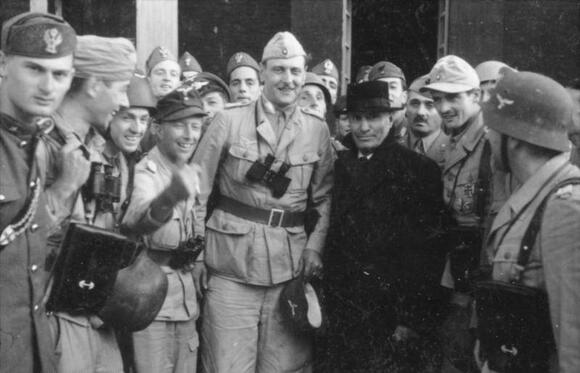
Wikimedia Commons Deposed Italian dictator Benito Mussolini and Otto Skorzeny, outside the Campo Imperatore Hotel. Sept. 12, 1943.
Orders were given to abort, but Skorzeny ignored them and ordered his pilot to land. The pilot managed to awkwardly land 30 feet from the hotel. Within minutes, Skorzeny found Mussolini. Not one person had been killed.
Determined not to be overshadowed by Mussolini, Skorzeny barged onto a flimsy Fieseler Scorch aircraft, designed to only carry a pilot and one passenger. With three on board, the craft strained to take off, but somehow made it safely to its destination.
Skorzeny’s audacious plan had paid off. Hitler, delighted with Skorzeny, awarded him the Knight’s Cross. The plan even impressed Winston Churchill, who said the mission was “one of great daring.”
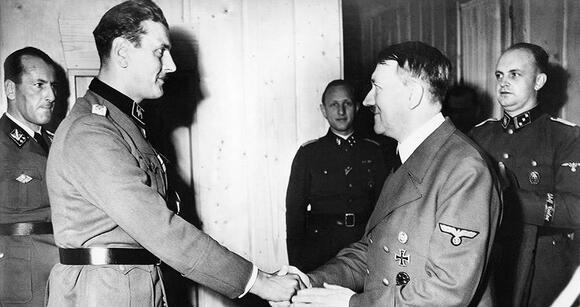
Getty Images Adolf Hitler awarding Otto Skorzeny his Knight’s Cross after the rescue of Mussolini.
And so Skorzeny’s legend began.
Otto Skorzeny’s Rising Power — And Involvement In More Secret Missions
A few months later, Hitler told Otto Skorzeny to carry out a mission that, at least in planning, was even more audacious. This time, Hitler planned to kill his major enemies in one location. In a plan called Operation Long Jump, Skorzeny and his commandos were required to infiltrate the Tehran Conference and assassinate the “Big Three”: Franklin Roosevelt, Winston Churchill, and Joseph Stalin.
According to the Soviets, their own legendary agent, Nikolai Kuznetsov, infiltrated the Wehrmacht in Ukraine, where he learned all the details about Long Jump after plying a German SS major with alcohol.
With this knowledge, the Soviets allowed the first phase of the German operation to unfold. A team of German radio operators had gone ahead to Tehran to prepare for the arrival of German commandos. There, Soviet spies intercepted messages sent by the Germans stating that Skorzeny and his men would parachute into Iran a few weeks before the conference started.
The Soviets, now with proof of the planned assassination, captured the Germans and thwarted the plan. Skorzeny and his team never made it to Iran.
Historians have debated whether this operation existed, with some claiming it was just Soviet propaganda. The Soviets insisted it was real, and high-ranking Soviet officers involved have even written books about it.
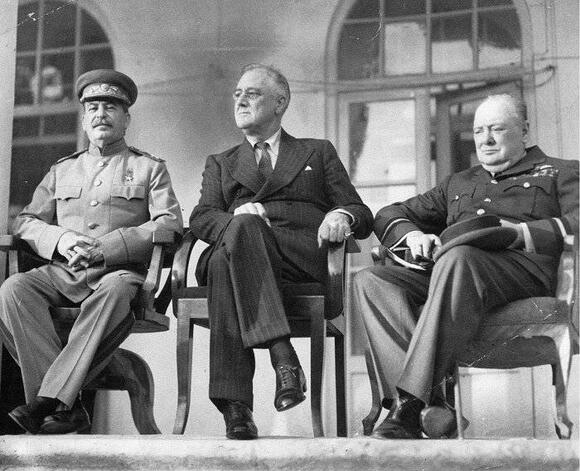
Wikimedia Commons In Operation Long Jump, Otto Skorzeny and his team allegedly planned to assassinate the “Big Three” (Franklin Roosevelt, Winston Churchill, and Joseph Stalin) at the Tehran Conference.
Skorzeny’s next success was his response to a threat to Nazi leadership.
In his memoir, he claimed he played an integral part in restoring order to Berlin and the war effort after Hitler’s assassination attempt on July 20, 1944. The conspirators had modified the Wehrmacht “Valkyrie” codeword normally used to suppress a revolt into instigating an uprising instead.
While Major Otto Remer spearheaded an attack against the plotters, Skorzeny got inside the conspirators’ base of operations and had the “Valkyrie” order rescinded. He then restored communications to Führer Headquarters, thus preventing a possible civil war between German troops.
Skorzeny took charge of Wehrmacht administration until normalcy returned.
Hitler now knew he could completely trust Skorzeny, and in October 1944, he sent him to kidnap the son of Hungarian leader Admiral Horthy. The mission kept Hungary on Germany’s side and involved in the war.
However, Skorzeny’s most infamous mission was Operation Greif (Griffin), which was part of Hitler’s last-ditch attempt at turning the tables on the Allies. His key objective required the capture of key bridges over the Meuse river during the Battle of the Bulge. Skorzeny devised a Trojan horse operation, which required his men to go behind enemy lines in the Belgian Ardennes dressed as American soldiers and cause maximum confusion.
But there were major hurdles. Only a handful of men spoke adequate English and there was a lack of appropriate American uniforms and equipment, which made the charade risky at best.
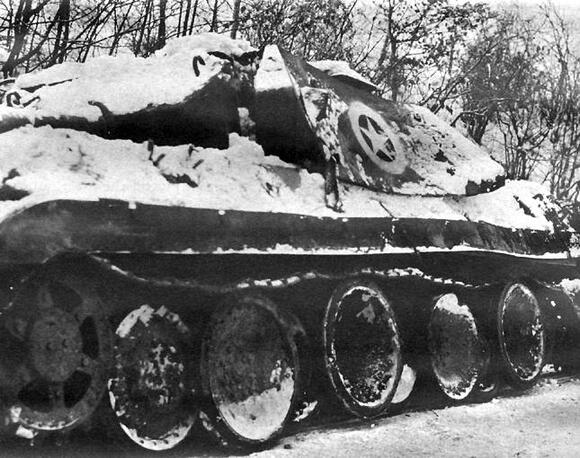
Wikimedia Commons A German tank disguised as an American tank during Operation Greif. Belgian Ardennes. December 1944.
Still, on Dec. 16, 1944, Operation Greif launched into action. Skorzeny’s men cut communication wires, issued fake orders, and turned around road signs.
Paranoia set in amongst American forces as word of the German impostors spread. Some Americans fired on each other, and soon, GIs grilled each other on American popular culture to flush out German agents.
Many American soldiers and Allied generals were detained at checkpoints for answering questions wrong. For instance, Field Marshal Bernard Montgomery refused to show his ID and had his car tires shot out. He was then dragged into a barn and restrained until his identity could be confirmed.
But the biggest confusion — and the masterstroke of the operation — came from Skorzeny himself when he let a rumor run wild within his own ranks that the real target was General Eisenhower, who was still in Paris.
Convinced of the “real” mission, two jeeps full of German agents confirmed the assassination plot to kill Eisenhower when interrogated by Americans. Back in Paris, Eisenhower spent time in protective custody.
In the end, the impostors’ inability to correctly mimic “Americanisms” and U.S. Army protocol proved to be their undoing. Many were shot for being spies and impersonating the opposing side.
What Happened To Otto Skorzeny After World War II?
By war’s end, Otto Skorzeny had received oak leaves for his Iron Cross, the highest honor awarded by the Nazis. However, his directive for his men to wear American uniforms later got him in trouble in 1947 at the Allied Dachau War Crimes trials.
Luckily for Skorzeny, he escaped execution when British SOE operatives confirmed that they had worn German uniforms during the war.
Other charges loomed — and Skorzeny avoided those, too, when former SS men, donning American military police uniforms, helped him escape from prison. Skorzeny also claimed that the U.S. directly aided his escape, which would perhaps explain why he reportedly later worked for the Office of Strategic Services, the predecessor to the CIA.
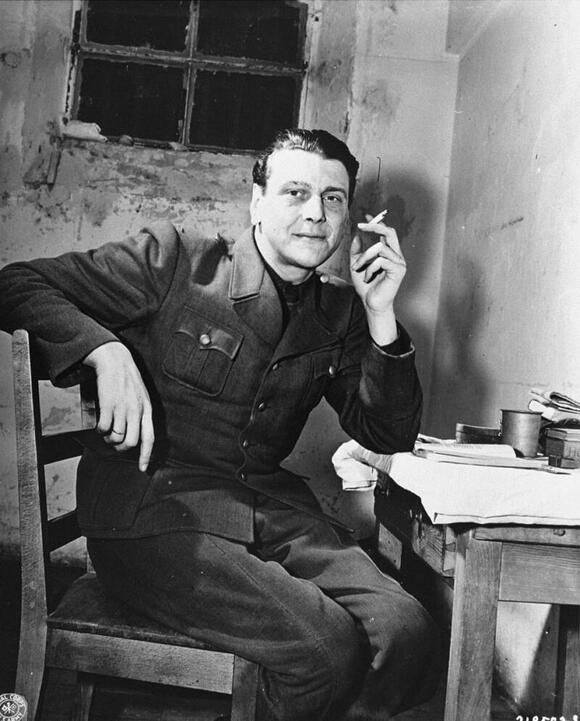
By 1950, he had moved to Spain, where former Nazi soldiers received asylum. On the surface, his new life there with his wife and their small engineering business appeared relatively normal. But his business may have also been a front to help numerous Nazis escape to Spain or Latin America.
However, Skorzeny’s loyalty to his former comrades didn’t last. Over 10 years later, Skorzeny became a hitman for Israel.
One evening in 1962, two Mossad agents posing as a couple befriended Skorzeny and his wife in a Spanish bar. But Skorzeny was no fool, and he later pulled a gun on them.
He said, “I know who you are, and I know why you’re here. You’re Mossad and you’ve come to kill me.” The agents said he was half-right.
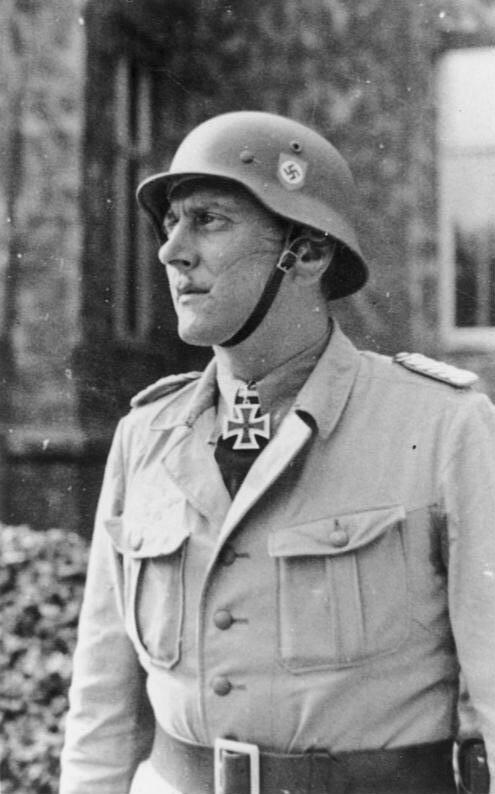
Wikimedia Commons Pictured here wearing the Iron Cross, Otto Skorzeny eventually worked for the Israelis as a hitman.
The agents admitted to being with Mossad, but they said they didn’t want to kill him. Instead, they wanted to recruit him. Israel wanted to stop Egypt’s missile program, and Mossad saw Skorzeny as a person who could help them do it.
After tense negotiations at the point of a pistol, Skorzeny agreed to assist them only if Mossad removed his name from Israel’s hit list.
Apparently, Mossad tried to convince Nazi hunter Simon Wiesenthal to take Skorzeny’s name off his list, but he refused. So, Mossad presented Skorzeny with a forged letter from Wiesenthal that supposedly agreed to his terms.
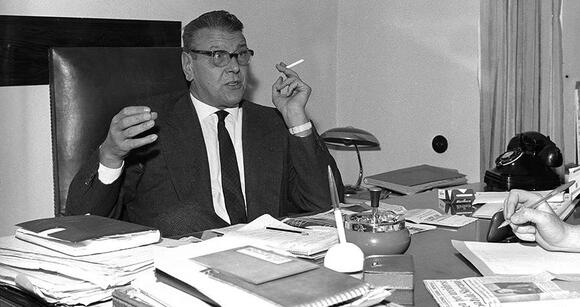
Gianni Ferrari/Cover/Getty Images Former Nazi soldier Otto Skorzeny sitting in his office in Madrid, Spain. At various points in his life, he reportedly took on a job as Eva Perón’s bodyguard in Argentina and set up a farm in Ireland.
Convinced, Skorzeny got to work. In Munich, he assassinated Heinz Krug, one of the principal former Nazi scientists working on the missile project. In Egypt, he sent an exploding package, which killed five Egyptians at Factory 333, the military site where German scientists worked. The intimidation worked, because the remaining German scientists all left by the end of 1963.
Why Skorzeny decided to work for Mossad — with a surprising level of cooperation — is difficult to ascertain. Skorzeny is unlikely to have assassinated Nazi scientists just to have his name removed from a Nazi hunter’s list, especially since the Allies had officially declared him de-Nazified in absentia in 1952. Though many believe Skorzeny was simply trying to avoid being killed by Mossad, others think that he wanted to return to the excitement and adventure of carrying out secret missions.
Alternatively, some have suggested that he may have wanted to atone for his actions as a Nazi. When he was taken to a museum in Jerusalem honoring the Jewish victims of the Holocaust, his handlers said he was quiet and “seemed respectful.”
Whatever his reasons, he took those with him to the grave.
On July 5, 1975, Otto Skorzeny died at the age of 67 from lung cancer. He had two funerals, one in Madrid, and the other at his family plot in Vienna. At both, he received a full Nazi send-off, with other former Nazi soldiers giving him the Nazi salute and singing some of Hitler’s favorite songs.
Next, read about the mission that may have saved us all from Nazi rule. Then, learn about how Nazi scientist Wernher Von Braun helped send the U.S. to the Moon.
The post The Chilling Story Of Otto Skorzeny, Hitler’s Scar-Faced Henchman Who Later Worked For Israel appeared first on All That's Interesting.