He also began travelling to the UK and Europe. In 1930, he played Othello at London's Savoy Theatre, the first black actor to do so in the British capital since Ira Aldridge a century before. And when, after spending much of the early decade performing overseas, he returned to the US to star in the 1936 Hollywood film version of Show Boat, his ascension to A-list status was complete. In 1928, New Yorker magazine had labelled him "the promise of his race", "King of Harlem", and the "idol of his people".

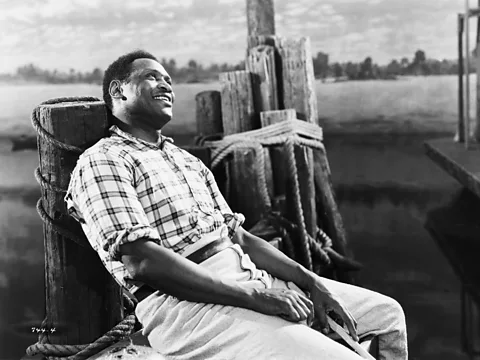 Getty Images
By 1940, shortly after he performed Ballad for Americans for 30,000 people at the Hollywood Bowl, Colliers magazine crowned him "America's No. 1 Negro Entertainer". According to his biographer Martin Duberman, Robeson seemed to "the white world in general […] a magnetic, civilized, and gifted man who had relied on talent rather than belligerence to rise above his circumstances".
A swift and damning response
In reality, Robeson spent much of his rise to fame educating himself, and becoming increasingly outspoken, on the broader context of the black struggle. In Europe, he performed benefits for Welsh miners, Jewish refugees and Republican fighters in the Spanish Civil War. He studied African languages and Marxist writings, and visited the Soviet Union. Back home in the US he refused to perform for segregated audiences, joined union picket lines, and, in the 1948 presidential race, campaigned for Henry Wallace's Progressive Party. Yet all these causes proved relatively undamaging to Robeson, prior to a speech he gave in Paris on 20 April 1949. The World Congress of Partisans for Peace was a gathering of some 2,000 scientists, teachers, activists and artists from 75 countries, convened to condemn the Cold War arms race and what it saw as US aggression against the Soviet Union.
"It is unthinkable that American Negroes would go to war on behalf of those who have oppressed us for generations," Robeson announced to the assembled leftists, "against a country [the USSR] which in one generation has raised our people to the full dignity of mankind." Some six years before the Montgomery Bus Boycott and the birth of the modern civil rights movement, Robeson suggested a form of black rebellion that far outstripped the assimilationist goals of the then-dominant NAACP (National Association for the Advancement of Colored People). The response, from mainstream liberals and conservative anti-communists alike, was swift and damning.