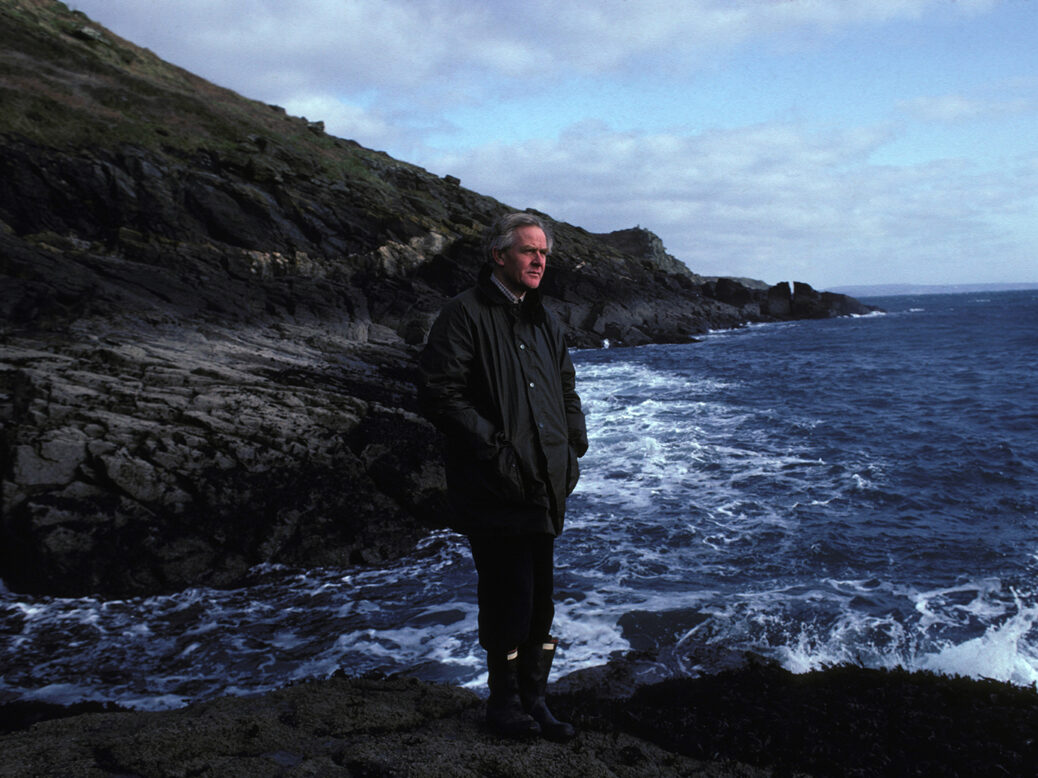
Once again, John le Carré is back. The TV series inspired by his post-Cold War novel, The Night Manager, is returning to our screens on New Year’s Day. There’s an exhibition about his “tradecraft” on at a museum in Oxford. And his early breakthrough, The Spy Who Came in from the Cold, is not only being adapted for TV too, starring Matthew Macfadyen – it’s appearing in a medium which has seen rather fewer versions of le Carré’s work: the theatre. I grew up at the end of the Cold War, and that story changed how I saw the world. But what does it mean now?
It was in 1985, 12 years old behind my brown NHS specs, that I committed what may be the nerdiest transgression that ever took place in my Wirral comprehensive. I defied the fierce librarian, and went and looked at the books that were reserved strictly for the sixth form. And there I found an orange hardback with strange names on it: “John le Carré” and his publisher, “Victor Gollancz”. That “cz” was already drawing me beyond the world I knew. Then there was that title.
The Spy Who Came in from the Cold was the first proper grown-up book I ever read. I had never read a spy book like it. Opening it cracked the door on adulthood. Some of it was hard to follow, but I remember the shocking first scenes: Alec Leamas, a pissed-off middle-aged intelligence officer, sees his last agent in East Berlin shot trying to flee to the West, and is recalled to London, where he seems to turn to drink, and loses his job.
I remember being stunned by the image of him as a swimmer “barred from the water”. I remember the lonely young communist, Liz Gold, who Leamas meets at his dead-end job in an esoteric library, and their cold, bare flats in shabby bits of Bayswater (I’d only ever been to London once.) I remember the sequence of encounters which draws Leamas from Hyde Park, via a nightclub with, um, dancers, to East Germany, as his ostensible defection gets out of hand. And I remember his horrifying vision: of a dad and his kids in a little car on the autobahn, being smashed to pieces between two juggernauts.

New year, new read. Save 40% off an annual subscription this January.
But the revelation came on the very last page. Leamas and Liz have 90 seconds to scale the Berlin Wall and escape from the East – but she’s shot. Rather than leap to safety in the West, he climbs back down. As he’s shot too, he sees the vision of the car again.
I just did not know an ending could be that dark. So this was grown-up writing! I’ve been suspicious of happy endings ever since.
Victor Gollancz had published le Carré’s breakthrough novel two decades earlier, in September 1963 – a couple of weeks before Harold Wilson’s “white heat” speech, a couple of months before Kennedy was shot – and it was a runaway bestseller, partly because it appeared to swing a searchlight onto the workings of a secret world, at a time when spies seemed vital to the survival of the actual world. During the Cuban Missile Crisis, less than a year earlier, Kennedy had been significantly assisted by intelligence from Oleg Penkovsky, a British-run agent high up in the Soviet Union; news of his execution broke the following May. In 1961, there’d been a similarly high-stakes stand-off in Berlin, which was only resolved when East Germany put up an “Anti-Fascist Protection Rampart”, better known as the Berlin Wall, where Spy begins and ends.
In Oxford’s Weston Library, in that exhibition about le Carré’s “tradecraft”, there’s a photo of him writing Spy in longhand. He’s sitting topless at a table in a Hamburg garden, hair as neatly parted as if he were going a wedding. But then he knew how to play a part, curating the insider-outsider persona that saw him become Britain’s great laureate of Cold War conflict. Le Carré’s real name was David Cornwell; he was a conman’s son who’d found his way, via Sherborne School and Oxford, into a role in the Establishment as a junior diplomat and intelligence officer in West Germany. And in this guise, he went to see the Wall as it went up. It was “perfect theatre”, he wrote later: the stage on which capitalist West and communist East faced off every day.
Within a few years, that garden photo would have looked hopelessly square. But not the book emerging from his pen: through the 1970s and 1980s, after all, the Wall was still right there. I went to see the Oxford exhibition with my friend Alex, whose dad had worked for the Security Service, and was stationed in Berlin with his family. So when I was reading Spy at home, trying to picture the city, Alex was right there, and he remembers going on a school trip across the divide to East Berlin – a journey his father could never have taken. Coming back West, he says, was like going from black and white to colour.
To me, the idea of actually going to Berlin would have seemed like visiting the Antarctic. I just kept a scrapbook, snipping smudgy articles out of the papers: “Bonn tries to save agents as spy-catcher defects to the East”, “Over the wall leaving German red faces”, “Master Spy Rescued”. Turning its pages for the first time in decades, there’s my 12-year-old self, earnestly writing headings in felt tip. Trying, I guess, to get my head around the divided, frozen, grown-up world.
But then in 1989, as I hit 16, the impossible happened. The people of East Germany – and Hungary, Poland and Czechoslovakia – rose up, and weren’t gunned down, but instead were suddenly free. Right by the library where I’d found Spy, I remember feeling lifted off my feet by joy. The world we were soon to join had broken out in colour. That November, as Berliners clambered onto and over and through the Anti-Fascist Protection Rampart, le Carré wrote: “Reading today’s news from East Germany, those who remember the Wall can draw a direct line between the heroism of the few and the approaching liberation of the many.” The escapers, he added, “were the vanguard of what is now a great popular army”. In a blink, the Cold War was as old-fashioned as le Carré’s early 1960s parting. For a time, the world unfroze.
On a November night 36 years later, Alex and I found ourselves crossing Cambridge Circus, which provides the name for le Carré’s fictionalised MI6. We passed the pepper-pot building where he housed “the Circus”, and walked up Charing Cross Road, to watch the opening night of a new stage adaptation of The Spy Who Came in from the Cold. Leamas’ London of milk bars and indoor fags is long since gone. The theatre, @sohoplace, is on the site of what was once a cinema – now all gloss and glass and bright pink signage, then bag checks and content warnings. So would Spy turn out to be a period piece – a diverting glance back at a forgotten age that was more scared of some things, braver about others? Or is it as relevant as ever?
The adaptation is by the playwright David Eldridge, who I went to meet a couple of weeks before. He too, it turns out, was 12 in 1985, and grew up fascinated by the Cold War: he read thrillers by Frederick Forsyth and Tom Clancy, and enjoyed playing naval war games. He was also leading a double life. He went to a private school in his grey tweed uniform, but on an assisted place with a part-scholarship. He lived in Romford with his mum and dad, a shoemaker. When he wasn’t playing war games, he was quite happy in his “shabby market boy jeans, drinking a can of Tennant Super and going to the Romford under-18 disco”. This was one reason the le Carré people were interested in working with him, he says. He understood “that feeling like you can never, ever be yourself, completely, ever in your life”. Like Leamas, like le Carré.
Eldridge first considered staging Spy in late summer 2018, a few months after the Salisbury poisonings. When he reread the novel, an early scene leapt out, when Leamas’ boss, “Control”, says: “I mean, you can’t be less ruthless than the opposition simply because your government’s policy is benevolent, can you now?” Yet in response to Russia’s Novichok attack, which killed an innocent British woman, the May government merely co-ordinated a mass expulsion of Russian diplomats with its allies. By then, Russia had already invaded Crimea; tensions between Xi’s China and Trump’s America were rising. “Some of the Cold War language of the novel,” Eldridge told me, “started to feel a bit more prescient.”
Watching the actors play out le Carré’s tragic tale from the original Cold War, our new farcical version hovers in the back of your head. When Rory Keenan’s Leamas lambasts Britain’s “loudmouth” American masters, you think, Well at least they’re not mates with Moscow. But when he denounces the public schoolboys who still act “like they still run the place”, it feels current enough. So does the underlying sense of a once-confident nation on the slide. And Eldridge tackles one particularly dated aspect of the novel by giving Liz (Agnes O’Casey) much more agency. She’s a communist, she tells Leamas, because she wants to throw off oppressions like misogyny and landlords: not problems you need to remember the Cold War to grasp.
Still, today, the figure of the spy feels less central to the drama of great power conflict; there’s no perfect theatre to match the Berlin Wall. Instead, the play pushes our attention towards the permanent moral dilemma posed by Ian Drysdale’s Control: are we prepared to do wicked things to defeat evil enemies? Answering his own question, Control works with George Smiley (John Ramm) to trick Liz and Leamas into a plot to save a British agent, Mundt, who is embedded as head of East German counterintelligence. The goal is to falsely implicate Mundt’s deputy, Fielder, who is about to expose him. The moral dilemma is sharpened by the fact that Mundt is an ex-Nazi, and Fiedler is Jewish.
This cunning plan provokes the scenes that really strike a chord today, because they dramatise one of the forces that stir up our “post-truth” shitstorm. After that Russian Novichok attack in Salisbury, for example, outlandish assertions appeared: that the poisoning had really been carried out to make Russia look bad; that MI6 did it. This is one of disinformation’s staple methods: the weaponised reversal of the truth. Think of Trump prosecuting his prosecutors.
As a result of the Circus’ machinations, Mundt (Gunnar Cauthery) and Fiedler (Philip Arditti) each accuse the other of betraying the East German worker state. Each has the other arrested. Then, in a climactic tribunal, they come face to face. Fiedler uses Leamas’ evidence to show that Mundt is a British spy, screaming that he is a lackey of “imperialists” and “fascists”. This evokes one of the great historical spectacles of truth reversal: the real-life theatricals of the 1930s Moscow show trials, in which Stalin’s rivals were pressured to confess imaginary crimes. In the novel, Leamas remembers reading Arthur Koestler’s bestselling 1940 fictionalisation of the trials, Darkness at Noon. The denouement is a head-spinning wilderness of mirrors, of accusations discredited, of guilty men smearing the innocent.
As well as portraying British intelligence as every bit as adept at this as the Stalinists, it seems le Carré may have got a sly dig in here at America too, given its recent history of throwing around false accusations with devastating effect. Mundt and Fiedler share their names with prominent 1950s US anti-communists. Leslie Fiedler was a Cold War liberal journalist notorious for his snarky articles about the victims of McCarthyism; Senator Karl Mundt was the godfather of the 1950 Internal Security Act. That may just be coincidence, but either way, it’s in these scenes between Mundt and Fiedler, rather than the harder-to-stage ones at the Wall, that the play comes most vividly alive. It dramatises something of the dizzying logic of our own wilderness of mirrors, through which all of us must pick our way.
Back in the Sixth Form section of the library, I found books – my first, again – about how totalitarian ideologies worked. Spy, I realise now, wasn’t really teaching me about the passing paraphernalia of the Cold War. It was showing us how power had been weaponising truth for decades by the time le Carré watched the Wall go up. And that’s why we can’t let go of this story, decades after the Wall came down again. Because if those techniques did seem to fade, it was only for a time.
[Further reading: John Le Carré and the spectre of British decline]
Content from our partners
Topics in this article : Cold War