Photo-Illustration: Intelligencer; Photos: House Oversight Committee
For years, everyone wanted to know what was in the Epstein files. Now, millions of documents have been made public by Congress, albeit with countless redactions, and sure enough, the files have produced a stunning and still growing number of revelations. The fallout is ongoing. The files themselves are a convoluted mess. The only way to unearth what’s inside is to search for specific words and terms, all of which are potential rabbit holes. Many people have been falling into them. The more than 800 results for “pizza,” for instance, prompted a sudden resurgence of the debunked Pizzagate conspiracy theory. Any other search could produce results that are equally dubious, mundane, baffling, or startling — sometimes all at once. And it can get addictive. It’s a billion-word crime scene where everyone gets to play detective.
It’s also really hard. The Epstein Files Transparency Act may have forced the Trump administration’s hand, but the Justice Department’s haphazard document dumps and the Epstein Library website it slapped together to house them are maddeningly opaque. The DoJ broke the files up into 12 enormous data sets that are not organized in any meaningful way, and the files cannot be sorted or filtered. Data Set 11, for example, contains over 325,000 individual PDFs with indiscernible file names split up across 6,500 web pages, and you need to open each PDF to get any sense of what’s inside. While the text of the documents is searchable, the library is rife with duplicates, redactions strip away crucial context, and many documents — including virtually all the messages Epstein wrote — are teeming with misspelled words, garbled characters, and atrocious punctuation. (A search for “Epstien” yields 416 PDFs.)
The DoJ also released and later took down files that hadn’t been properly redacted. Those distressingly included at least 43 victims’ unredacted names and at least 40 unredacted nude images, and some of these files were downloaded before the mistake was corrected and remain available elsewhere. Additional documents obtained from Epstein’s estate and released last year by the House Oversight Committee are not included in the DoJ files. And there are huge tranches of schedules and emails that news organizations obtained and reported details from ahead of the federal file dumps. There are at least a dozen nonofficial online repositories of the Epstein files. Some, like Jmail, utilize AI to help organize and search what’s inside, but most of these databases aren’t yet complete. Undoubtedly, AI will eventually make it much easier to parse and digest what’s in the files, but that hasn’t happened yet.
In the human-powered meantime, making sense of this massive mess of text starts with a single search field on the Epstein Library website. Punch in a name or place or term and you may get back hundreds or thousands of PDFs with only a fraction containing novel information, and you won’t be able to scan or read or sort the results in any sensible order. It’s like looking for an unknowable number of needles in a warehouse filled with haystacks. And for now, keywords offer the only keyhole-size view.
Not surprisingly, most of the initial analysis and coverage of the files has been focused on names.
A search for “Elon Musk” produces 1,080 results split up across 109 pages. Like every search, many if not most of those results are redundant: Every email message or calendar reminder may appear in several files or more. The results don’t just include correspondence between Musk and Epstein but all the times Epstein mentioned Musk to others, as well as all the mentions of Musk in CNBC and Washington Post newsletters Epstein subscribed to and in FBI news briefings sent years after Epstein died. But the results also contain important revelations, like how Musk and Epstein made what appear to be serious plans for him to visit Epstein’s private island, contradicting Musk’s public statements. Another search for “Musk” by itself returns 1,420 files and captures the correspondence Epstein had with Elon’s brother Kimbal (326 results), who, it turns out, dated one of Epstein’s name-redacted associates.
A search for “Trump” produces 4,725 results in the DoJ files, but when the New York Times used its own proprietary search tool, it actually found more than 5,400 files in the latest sets of DoJ documents that reference Trump or Trump-related terms, and even that’s probably an undercount. Out of all those references, the most important new information uncovered so far is a single file containing an October 2019 FBI report that notes a Florida police chief said Trump had called him in 2006 and said he knew Epstein was abusing young girls.
A search for “Sulayem,” regarding Epstein’s longtime friend the Emirati businessman Sultan Ahmed bin Sulayem, yields more than 5,000 results, including emails in which he describes sexual experiences to Epstein. A search for “Sultan” yields more than 9,400 results. Bin Sulayem, who has now been ousted from his job as CEO of DP World, made multiple visits to Epstein’s private Caribbean island, Little Saint James. There are 51,136 results for “island” and 36,389 results for “lsj” (Little Saint James). “Your island” (1,437 results) is more useful or “to your island” (317 results) and “on your island” (300 results, including seven copies of Musk’s 2012 message to Epstein asking, “What day/night will be the wildest party on your island?”).
Search for another place, like “University of Texas,” and one of the 149 results, The Daily Texan reports, is a 2015 letter a controversial former UT professor sent to Epstein’s charity requesting funding for a conference on campus rape, where scholars would “interrogate the concept of sexual consent.”
Many of the words you’d expect to reveal troubling files absolutely do. There are 8,760 results for “Russian,” and many refer to women, including victims whose names are redacted, whom Epstein and his associates recruited. Some of the results refer to the several Russian officials Epstein had or sought ties with. “Your girls” appears in 302 files. “My girls” appears in 244. A search for “massage” — which federal prosecutors say was Epstein’s code word for sex — yields nearly 8,000 results in the DoJ files, maybe half are from correspondence involving Epstein and his associates, and yes, they are stomach-churning to read.
So too are many of the 1,471 results for “naked,” which include messages in which Epstein asks recipients with redacted names to send him photos of themselves. They also include an unsettling 2017 email exchange in which someone trying to recruit women for Epstein tells him, “Jeffrey, dont [scare] candidates away asking to swim naked around the island because [REDACTED] got uncomfortable when you joked around about this.” Epstein tells her not to include her own thoughts, scolds her for suggesting someone older than 24, and says “You must produce two candidates” if she wants his help paying her college tuition.
“Loyal” appears in that file too and in more than a thousand others. Those results capture Epstein publicist Peggy Siegal signing emails to him with “Your loyal fan,” as well as Epstein telling Ghislaine Maxwell that some woman with a redacted name is “100% loyal” because he pays her rent. It also captures a 2009 email argument between Epstein and Manhattan dermatologist Steven Victor (567 results), in which Victor complains, “I agreed to NOT charge the girl friends which I have not but you can NOT just send friends and expect me to bear the costs,” adding, “I have been loyal to you about the magazines calling me over and over about you.”
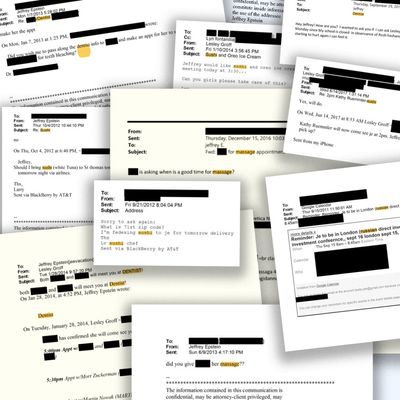
“Pizza” isn’t the only frequently occurring food. “Sushi” appears 1,285 times in the files, “pasta” appears 409 times, and “ice cream” appears 583 times. Nearly all the food references appear to be references to actual food, but look hard enough and they’ll undoubtedly turn up something else. An Epstein employee in Florida told the FBI that Epstein “enjoyed getting ice cream from a local ice cream parlor with the girls.” LinkedIn founder Reid Hoffman informed Epstein in a 2014 email that he had sent two gifts to his Manhattan home, including “ice cream. if you have any interest, you should try — else for the girls.” Epstein wanted “sushi and Oreo ice cream” for a 2014 meeting with banker Ariane de Rothschild and then-vice-president of Kissinger Associates Joshua Cooper Ramo. That’s one of the 35 times “Oreo ice cream” appears; “cookies and cream” appears only twice.
In another email, from 2013, Hoffman tells Epstein that “beef jerky” is one of “many threads for our next call.” (The others are: “planes. charity, mapping orthogonal dimensions.”) There are 380 mentions in the files of “jerky,” which was apparently one of Epstein’s favorite foods (though some wide-eyed online theorists have suggested it’s really a code word for cannibalism). There’s a lot of jerky-related correspondence from chef Francis Derby, who according to the files worked as Epstein’s private cook, made trips to Little Saint James, and spoke with other Epstein associates about making, supplying, and storing large amounts of jerky.
An X user recently obsessed over the repeated appearance of “dentist” (1,688 results) and collected numerous emails to Epstein from people telling him they had just gone to the dentist, as well as instances in which Epstein made and apparently paid for teeth-cleaning and -bleaching appointments for others (including Norwegian crown princess Mette-Marit). Photos taken on Epstein’s private island also showed he had a dentist’s chair there, and Epstein’s girlfriend Karyna Shuliak trained as a dentist. Many of the actual dentist appointments referenced in the Epstein files were in Manhattan with Dr. Thomas Magnani. As Bloomberg reports, he helped Epstein get Shuliak admitted to Columbia’s dental school in 2012, which the university now admits was an “irregular process” that did not meet its standards. Digging into mentions of “teeth” (1,814 results) or “donation” (2,153) would have led to Magnani (3,100 results) and Columbia Dental’s back door, too.
With the Epstein files, searching for almost any word can lead to some interesting, weird, confusing, awful, or misleading insight. It could also lead to some random person’s lunch order. Any single file, deciphered and placed in the right context, could be some important something no one has yet brought to light. It could also just be spam from Epstein’s junk folder or cryptic inside-joke gibberish that will soon become fodder for a conspiracy theory no one will ever be able to debunk. Even an AI-powered dissertation on what’s in all this bulk data might be volume length.
It took years to get ahold of just more than half of the millions of known Epstein files. It may take just as long, or longer, to fully understand what they mean.