That capacity for abstract thought, suggests Cole, may also be the bedrock of language. Take the word "tree", he explains. "The word doesn't bear a relationship to the object in the way that a sign or a symbol might. So, the label has to gain traction through a commonality of understanding within a cultural group. So when I say the word tree, you know it's a tree."
Being able to talk about ideas and the past and future, rather than just expressing feelings in the moment, would have been useful and often life-saving, helping humans to make plans, coordinate, innovate and adapt to different situations and habitats. Because it was so useful, and our species was generally physically able to do it, this new skill of chatting might then have spread.
The second view is that language development is ancient and selection-driven. This theory supposes that language evolved gradually.
The position of the vocal tract, the structure of the brain and the size of the spinal cord evolved slowly into the modern human form, over millions of years, indicating the human capacity for language and speech may also have developed over a very long time. As our sounds and vocabulary became more varied and precise, we would have gained an important evolutionary advantage through language-related survival skills such as strategising, solving complex problems and forming social bonds.
What would those early utterings have sounded like? Vialet, alongside a team of researchers and in collaboration with Radio France, has used scientific insights to try and recreate them.
"We now understand that the most important organ for modulating sounds is the tongue. By deforming – and it has an incredible ability to do so – it filters the air and produces differentiated sounds at an astonishing speed," she says.
Vialet and her collaborators, together with Radio France, used her data to "cautiously imagine" what our distant ancestors may have sounded like – and to bring their voices back from the dead.
27 million years ago: Old World monkeys
In 2019, researchers from the University of Alabama, US, analysed several decades of research into primate vocalisation and vocal tract evolution. They were searching for the origins of the vowel. The ability to produce contrasting vowel sounds allows us differentiate between unrelated words, such as "cat", "caught" and "cut".
The fact that modern human vocalisations share similarities with those of baboons, say the researchers, indicates that the physical ability to produce and perceive contrasting vowel sounds had already appeared by the time of our last common ancestor with Old World monkeys – about 27 million years ago, long before the evolution of our own species, Homo sapiens.
Vowels, some experts consider, are the core of speech production – and lay the foundation for the very beginnings of language.
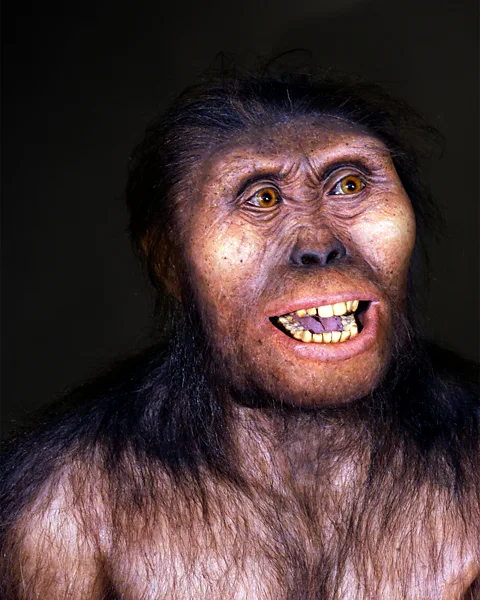
3.2 million years ago: Lucy, Australopithecus afarensis
Lucy lived in Eastern Africa around 3.2 million years ago. She stood about 1m (3ft 3in) tall and weighed just 25kg (55lbs). She belonged to the genus Australopithecus, a group of small-bodied, small-brained early hominin species.

 Elisabeth Daynes/ Science Photo Library
Australopithecines were small individuals with small brains, says Vialet. They moved both through the trees and on two legs, and some are thought to have made tools.
Lucy's speech may have been driven by emotion and accompanied by gestures. She may have been as vocal as a chimpanzee – and she may have sounded a bit like one too, with a similar high larynx. Because of this, her vocalisations were likely limited to a few distinctive sounds, with no syntax – the arrangement of words to form meaningful sentences. She would not have had the ability to make all the vowel sounds, and almost certainly no "i".
What might Lucy have chatted about? We can only speculate, but she and her friends might have warned each other of predators – and perhaps, shrieked with interest and surprise at the tool one of them managed to make and use, for the very first time.
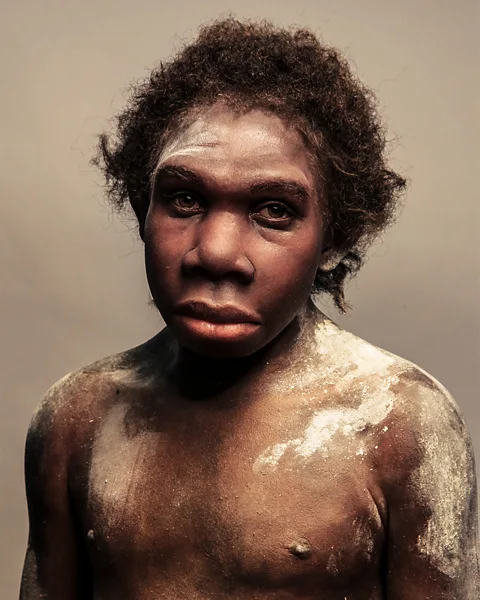
1.6 million years ago: Turkana Boy, Homo erectus
A key turning point in the evolution of language, says Cole, is when we started to use sound in a very intended and directional form of communication "which goes beyond having a specific alarm call for an eagle or a python" like we can see in other primates like macaques.
Turkana Boy was about 12 years old when he died in Kenya, around 1.6 million years ago. He was a member of the Homo erectus species, and the first of our ancient relatives to have human-like body proportions, with long legs and short arms indicating they lived on the ground, rather than in the trees. His body was built, like our own, for endurance running.
"Our ancestors at that time had a fully upright posture which suggests they had greater muscular control of their upper bodies – their thorax – and their breathing, which they'd use for walking and running," says Steven Mithen, professor of archeology at the University of Reading and author of The Language Puzzle: How we talked our way out of the Stone Age. "This suggests they also had greater muscular control of that for making a greater variety of sounds."
Based on his fossilised remains, and the brain size and shape they suggest, he probably sounded very different from Lucy, and would have been able to communicate through a wider range of sounds, beyond mere calls and shrieks.
Inside Turkana Boy's skull, an impression was left of his brain's "Broca's area". The Broca's area is a region of the brain thought to be associated with both language and tool use. It was once widely accepted to indicate an ability to speak, though some scientists now question whether its role in language is quite as critical as was previously thought.
 S Entressangle/ E Daynes/ Science Photo Library
Turkana Boy may have used "iconic words" to describe objects, people or actions – meaning, he may have mimicked the things he was trying to talk about.
"They somehow imitated the sensations of what was being seen. They might also have tried to have captured the speed, or the size and so forth – a bit like onomatopoeias that we use today," says Mithen, referring to a type of word that sounds like the thing or action it refers to, such as "splash","boom" or "buzz". Mithen adds: "If you define language as the use of words which have a shared meaning within a community, I'd put that at about 1.6 million years ago, with our Homo erectus ancestors."
This new ability to communicate may have helped Homo erectus to coordinate as a group; to hunt, explore, protect themselves from predators, and experiment with new skills. Homo erectus was probably first to migrate out of Africa, and possibly the early human first to cook food, and language would have helped them with both of those adventures.
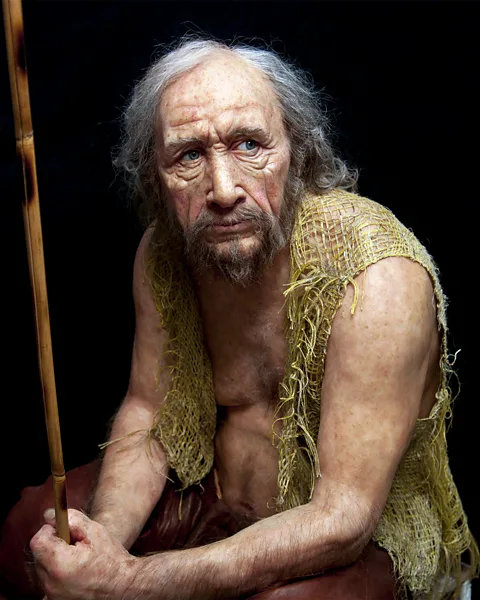
50,000 years ago: Nana, Homo neanderthalensis
In 1848, the skull of an adult woman was found in a quarry in Gibraltar. Nana – also called "Gibraltar 1" – is thought to be about 50,000 years old. She was the first Neanderthal ever found.
 Elisabeth Daynes/ Science Photo Library
Homo sapiens finally had it all – the physical capability to use a wide range of sounds, including the final vowel, the all-important "i", as well as the cognitive capacity to process and transmit abstract ideas.
We are the "wise men", according to the translation of "Homo sapiens". Over our 300,000 years of existence (or perhaps even longer), we have finally mastered the most complex communication system of all life on Earth.
Language is "infinite", says Vialet. "You can talk for hours, going from digression to digression, combining a succession of words in all directions." It's "pretty incredible", she says.
But listen closely and you might hear echoes of the distant past, says Mithen. "I think some of the words we use are really ancient. If we look across all languages today, there are some commonalities, like the words for 'mother' is often mum, mom, mama – it's an 'm' sound. There's an argument that the 'm' sound originates from babies sucking at the breast. That's a typical example of an iconic word. I'm sure the Neanderthals probably used a very similar word to that for their own mothers."
Today, there are over 7,000 languages spoken all over the world. Sadly, almost half of these are in danger of disappearing. But language, like us, is always evolving. As the world we live in changes and human needs change with it, so too will our mode of communication. What will humans sound like in millennia to come?
--
If you liked this story, sign up for The Essential List newsletter – a handpicked selection of features, videos and can't-miss news, delivered to your inbox twice a week.
For more science, technology, environment and health stories from the BBC, follow us on Facebook and Instagram.