Emily Atkinsonand
Raffi Berg,Middle East editor
 EPA
EPA
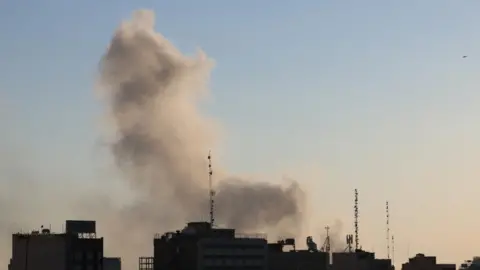
Conflict has spread across the Middle East following US and Israeli strikes on Iran, in which the country's supreme leader was killed.
Iran has responded by launching attacks on US-allied states in the Gulf, which have extended to non-military targets, including civilian sites and energy facilities.
The fighting has escalated quickly, pulling in Cyprus and Lebanon in recent days, and shows no sign of abating.
What has been happening in Iran?
The US and Israel launched widespread strikes on 28 February, targeting Iran's missile infrastructure, military sites and leadership.
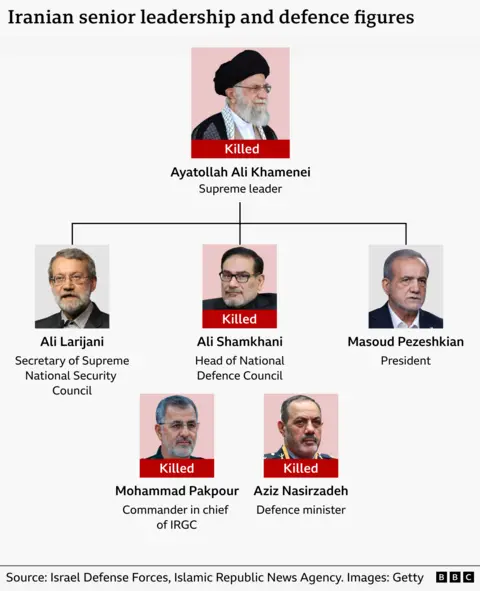
Iran's Supreme Leader, Ayatollah Ali Khamenei, who had led Iran since 1989, was killed during the first wave of strikes.
Israel's military said dozens more senior figures in the powerful Islamic Revolution Guard Corps (IRGC) were also killed, including its commander-general and defence council secretary.

The death toll in Iran since the US-Israeli attacks began has reached 787, according to the Iranian Red Crescent. Meanwhile, US-based Human Rights Activists in Iran (HRANA) reports that 742 civilians have died, including 176 children.
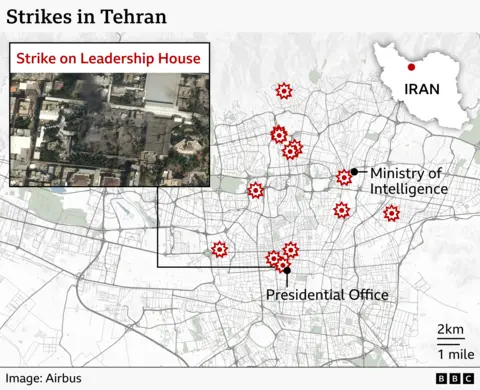
US and Israeli strikes on Iranian targets have continued since the weekend, including on the capital, Tehran, and Iran's naval capabilities.
Iran accused the US and Israel of launching a deadly attack on a school near an IRGC base in southern Iran on Saturday.
The US said it was looking into reports of the incident, while Israel said it was "not aware" of any military operations in the area.
Tehran has also accused the US and Israel of targeting nine hospitals in Iran. Israel said it received reports that a hospital in Tehran was damaged on Sunday after an attack on nearby military infrastructure but it said the hospital was not the target. The BBC has approached US Central Command (Centcom) for comment.
Internet connectivity in Iran has been almost entirely restricted and its airspace has been closed.
Why have the US and Israel attacked Iran?
The US and Israel called the attacks "pre-emptive": the US said it knew Israel was about to attack and acted before Iran could retaliate against its bases in the region, while Israel said it attacked "to remove threats".
But there are also underlying reasons.
Israel and the US - its closest ally - have been arch-foes of Iran since the Islamic revolution in 1979. The Iranian leadership has consistently called for Israel's elimination and denounced the US as its greatest enemy.
The two countries have led Western opposition to Iran's nuclear programme, claiming Iran is seeking to develop a nuclear bomb - something Iran has vehemently denied.
They attacked Iranian nuclear and military sites in June 2025 in a war which lasted for 12 days.
Since then, they have claimed Iran has been trying to rebuild its nuclear programme and develop missiles capable of delivering nuclear weapons.
Trump said these missiles could eventually reach the US, though this has not been supported by US intelligence assessments.
For its part, Israel considers Iran a threat to its existence and wants the complete removal of Iran's nuclear and missile programme, as well as regime change.
The US first openly talked in January about potentially attacking Iran when its security forces cracked down on protesters with deadly force.
But the US and Iran began negotiations and appeared to be making progress until Trump said he was "not happy" with the way the talks were going. Hours later the US and Israel began attacking.
 Reuters
How has Iran responded?
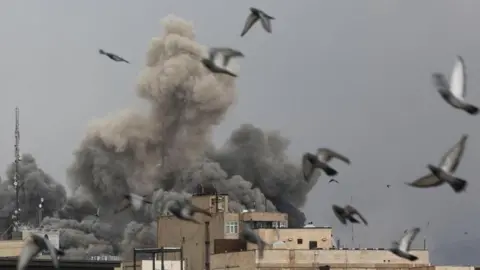
Iran has described the US and Israeli strikes as "unprovoked, illegal and illegitimate", and has carried out widespread missile and drone attacks in response.
The IRGC said it had targeted Israeli government and military sites in Tel Aviv and elsewhere.
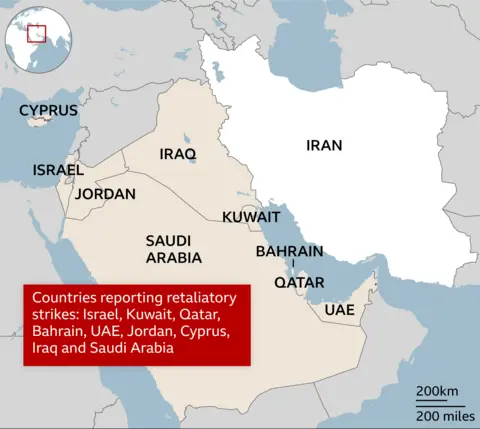
Strikes have also been reported in countries hosting US bases - Qatar, Bahrain, Jordan, the United Arab Emirates (UAE) and Kuwait - and US-allied Oman and Saudi Arabia.
Iran has been accused of widening its attacks to include other targets in recent days, including on shipping, civilian sites - including hotels in Dubai - and the US embassy in Saudi Arabia's capital, Riyadh.
The US and its Arab allies issued a joint statement condemning Iran's attacks, saying "the targeting of civilians and of countries not engaged in hostilities is reckless and destabilising behaviour".
Elsewhere, a British military base in Cyprus was struck by a drone, according to the UK Ministry of Defence, which the Cypriot president blamed on Iran.
Separately, three American jets were shot down over Kuwait in an "apparent friendly fire" incident, the US military said. The pilots survived.
Six US servicemen have been killed and 18 injured in action as of Monday, according to Centcom.
The US state department has urged American nationals to "depart now" from Bahrain, Egypt, Iran, Iraq, Israel, the West Bank and Gaza, Jordan, Kuwait, Lebanon, Oman, Qatar, Saudi Arabia, Syria, United Arab Emirates and Yemen.
What's happening in Lebanon?
A new front in the conflict has opened in Lebanon.
Beirut, and parts of southern Lebanon, have been hit by Israeli strikes, launched in response to what Israel said were rocket attacks from militant group Hezbollah.
Hezbollah is allied to Iran's government and said it was seeking to avenge Khamenei's assassination.
On Tuesday, Israel's defence minister said ground troops would "advance and seize additional strategic areas in Lebanon" in order to stop attacks from Hezbollah.
In Israel, the defence minister says ground troops will "advance and seize additional strategic areas in Lebanon" in order to stop attacks from Hezbollah.
The United Nations said more than 30,000 people had been forced to flee their homes since the escalation of hostilities.
How is the war affecting the economy and energy prices?
Instability in the Middle East has begun to impact the global economy.
Tehran has been accused of attacking ships in the Gulf, forcing the effective closure of the Strait of Hormuz - a key artery accounting for about 20% of global oil and gas supply.
Attacks have also been reported on major oil and gas hubs, including in Oman's Duqm commercial port and the UAE's Fujairah terminal.
The strikes have prompted some of the world's largest producers of oil and gas to suspend production, including Qatar's liquefied natural gas (LNG) facilities and Saudi Arabia's largest domestic refinery.
How might Khamenei's successor be chosen?
Iran has said it will appoint a new supreme leader swiftly.
A transitional leadership council has been formed to run the country temporarily, consisting of: President Masoud Pezeshkian, judiciary chief Gholamhossein Mohseni Ejei and senior cleric Alireza Arafi.
The formal selection is decided by 88 senior clerics, known as the Assembly of Experts.
Under the country's constitution, these clerics must select the new supreme leader as soon as possible, but this may prove difficult while the country is under attack.
The IRGC has already named a new commander-in-chief, Ahmad Vahidi.
Is it safe to travel to the region and how long could the war last?
US President Donald Trump on Monday said has said the attacks were projected to last for "four to five weeks, but we have capability to go far longer than that".
On Saturday, Israeli Prime Minister Benjamin Netanyahu said the campaign would "continue as long as it is needed".
The war has prompted one of the most serious disruptions to global travel since the Covid-19 pandemic, with widespread airspace closures and thousands of flights grounded across the Middle East.
Some services from carrier Emirates have resumed from Dubai. Flights have already departed for the UK and other European countries, although many more have been cancelled.
Emirates has told passengers not to head for the airports unless they have been contacted directly.
The Abu Dhabi-based carrier Etihad says its scheduled services remain suspended until Thursday.
Flights out of Qatar also remain suspended due to the closure of airspace in the region.
With additional reporting by Olivia Ireland, Robert Greenall, Hafsa Khalil, Gabriela Pomeroy and BBC Persian.