In the years after World War II , the growing tensions of the Cold War fueled an intense race between the United States and the Soviet Union to develop ever more powerful weapons. Both sides moved quickly to test and deploy new systems, often accepting considerable risks along the way. One striking example came in 1958 in the small town of Mars Bluff , highlighting the very real dangers associated with this high-stakes competition.
The United States continued developing bombs after World War II
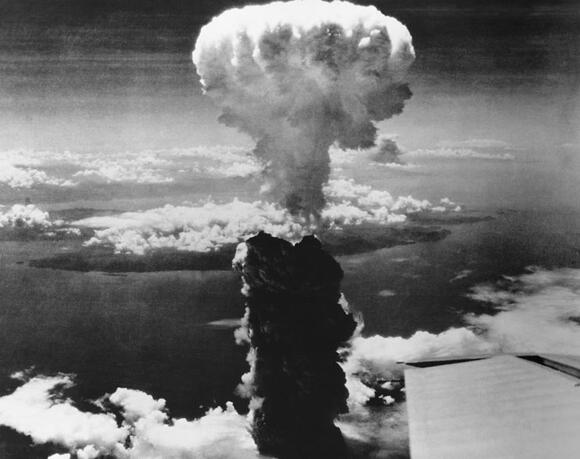
The Second World War was a harrowing conflict. The US brought it to a close in the summer of 1945 by dropping the atomic bombs Little Boy and Fat Man on Hiroshima and Nagasaki. Nonetheless, the nation continued to advance its development of newer and more powerful nuclear weapons.
Development of the Mk 6 nuclear bomb
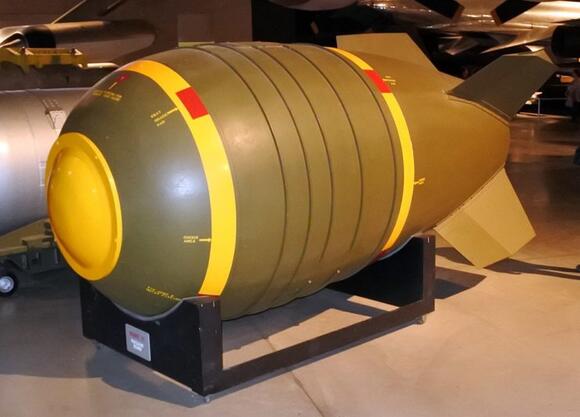
Modeled after the atomic weapon used in the Atomic bombing of Nagasaki , the Mark 6 nuclear bomb was developed into several variants and became one of the most widely produced early nuclear devices in the U.S. arsenal. Manufactured between 1951 and 1955 during the early Cold War , more than a thousand units were built with varying configurations and yields, remaining in service until 1962.
As tensions with the Soviet Union intensified, United States Air Force crews regularly carried out training exercises that simulated nuclear strikes, sometimes using live Mark 6 nuclear bomb s to mirror real-world conditions. These missions involved significant risk, and a number of accidents occurred throughout the 1950s, leading to the accidental release of nuclear weapons—events the military discreetly categorized as "broken arrows.”
A Mk 6 nuclear bomb is dropped on Mars Bluff, South Carolina
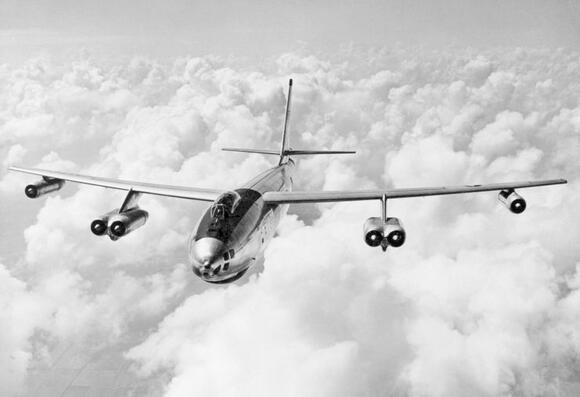
On March 11, 1958, a Boeing B-47 Stratojet assigned to the 375th Bombardment Squadron of the 308th Bombardment Wing departed from Hunter Army Airfield as part of Operation Snow Flurry—a drill simulating bombing runs over the U.K. and North Africa. The mission began under pressure due to a tight schedule, and complications arose during pre-flight checks when the locking mechanism on a Mk 6 nuclear bomb failed to engage properly. To secure it, airmen resorted to using a sling to force a steel pin into place.
Once in the air, the restraint system released as intended but failed to reset. While investigating the issue mid-flight, Captain Bruce Kulka —serving as navigator and bombardier—accidentally triggered the emergency release lever. The bomb fell from an altitude of approximately 15,000 to 20,000 feet. Kulka narrowly avoided being pulled from the aircraft, managing to hold on and climb back to safety.
Although the weapon lacked its plutonium core and could not produce a nuclear explosion, it still carried conventional high explosives. Upon impact in the backyard of a home in Mars Bluff, South Carolina , the blast destroyed a children’s playhouse, left a crater roughly 70 feet wide, injured members of the Gregg family, and damaged several nearby buildings. Remarkably, no fatalities occurred.
Reaction to the Mars Bluff Incident
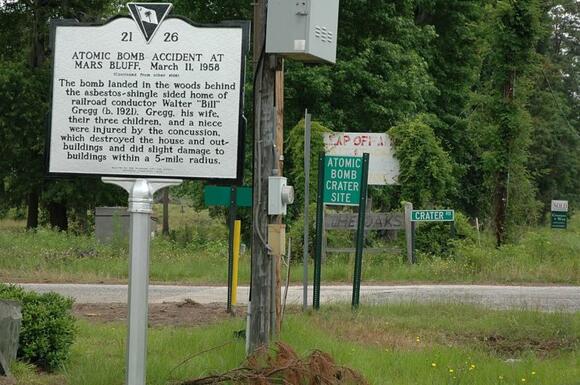
Surprisingly, no one suffered serious injuries from the blast because the Mk 6 bomb’s nuclear core was stored separately in the B-47 aircraft. The explosion was caused only by the TNT inside the bomb. If a full-scale nuclear detonation had occurred, the destruction would have been devastating.
Military authorities arrived at the scene shortly after the incident. The Gregg family, who lost everything in the explosion, sued the Air Force and granted $54,000 in compensation. Despite their hardship, Bill Gregg remained optimistic, later telling a local newspaper, "I've always wanted a swimming pool, and now I’ve got a hole for one at no cost."
Legacy of the Mars Bluff Incident

More from us:The US Army Air Corps Once Dropped Bombs on Boise City, Oklahoma
The near-disaster became known as the "Mars Buff Incident," and received local and international coverage. It also contributed to a change in the way the Air Force ran its training exercises going forward, especially since accidents like it were more common than the military would have liked to admit. Shortly after, the branch stopped carrying nuclear bombs during training missions.