by Dr. Ethan Siegel
We all had a moment when we began to wonder about things greater than ourselves. What were things like before we came into existence? Before our parents, grandparents, or our most distant ancestors were around? Before life on Earth, or even planet Earth itself, existed? What about the Sun? What about the entire Universe: matter, energy, space, time, and the underlying laws of nature?
It’s possible, and perhaps even likely, that curious humans have been asking questions such as these for as long as our species has existed (hundreds of thousands of years). For nearly all of that time, our scientific knowledge was far too primitive to draw any conclusions. We didn’t know about the history of life on Earth, about the geological and fossil evidence for the enormous timescales required for evolution, or about the nature of the planets and stars found all throughout the Universe. The science of astrophysics didn’t exist.
But the advances of the 20th and 21st centuries have brought those questions firmly into the realm of science, giving us answers rooted in reality rather than in our own emotional satisfaction. In a long, more than two-hour interview with Big Think, I got the opportunity to unpack all of this. Give it a watch, or read a (condensed) set of highlights below.
Humans began to discover the long history of Earth and its lifeforms long before we began to understand the Universe: back in the 1800s. Charles Darwin, famed nowadays for his discovery of the mechanism of evolution — inherited traits, coupled with random mutations, plus the effects of natural selection — wasn’t just a naturalist who looked at organisms and studied inheritance. He was a natural scientist who was trying to make sense of the world.
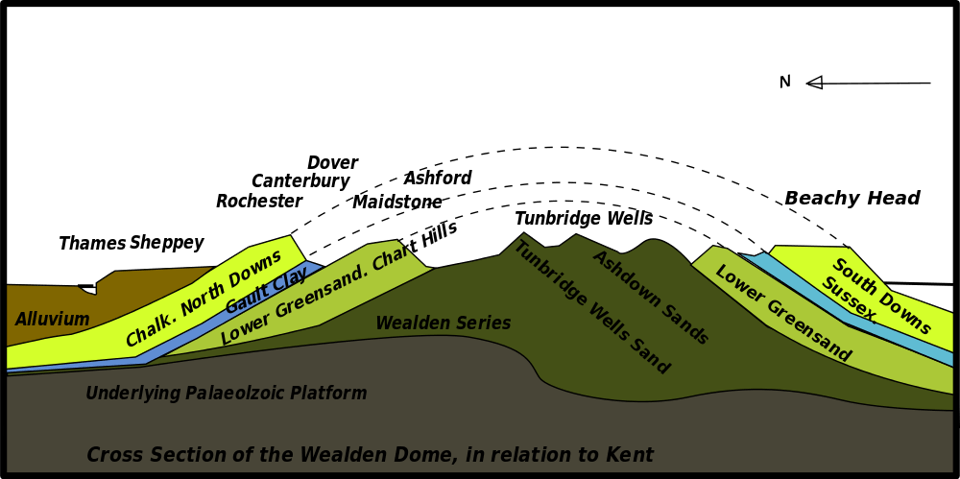
One of the things he got to study was southern England’s Wealden Dome, an eroded layer of uplifted sedimentary rock that had characteristic chalk-rich deposits on both sides. Embedded within those layers were fossils from hundreds of millions of years ago. Based on the timescales needed for:
the biological evolution of the past and present organisms seen in the fossils,
and the geological creation, deposition, and erosion of the layers in the sedimentary rock,
Darwin recognized that the Earth itself needed to be old: hundreds of millions, and perhaps even billions, of years old. Although there were no known mechanisms that could power the Sun for such long periods in the 19th century, the evidence for this “old Earth” persisted and was difficult to ignore.

Astronomy would eventually catch up, however, and began to do so in earnest in the 1910s and 1920s. A series of profound discoveries happened in those years:
Einstein put forth his general theory of relativity in 1915, overthrowing Newtonian gravitation and giving us a Universe where spacetime was a fabric, and where matter and energy’s presence and distribution determined the curvature and evolution of that spacetime.
Vesto Slipher, examining the spiral and elliptical nebulae in the sky throughout the 1910s, found evidence that their light was redshifted, indicating that they were moving away from us.
Alexander Friedmann, working with Einstein’s equations in 1922, determined that a Universe that was uniformly filled with any species of energy — matter, radiation, a cosmological constant, spatial curvature, or anything else — could not be both static and stable, but would be compelled to either expand or contract (and hence evolve) over time.

And then the big advance came in 1923, when Edwin Hubble was observing the Great Nebula in Andromeda. Bright "flares" appeared, brightened, and then faded away. He observed three separate flares over the span of just a couple of nights and assumed they were novae. Then he found a fourth in the same location as the first and got very, very excited. He crossed out the "N" he had previously written down for nova and replaced it with "VAR!" in red capital letters.
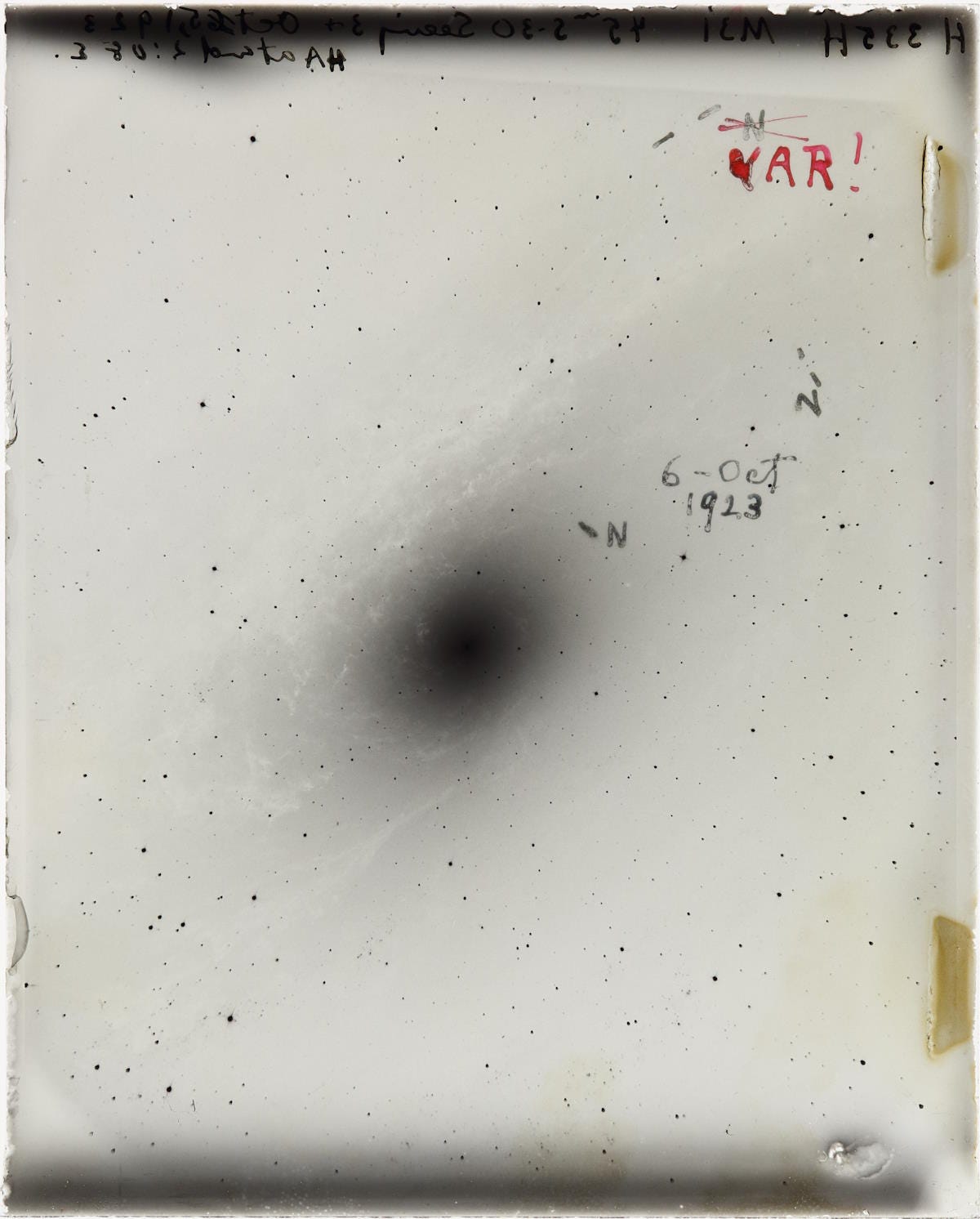
You see, novae are stellar events that take a long time to recharge: years, decades, centuries, or millennia. But variable stars brighten and dim in the span of days or even hours. The rapid appearance and disappearance of the light Hubble saw meant it wasn’t a nova at all, but a variable star.
For a variable star to appear this faint, however, it must be extremely far away: not just hundreds, thousands, or even tens of thousands of light-years, but more like a million. (Today, we know the distance to Andromeda is about 2.5 million light-years.) Hubble recognized that Andromeda must be an extragalactic object — what was originally known as an “island Universe” — and that other spiral and elliptical nebulae were likely entire galaxies unto themselves as well.
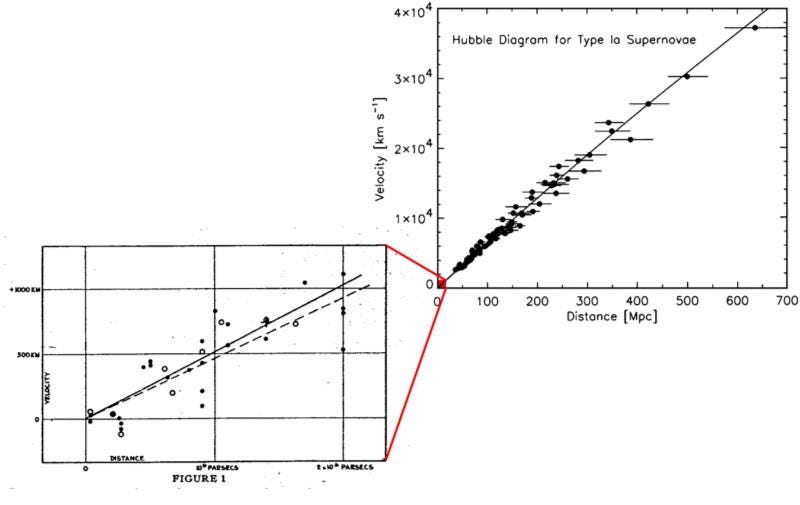
While Hubble went on to measure the stars within (and hence the distances to) many other galaxies, combining his data with Slipher’s data led others to the conclusion that the Universe was expanding, as the farther away a distant object was, the faster it appeared to recede from our perspective. The first to put these pieces together was Georges Lemaître in 1927, but others would soon follow. By the 1930s, Hubble, Einstein, and many other influential astrophysicists accepted this conclusion. The Universe was expanding and getting less dense, which meant that long ago, in the distant past, it was denser, things were closer together, and its volume was smaller.
Well, if the Universe were smaller and denser long ago, then it must have been hotter long ago as well.
Why is that? Because the Universe isn’t just full of matter (i.e., the stuff that stars and planets are made out of), but also of radiation, or photons. These quantum particles of light each have a specific energy to them, and that energy is defined by their wavelength. As the Universe expands, the wavelength of every photon traveling through that expanding Universe expands as well, and as it lengthens, it brings the photons down to lower energies.
That’s what happens when we go forward in time. So, what happens if we look backward and ask, “What was the Universe doing in the past?” If the Universe were smaller and denser in the past, and the distances between objects were shorter, then the wavelength of photons in the Universe must have been shorter as well. If photons had shorter wavelengths in the past, that implies that they were more energetic, and that the Universe was therefore hotter. This idea of a smaller, hotter, denser Universe that expanded and cooled to become the Universe we inhabit today is the core idea behind what we now call the hot Big Bang.
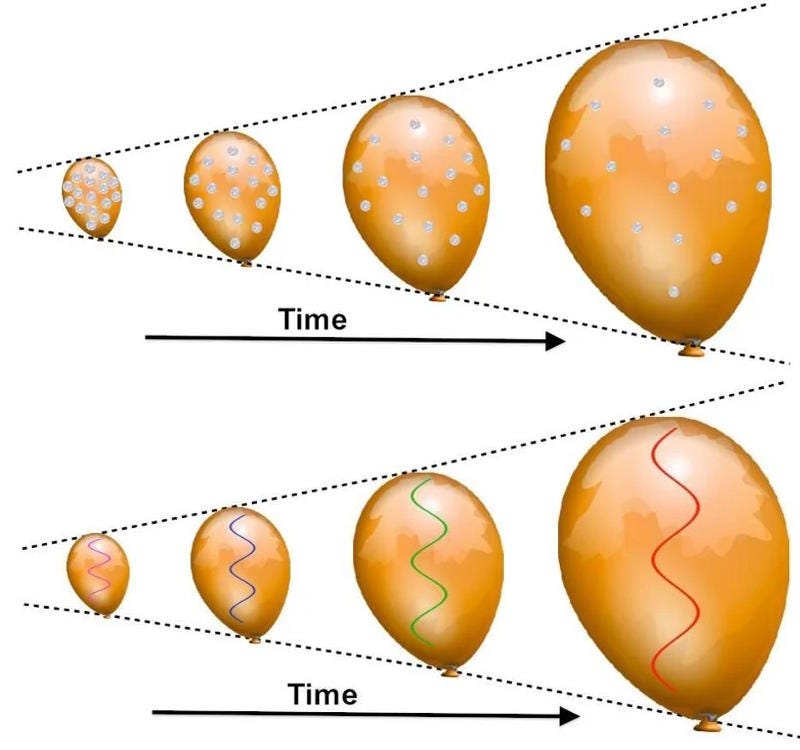
This small, hot, dense Universe must also have been very close to perfectly uniform, and therefore, as it expanded and cooled over time, it must also have gravitated and clumped and clustered together. This implies that, as we go back in time and look farther and farther away into the distant past:
we’d find a time when galaxies were smaller, lower in mass, and less evolved than they are today,
that there were fewer stars in the distant past than there are today,
that if you go back far enough, you’d find a time with no stars or galaxies, as they hadn’t formed yet,
that even before that, the Universe would’ve been hot enough to prevent the formation of neutral atoms,
that even before that, the Universe would’ve been hot enough to prevent the formation of stable atomic nuclei,
that at still earlier times, we could have created matter-antimatter pairs of nearly any species of particle,
and that even before that, the Universe would’ve been too hot, dense, and energetic for even protons and neutrons to form.
These are some of the main predictions of the hot Big Bang. In addition to an expanding Universe, we should see evidence for the emergence, growth, and evolution of structure. A younger Universe should be less enriched in the types of heavy elements formed in stars (carbon, oxygen, silicon, sulfur, iron, and more), eventually revealing, at the earliest times, only the elements forged in the fires of the hot Big Bang itself. And a sign of the leftover relic radiation from the Big Bang, or a cosmic background of radiation, should persist even today, just a few degrees above absolute zero.
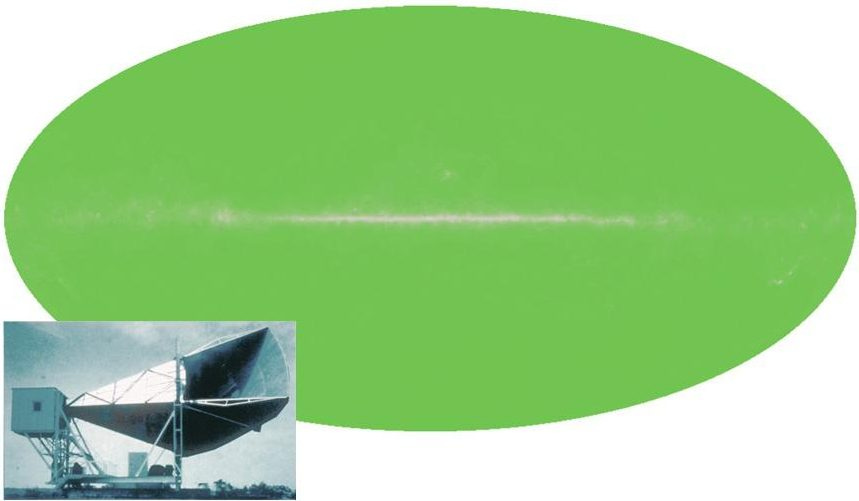
The evidence for this came in almost complete reverse order. In the 1950s, it was realized that most of the heavy elements in our cosmos weren’t formed in the early stages of the hot Big Bang, but rather were built up in the cores of stars through nuclear fusion; it wouldn’t be until the 1970s, in earnest, that the evidence showed that the light elements and their isotopes only were forged in the hot Big Bang. The large-scale structure and evolution of the Universe, from galaxy evolution to the growth and distribution of galaxy clusters and the large-scale cosmic web, would elude us in a scientific manner until the 1980s and even the 1990s; this was no easy task.
But the leftover glow from the Big Bang — originally called the primeval fireball and now known as the cosmic microwave background — was discovered by serendipitous accident in the mid-1960s, when Arno Penzias and Robert Wilson did it with the Holmdel Horn Antenna in New Jersey. We’ve since measured:
the spectrum of this radiation,
the variations in temperature across the sky of this radiation,
and the wavelength-dependence of this radiation.
We’ve determined that it is, in fact, blackbody in nature: just as the hot Big Bang predicts. We’ve determined it is the same temperature in all regions of the sky to ~1-part-in-30,000, and that the imperfections in the overall temperature are Gaussian (or follow a normal distribution) in nature. It’s just as the Big Bang predicted, validated perfectly by observations.
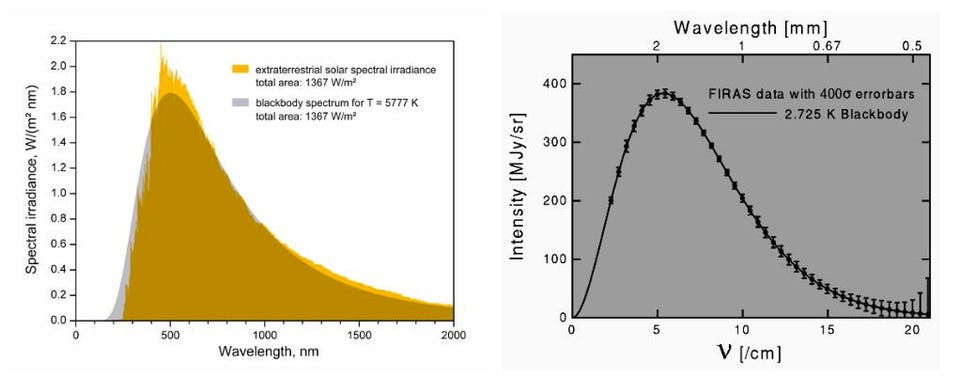

This is how the Big Bang, originally formulated in the 1920s by Georges Lemaitre, expanded upon and developed in the 1940s by George Gamow, and then had its most essential prediction confirmed (refuting several prominent alternatives) in the 1960s by Penzias and Wilson, provided us with our first scientific answer to the question of “where did all this come from?” For the first time in human history, we had an answer to the biggest existential question affecting all of humanity.
But then, on the other hand, there were also puzzles that the Big Bang framework, on its own, couldn’t explain:
Why was the Universe exactly the same temperature to such a severe degree, even in regions that haven’t had enough time to come into causal contact, achieve thermodynamic equilibrium, or exchange information?
Why was the Universe perfectly spatially flat, and why did the matter-and-energy density balance with the expansion rate so pristinely, even after billions of years of cosmic evolution?
And why, if the Universe could be extrapolated back to an arbitrarily hot, dense state, did we see no evidence for leftover high-energy relics, as predicted by theoretical physics, in our modern Universe?
It was by pondering these questions, and by searching for a mechanism to provide a solution to them while simultaneously reproducing all the successes of the hot Big Bang model of our early Universe, that scientists in the late 1970s and early 1980s arrived at a powerful theoretical extension to our description of cosmic history: a period of cosmic inflation that preceded and set up the hot Big Bang.
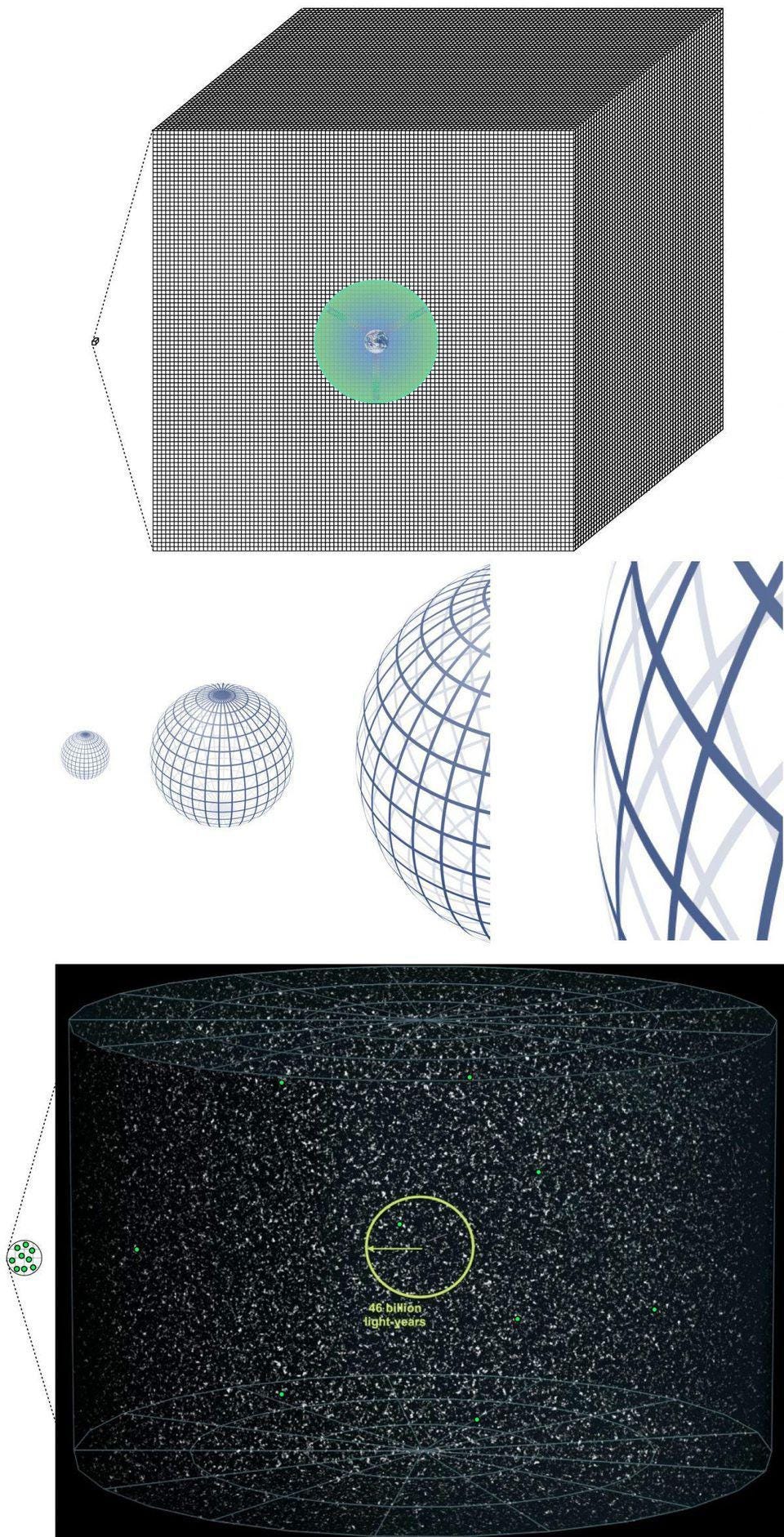
Inflation, originally theoretically developed in the 1980s, went on to make a series of profound predictions about what should be in our Universe that differed significantly from the predictions of the old school, non-inflationary hot Big Bang. Those predictions include:
a nearly, but not perfectly, scale invariant spectrum of initial density/temperature fluctuations,
including fluctuations that exist on scales larger than the size of the cosmic horizon (e.g., super-horizon fluctuations),
in a Universe that reached a maximum temperature that’s well below the energy scale at which physics breaks down (the Planck scale),
whose fluctuations are 100% adiabatic and 0% isocurvature (the only allowable alternative) in nature.
Observationally, those four predictions have now been robustly tested, and inflation is 4-for-4, while the non-inflationary hot Big Bang is 0-for-4. That cements the inflationary hot Big Bang as our best theory, at present, for the cosmic origins of our Universe.
But huge unknowns and open questions still remain. We may have figured out what origin story best fits the full suite of data that we have — a fit with no major holes, gaps, or unexplained observations to the story — but there are a great many aspects to the cosmic story that we’re still ignorant of.
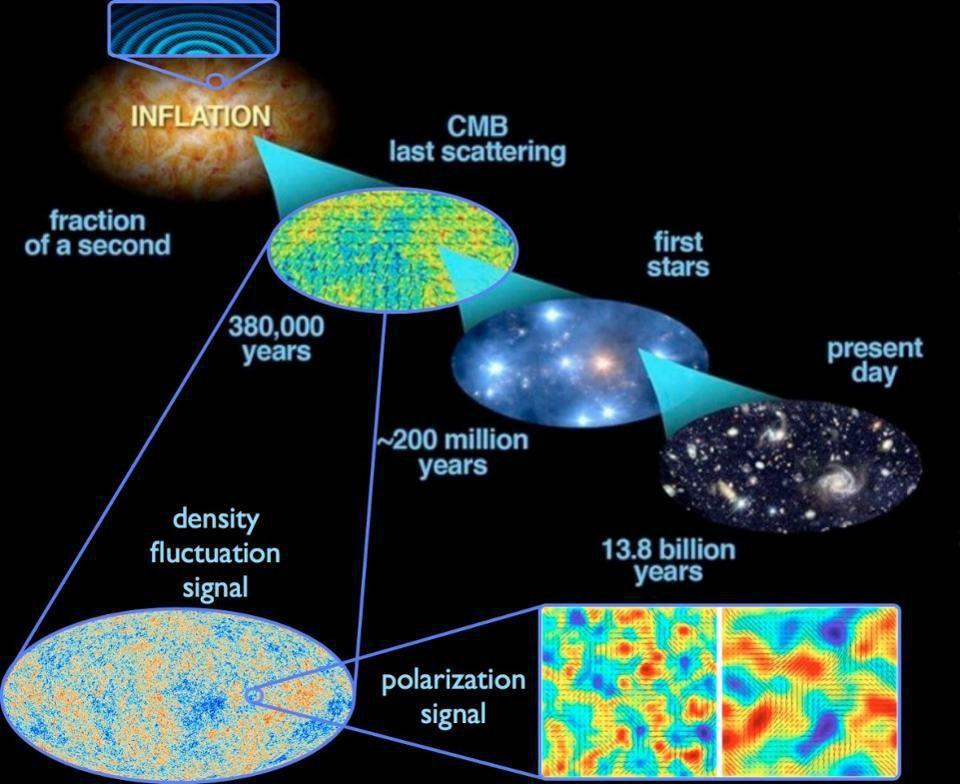
For example, inflation predicts the existence of tensor modes, or gravitational wave fluctuations, imprinted all across the Universe. Inflation can tell you what the spectrum of those fluctuations should be, but it can’t tell you the amplitude; we only have upper limits on how large they can be as we attempt to make those critical measurements. How did the inflationary state arise, and how long did it endure? We know, theoretically, that it couldn’t have been eternal to the past, but did it arise from:
an original singularity that then gave rise to inflation,
a non-singular state that transitioned to have inflation begin somewhere,
or a past-eternal state that triggered inflation to begin at some point in some location?
How long did inflation last: a fraction of a second, many times the current age of the Universe, or somewhere in between? Are there any observations we can make that will shed a light on the specific type, or flavor, of inflation that occurred in our past? Can we model inflation successfully by a single scalar field, or will some more complex model (eventually) be necessary?
As is always the case with science, the answers we’ve found so far don’t represent the end of the story, but rather the foundation for the next steps we’re working to uncover the answers to at present. For every generation prior to that of our grandparents in the 20th century, the question of “where did the Universe come from?” could only be answered with stories. It’s only since the mid-1960s that we have a scientific answer. We can now say a lot that’s quite meaningful and information-rich about our cosmic origins. The next steps, and the answers to the next round of questions, bring us to where the frontiers of modern science are today.
This article was first published on Big Think in September 2025. It was updated in April 2026.