The global financial system is a colossal factory containing an endless web of information assembly lines. Every time you tap your card on a payment terminal, whether it’s for a coffee on the way to work or a new vacuum cleaner, you are sending a new informational signal to that factory. Like raw material, that signal is then loaded on a conveyor belt where it is checked and modified by your bank, the seller’s bank, a payment processor, card network, and other intermediaries as it proceeds. The assembly line may be relatively short for cups of coffee. For more complicated purchases, however, like mortgages and stocks, the transactional chain can become remarkably complex.
But not all transactions take place in this factory. There are, in fact, entirely separate payment networks that operate outside the confines of state-regulated information assembly lines. The Chinese refer to them as feiqian (‘flying money’). Arabic speakers prefer the term hawala, whereas the Indian diaspora operates through a practice called hundi. In English, we have developed an ominous phrase to capture these various informal networks: underground banking.
Such a phrase may evoke images of drug dealers, money launderers and corrupted officials. And, indeed, states have long been concerned about the potential utilisation of these networks for crime and terrorist financing. But numerous scholars have pushed back against this securitised narrative. The political scientist Marieke de Goede, for instance, observes that focusing on criminality in underground banking ignores the tremendous volume of illicit finance passing through the aboveground system. What’s more, the fundamental elements of underground networks – trust, speed, global reach – are precisely what ‘modern’ financial institutions aspire to.
The truth is that there is nothing inherently suspect about underground banking. It is simply another method of transferring money. So why are they controversial? The real answer is not so much about financial crime. It is, instead, about power. Underground banks represent a challenge to states’ control of the global financial system, one that undermines their capacity to surveil our each and every transaction. As a result, those states seek to eliminate informal networks by subjecting them to regulation.
It hasn’t worked. On the contrary, evidence suggests hawala, feiqian and other informal payment networks are alive and well. And, unlike the false promises of bitcoin, they remain the only alternative payment networks that offer a true escape from the information assembly lines of the state-regulated financial system. Do these networks promise a viable alternative? In a world increasingly wary of its economic dependence on the United States, could underground banks offer guidance on the art of decoupling?
Nobody knows the true scale of this ‘hidden’ financial system. But there is reason to believe that it can be measured in the hundreds of billions of dollars. That volume is primarily driven by those using underground banks to send remittances. Officially recorded remittances from immigrants to their home countries exceeded US $650 billion in 2023. That number does not include the informal money transfers facilitated by underground banks. Studies roughly estimate that these transfers equate to about 35 to 75 per cent of official totals. Extrapolating to present-day figures, that would suggest underground banking networks are facilitating somewhere in the region of $228 to $488 billion of informal remittances per year.
These networks are not a new phenomenon. They have existed for thousands of years and can be traced back to the ancient Silk Road, where they emerged as a solution to the risks of long-distance trade. Islamic texts suggest that the Prophet Muhammad was familiar with the concept of transferring debt in the 7th century. Archaeologists have also found premodern promissory notes across the world – written promises by one party to pay a certain amount of money to another at a pre-specified future date. These include Chinese notes written on scrolls or wood dating back to the 9th century.
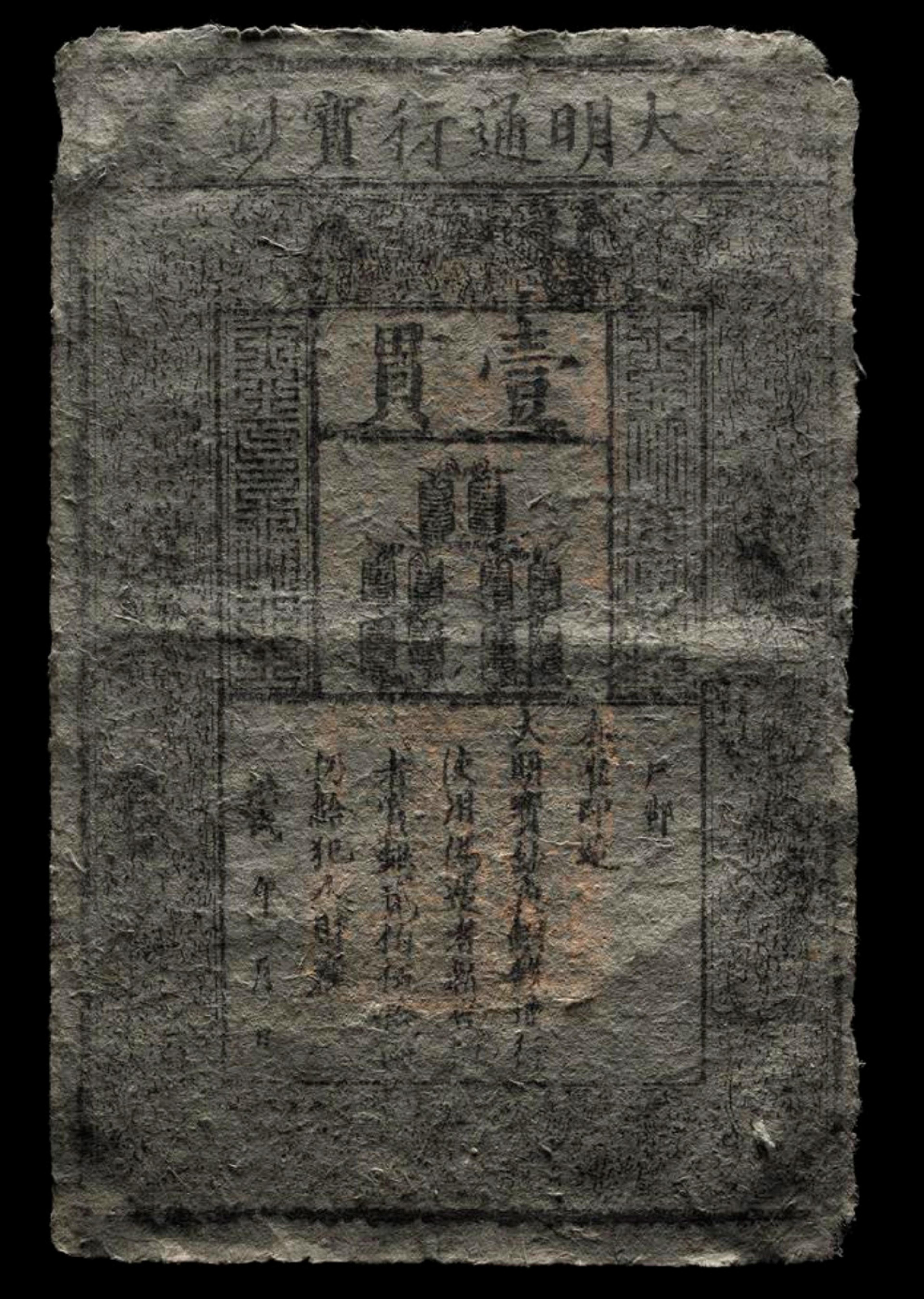
A Ming dynasty-era banknote from 1375. Courtesy the British Museum, London
Through a trust-based system of credit, Silk Road brokers facilitated advanced payment by issuing such notes, as well as bills of exchange and other instruments. This obviated the need to carry physical coins across long distances. And it mitigated the danger of travelling for months on end only to find that your customer had disappeared. These credit systems were, in other words, the earliest known forms of trade finance, which disentangled money from its mere physical form. As the historian Dan Du summarises, they allowed Silk Road currencies to ‘“fly” over time and space’.
Such credit systems, though rooted in commercial trade, would slowly become popular for transferring personal remittances. Contemporary underground banks primarily revolve around networks of brokers located in different countries. If you live in a moderately sized city, you are probably not far from a broker. They often operate secretly out of mini-markets or mobile phone stores. Take, for example, the case of an African grocery store in Philadelphia catering to Muslim immigrants. One enterprising law student at the University of Pennsylvania visited this store and found they could facilitate money transfers to various sub-Saharan African countries and even parts of South Asia. But you will not find the store on the US Treasury Department’s official list of registered Money Service Businesses.
Unlike international wire transfers through banks, hawala networks can move money in a matter of minutes
These brokers facilitate transfers through the ‘two-pot’ system. Imagine, for example, that you live in New York City and want to send $500 to your mother in Bangladesh. The first step is to hand over cash to your local broker. That broker will then provide you with a code – perhaps a verse from the Quran – and contact his partner in Dhaka. Once you share the secret code with your mother, she can cite it to her local broker in return for the equivalent total in Bangladeshi taka. Like magic, your $500 disappeared in New York and reappeared across the world. But no money has actually crossed the border. Instead, each broker has collected and distributed funds from their respective ‘pots’ in return for a small commission. Those pots are originally seeded through some other source of value, whether it be side businesses or family contributions, and continuously replenished through reverse flows or other side transactions.
This is a highly efficient system. Unlike international wire transfers through banks, which can sometimes take three to five business days, hawala networks can move money in a matter of minutes. They also often charge a much lower commission. Research by the United Nations found that hawala brokers charged 0.5 to 7 per cent depending on the nature of the transaction and its ultimate destination. And it has recently been reported that informal Chinese brokers are undercutting the competition by charging ultralow fees for international transfers. Most regulated firms cannot hope to match these prices, and those that try are often forced to compensate by providing customers with substandard exchange rates.
Part of the reason informal brokers can achieve these efficiencies is that they are free from the burdens of state regulation. Banks and financial institutions are obligated to monitor their customers and report suspicious activity to regulators. Like produce inspectors, these companies stare at the information assembly line all day, sorting out the bad apples and sending them to the state for further analysis. Performing this task is shockingly expensive. It has been estimated that financial institutions spend more than $200 billion per year on financial crime compliance. Much of this is spent on staffing. In the Netherlands, for example, an astounding 20 per cent of the entire banking workforce is dedicated to compliance. Also burdensome is the necessity of collecting information on every transaction and reporting data to regulatory authorities.
Underground banking is free from these obligations. That is not to say that informal brokers always avoid keeping records: one study of hawala in Afghanistan found that merchants were taking photos of passports and writing down transactional details. But these brokers can and often do choose to skip these time-consuming steps. Nor are they likely to probe customers about the purpose of their transfer or the origin of their funds in the same ways regulated banks do. Such queries are likely to drive customers to less curious competitors. It is, instead, a trust-based network built on the reputation of individual brokers and the social relationships they develop with clientele. It is not centred around extensive paper trails. That opaqueness, however, creates obvious risks.
The great majority of underground banking is perfectly innocent, most often used to send personal funds abroad and help family members. We can also reasonably assume that most informal brokers have no interest in dealing with criminals. Nevertheless, a largely paperless international money transfer network is naturally attractive to terrorists, money launderers and other nefarious actors. And it is here – the spaces where underground banking has facilitated aboveground crimes – that the regulated and unregulated worlds of international finance have most contentiously collided.
Yearly tuition at the NYU Stern School of Business, not counting housing, food and supplies, is now $70,464. For many of China’s newly wealthy families, this is a small price to pay for the prestige of sending their kids to a top American university. More problematic is how to actually transfer their money abroad. China has imposed strict controls on foreign exchange, prohibiting their citizens from converting more than $50,000 per year. The purpose of these controls is to prevent what economists refer to as ‘capital flight’, in which residents, fearful of devaluation and political risk, seek to park their money in other currencies. For Chinese students abroad, the natural alternative is underground banking.
Like most underground financial networks, the Chinese feiqian system involves brokers distributing money from their respective pots and communicating secret codes through popular messaging applications, such as WeChat. The volumes are enormous. We know this because Chinese students, after having received money through these networks, subsequently move it into regulated bank accounts to pay tuition and other expenses.
Those banks, unlike feiqian brokers, are required to report suspicious activity to the Financial Crimes Enforcement Network (FinCEN), a US agency that sits within the Treasury Department. Between 2020 and 2024, FinCEN received 20,282 reports involving Chinese students. The total value: $13.8 billion. And that number does not include Chinese students who pay their tuition in cash rather than using the regulated banking system – a practice that is allowed at many universities.
This wouldn’t be so concerning if we were talking only about tuition fees. The real problem, especially for state regulators, is where feiquan brokers in the US are obtaining the large amounts of cash they need in their pots. Every underground banker operating in the US has to receive US dollars before they can redistribute that money to their clients. Normally, those deposits would gradually accumulate from repeated business. But, according to a blockbuster indictment in 2023 by the US Department of Justice, much of the cash Chinese students were receiving was found to have come from a troubling source: the Sinaloa drug cartel.
It was a brilliant scheme, in its own devious way. Based in Mexico, the Sinaloa cartel had been making enormous profits selling fentanyl in the US, producing dollars that needed to be laundered. Chinese students in the US, in turn, needed dollars. So, sometime around 2019, the cartel started infusing their cash into the underground banking system. Every time a Chinese student obtained dollars, the cartel would be credited with the same amount in yuan. Conspiring brokers in China then arranged for local businesses to purchase products from Mexican companies controlled by the cartel, producing profits in pesos that appeared perfectly legitimate. Like magic, dollars from the drug trade were transformed into yuan, only to be transformed once again into crystal-clean pesos.
There is no space that states would like to tame more than underground banking. But they have not succeeded
It is not the first time underground bankers have exploited their international networks to move criminal funds. Al-Qaeda infamously employed hawala networks spanning Afghanistan, Somalia, Pakistan, Dubai and other Middle Eastern countries to move their funds or receive donations from sympathetic brokers. The average person participating in these networks, who often lacked access to alternative banking services, would have had no idea that their funds were being intermingled with those of Osama bin Laden.
Following the terrorist attacks on the US of 11 September 2001, officials were in little mood to contemplate these subtleties. The US aggressively sought to shut down hawala networks used by Al-Qaeda while pushing for the regulation of underground banking. What particularly irked US officials was the existence of an alternative economic network, one that operated outside the confines of the state-controlled financial system and its surveillance mechanisms. Juan Zarate, former assistant secretary of the Treasury for Terrorist Financing and Financial Crimes, summarised the government’s desire to close this gap in his revealing memoir Treasury’s War (2013):
In the months after 9/11, the Treasury Department targeted and shut down suspected hawaladar networks that were being used to siphon money for Al-Qaeda, but we understood that the hawala system as a whole was not going to be eradicated. We knew, in fact, that it could serve important purposes, but early on we determined that it needed to be regulated and brought into a framework wherein its transactions could be monitored. [Emphasis added.]
What the US wanted, in other words, was to incorporate underground banking into the state-controlled information assembly lines of global finance. The US is not the only state that has sought this kind of control. As early as 1973, India outlawed hawala to curb capital flight. Various other countries, from Pakistan to the United Kingdom, have sought to regulate underground banking through registration requirements. These efforts were bolstered by the 2002 Abu Dhabi Declaration on Hawala, a post-9/11 agreement by numerous states to regulate underground banks and, in so doing, subject them to oversight.
This impulse is no surprise. It reflects what the political scientist James C Scott referred to as states’ desire to make society ‘legible’ as a means of exerting control. In his seminal book Seeing Like a State (1998), Scott documented how states use various tools to achieve this goal, including mandating official languages, requiring legal surnames, and transforming chaotic streets into organised city grids. All of these methods seek to tame the wild ungovernable spaces of society. And there is no space that states would like to tame more than underground banking.
But they have not succeeded. To understand why, it is helpful to compare underground banking with another alternative payment system, one that states also once viewed as an existential threat to their control of global finance: cryptocurrency.
The primary problem of finance, according to bitcoin’s pseudonymous founder Satoshi Nakamoto, is the necessity of trust. Nakamoto objected to the trust we must place in financial institutions to process our transactions. Even worse was the necessity of trusting central banks to responsibly manage monetary policy. As Nakamoto summarised in a 2009 forum post announcing the creation of their new digital currency:
The central bank must be trusted not to debase the currency, but the history of fiat currencies is full of breaches of that trust. Banks must be trusted to hold our money and transfer it electronically, but they lend it out in waves of credit bubbles with barely a fraction in reserve. We have to trust them with our privacy, trust them not to let identity thieves drain our accounts. Their massive overhead costs make micropayments impossible.
Nakamoto’s novel solution was a ‘trustless’ currency. One in which transactions are validated and recorded through an immutable digital ledger – what we now call a blockchain – with no need for the involvement of third-party intermediation.
Like underground banking, bitcoin was originally motivated by a desire to facilitate payments outside the information assembly lines of the state-controlled financial system. But it sharply diverged in its method of achieving that goal. Underground banking fundamentally revolves around trust. Bitcoin, in contrast, sought to be trustless. In this sense, bitcoin was seeking not just to replace the regulated financial system, but also the extensive networks of brokers that intermediate the world of underground payments. Why worry about secret codes, exchange rates, and finding your local hawaladar in a corner grocery store? Bitcoin promised to replace this system with a single digital currency that could be directly exchanged across the globe between anyone with an internet connection.
States can directly monitor digital currencies like a moustached inspector on the factory floor
Unfortunately, however, it has not been that simple. As bitcoin garnered more users, it began to experience wild fluctuations in price, transforming from a revolutionary store of value to an asset primarily used for speculation. This is not ideal for remittances. Nobody wants to send their hard-earned cash through a currency that might crash at any moment. This problem was largely solved by stablecoins, a form of digital currency whose value is pegged to a stable asset like dollars or gold to remain, well, stable. The world’s largest stablecoin is Tether, which, as of 5 March 2026, has a market capitalisation of approximately $184 billion. And numerous companies now offer stablecoin-powered remittance payments.
But stablecoins have not escaped the grasp of the state. Regulators, slowly but surely, have found ways to incorporate cryptocurrencies into the regulated financial system. This started with states imposing anti-money-laundering requirements on crypto exchanges. Eventually, these obligations would also be extended to stablecoin issuers. But it isn’t just that digital currencies have been incorporated into the information assembly lines of global finance. They are, in fact, much easier to trace than traditional wire transfers facilitated by banks.
The reason is simple. And it is the same reason digital currencies have been less successful than underground banks at retaining their independence: blockchains. The technology underlying these coins preserves a publicly available record of each transaction, thereby making it possible to directly observe how they move from one user to another. And government agencies have successfully partnered with forensic specialists like Chainalysis to scour blockchain records for signs of money laundering and terrorist financing. Digital currencies are, in other words, the most easily controlled information assembly lines ever created. Historically, states had to outsource surveillance to private firms. Now they can directly monitor digital currencies like a moustached inspector on the factory floor. It is one of the great ironies of modern finance that a technology designed for anonymity has produced its antithesis.
Underground banking, in its purest form, does not suffer from this weakness. Whereas bitcoin is trustless, underground banking can be recordless. And even where brokers do maintain records, they are not digital – transactions are simply recorded on paper. States have naturally tried to change this. Following 9/11, the Financial Action Task Force (FATF), an influential international organisation, has produced standards on how to regulate ‘money or value transfer services’. Numerous FATF member states have subsequently obligated hawaladars and other informal brokers to register their services and, in some countries, implement the same anti-money-laundering standards required of traditional banking institutions.
But what underground broker would want to deal with those requirements? Not those who wish to maintain their edge. And certainly not brokers who are comfortable dealing with the world’s less-savoury clients. The rational response, for these players, is simply not to register. And there is an endless string of enforcement cases demonstrating that many brokers are happy to take this risk in order to avoid the scrutiny of regulation.
The result is a world of competing financial systems. When we use our credit cards to enter the subway or purchase bitcoin, we are participating in the aboveground world. It is a world that states would like to preserve. One where every transaction is hoisted onto the conveyor belt of the information assembly line and dutifully monitored. A global network of interconnected panopticons that facilitate state control.
But despite their best efforts, states have not been able to eliminate the informal networks of underground banking. Hundreds of billions of dollars are floating through these channels as you read this article. It may, in fact, be just beneath your feet. The mini-mart where you get your falafel. The soap importer by your favourite brunch spot. Your cousin’s friend who works at the local currency exchange. To paraphrase Scott, it is a parallel universe that remains defiantly illegible to state control. And it is winning.