In the spring of 1945, Dwight D. Eisenhower visited the recently liberated Ohrdruf concentration camp , an experience that left a deep and lasting impression on him. Despite his familiarity with the brutality of war, he was confronted with scenes that were profoundly shocking—starving survivors, hastily dug mass graves, and clear signs of systematic cruelty.
Understanding the importance of preserving undeniable proof, Eisenhower moved quickly. He directed that extensive photographic records be created and invited members of Congress, senior military leaders, and journalists to witness the conditions themselves. He believed that firsthand exposure would make it far more difficult for anyone to dismiss or distort what had occurred.
Through these actions, Eisenhower helped ensure that the crimes of the Holocaust were documented in a lasting and irrefutable way, strengthening efforts to hold those responsible accountable and preserving a stark historical record for future generations.
Ohrdruf concentration camp
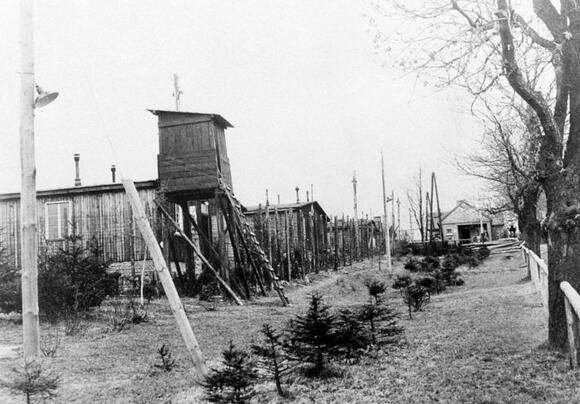
Established in November 1944 near Gotha , Ohrdruf concentration camp functioned as a subcamp of Buchenwald concentration camp , supplying forced labor for a vast underground construction project beneath Mühlberg Castle. The tunnel complex was intended to serve as a hardened communications center and, if needed, a secure base for Adolf Hitler ’s train and mobile headquarters should Berlin fall.
Life inside Ohrdruf was marked by extreme hardship. Prisoners were forced to work long hours clearing debris left by demolition crews, often using only their bare hands or rudimentary tools amid sharp rock and suffocating dust. Hunger, illness, and exhaustion were constant, with injuries left untreated and disease spreading unchecked. Within this tightly controlled and deadly environment, inmates were treated as expendable labor rather than human beings.
Death march to Buchenwald
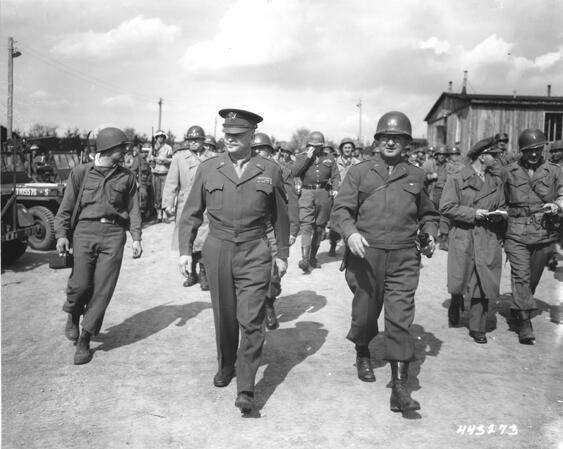
By March 1945, approximately 11,700 prisoners were held at the Ohrdruf concentration camp. They came from many different countries, including France, Belgium, Germany, Poland, Hungary, the Czech Republic, Russia, Latvia, Italy, Ukraine, and Yugoslavia. Jewish people and homosexuals were also among those imprisoned.
In early April 1945, as Allied forces drew near, the German guards began evacuating many of the prisoners, forcing them on a death march toward the Buchenwald camp. Those who were too weak, ill, or unable to keep going were executed.
Eisenhower witnesses the horrors of the Holocaust firsthand
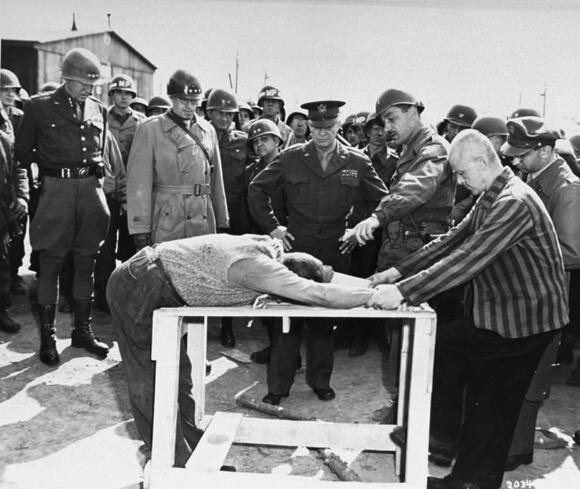
Ohrdruf was the first concentration camp to be liberated by American forces. Leading the charge, the 602nd Tank Destroyer Battalion, in collaboration with the 4th Armored Division and the 89th Infantry Division, uncovered harrowing scenes of decomposed bodies and emaciated survivors in desperate need of medical attention.
On April 12, 1945, General Eisenhower, accompanied by Gen. George Patton and Omar Bradley, visited Ohrdruf completely unprepared for the horrors awaiting them. Until that visit, Eisenhower had not fully grasped the extent of the atrocities committed by the Germans or the grim reality of the Holocaust.
During their tour, the delegation encountered a smoldering pyre, its charred remains serving as a grim testament to the prisoners' brutal mistreatment. The evidence suggested that the guards had made a rushed attempt to hide their crimes. Survivors courageously shared accounts of the cruel methods inflicted upon them by their captors.
Patton couldn't enter one area of the concentration camp
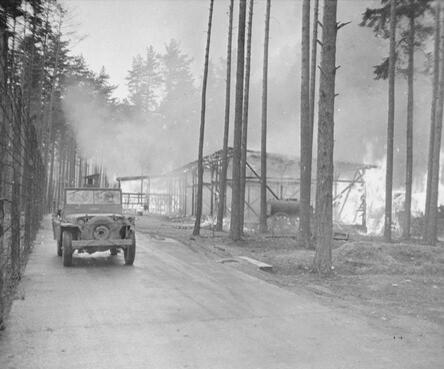
A closer look at Ohrdruf led to the discovery of a shed containing about 30 emaciated corpses. The bodies were dusted with lime, seemingly an attempt to mask the overpowering stench. The sight and odor were so appalling that Patton could not bring himself to enter the room.
Eisenhower explained this in a cable, stating, "In one room, where they were piled up twenty or thirty naked men, killed by starvation, George Patton would not even enter. He said that he would get sick if he did so. I made the visit deliberately, in order to be in a position to give first-hand evidence of these things if ever, in the future, there develops a tendency to charge these allegations merely to 'propaganda.'"
American soldiers and Congressmen were called to bear witness
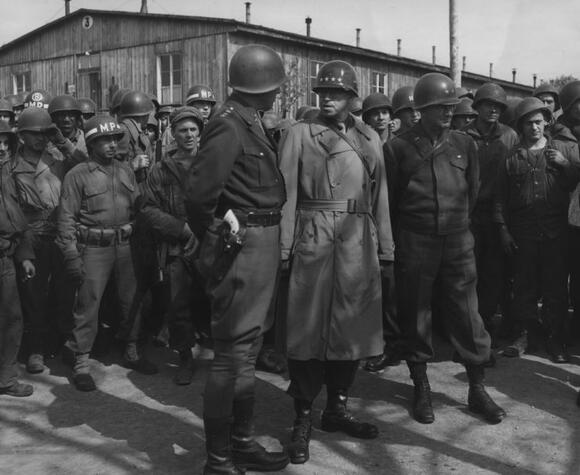
Utterly shocked by what he'd witnessed, Eisenhower worried there may come a day when the atrocities committed during the Holocaust would be rewritten, forgotten or denied. In order to preserve the truth, he took extra steps to expose the conditions of Ohrdruf.
He invited American media and Congressmen to visit the camp and observe the conditions for themselves. He then had pictures taken, to preserve the grueling sights. Additionally, he ordered all nearby American units not engaged in battle to come and observe the enemy's crimes.
In what later became common practice for liberated concentration camps during the the Second World War, Eisenhower had German civilians living in the area tour Ohrdruf and bury the dead.
More from us:Looking Back At the Red Army's Liberation of Auschwitz
Following the discovery and liberation of the concentration camp, Eisenhower succinctly said, "We are told the American soldier does not know what he is fighting for. Now, at least, we know what he is fighting against."