Pygmalion's love for the statue of a woman he has created has long appealed to artists like Rodin, who have used the story as an excuse to celebrate their own skill. However, for Scholten, Pygmalion's belief that his creation is superior to all the real women around him has echoes of humankind's misplaced faith in its own invention, AI. "We human beings think we can control everything and have solutions for everything," he says.
But this arrogance has consequences. At least in George Bernard Shaw's retelling of the myth, later adapted into the hit 1964 film My Fair Lady, the Pygmalion character, Henry Higgins, finds that his "creation", Eliza, eventually develops a mind of her own. Should the same happen with AI, the results could be far less pleasing.

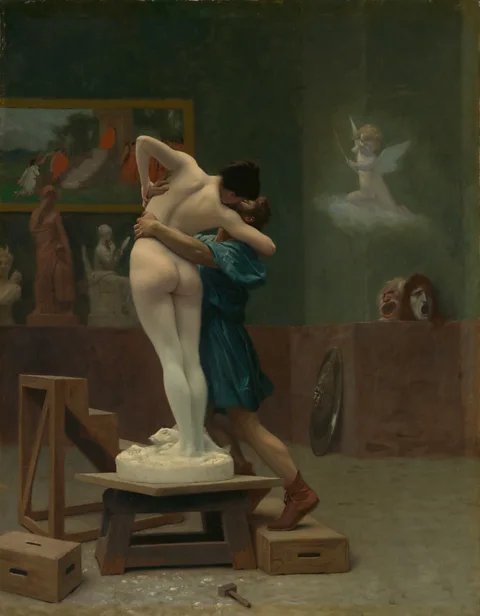 The Metropolitan Museum of Art
Those arrogant leaders currently in positions of power, be they tech giants or oligarchs, presidents or prime ministers, would do well to heed the story of the hunter Actaeon. When he spied Artemis bathing with her nymphs, the goddess was so furious that she transformed him into a stag who was then devoured by his own hounds. "All those world leaders so full of pride should be aware that things can change around," says Scholten.
Metamorphoses isn't all bleak warnings, however. In the story of the lovestruck Salmacis and Hermaphroditus, whose bodies, male and female, become united, we can see an ancient representation of gender fluidity. For Scholten, this is a suggestion that "we should take everyone as unique human beings and not deviations of the norm. The ambiguity that is in nature itself is in Ovid".