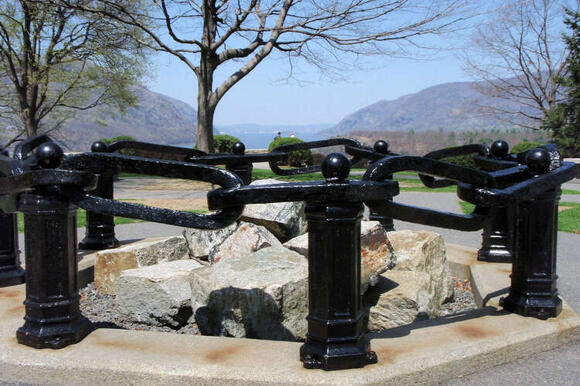
As America celebrates the 250th anniversary of its founding, the Hudson Valley stands out as a critical part of the Revolutionary War. Among the many stories centered here, one of the most surprising is that of the Great Chain, an iron barrier stretched across the river at West Point to block the passage of British ships.
That story is well known. Less familiar is how the chain was made.
Building a 75-ton chain five football fields long, comprising 2-foot-long, 150-pound oval links forged from molten iron, was no small feat in the 18th century. Doing it illegally, in a war zone, with British forces nearby, was even more daunting.
Historians have long known who manufactured the chain. But the location of the ironworks used to build it remained hidden until two intrepid explorers — one in 1961 and the other in 2007 — uncovered the remains of furnaces and the forge sites deep within Sterling Forest in Orange County.
Black rock
The story truly begins millions of years ago, when geological forces left the region that became northern New Jersey and southern New York rich in magnetite, an iron oxide.
In the 1730s, a man named Cornelius Board learned of this “black rock” from Native Americans and launched what would become a booming iron industry. He co-founded the Sterling Forge and Furnace Co. (soon renamed the Sterling Iron and Railway Co.) to produce iron.
Mines were everywhere. At least 20 magnetite mines were dug within what is now Bear Mountain State Park. Some, like the Pine Swamp Mine in Harriman State Park, are still favored hiking spots. One mine in Ringwood, N.J., operated until 1930. The O’Neil mine in Orange County and the Tilly Foster Mine in Brewster thrived for decades.
Sterling became one of the area’s most prominent iron producers, turning out pig and bar iron as well as finished products like wagon and chair spindles, teakettles, pots and anchors. Under partner Peter Townsend, the company supplied arms and ammunition to George Washington’s Continental Army and anchors for naval warships.
Then it took on an even more ambitious task: building the Great Chain.
400 pounds sterling for a chain
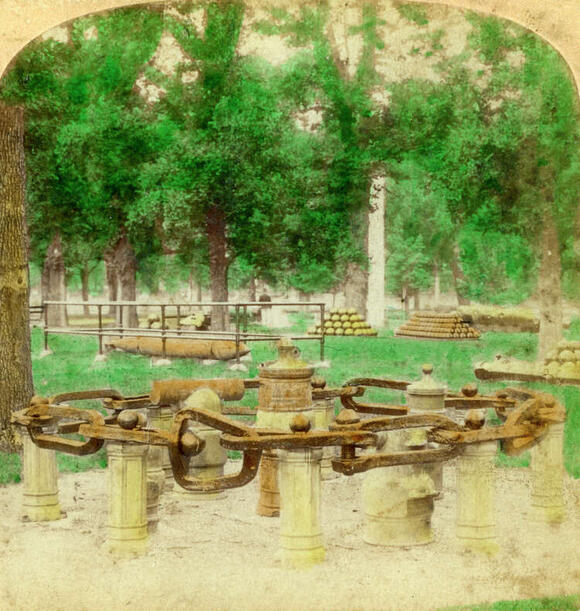
At the time, Sterling Iron Works comprised 20,000 acres of land, a furnace, forges and an anchory. In February 1778, Townsend signed a contract under which the new government would pay 400 pounds sterling for a chain “in length 500 yards, each link to be about two feet long, of the best Sterling Iron, two inches and a quarter square, with a swivel every 100 feet, and a clevis to every 1,000 feet.”
Laborers worked day and night for six weeks, using seven forging fires and 10 welding fires to produce the links and fittings. Secrecy was paramount because the British, under the Iron Act of 1750, forbade the colonies from making anything from iron.
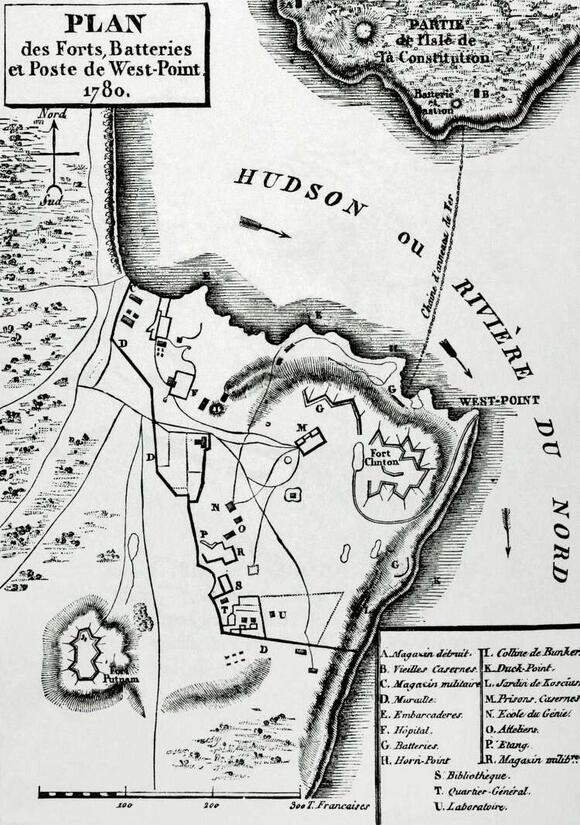
Once completed, the links were hauled nine at a time by oxen-drawn sledges through the snow to a forge in New Windsor, where they were joined together and fastened to logs that helped support the chain. In April, the finished barrier was floated downriver to West Point and secured between what is now known as Chain Cove and Constitution Island.
For five years, the British never tried to breach it, forcing the Redcoats to fight on two fronts separated by the Hudson.
After the war, the chain was left to rust on the shore before most of it was sold for scrap. A large portion was sent to West Point Foundry in Cold Spring and used to make Parrott guns and other armaments for the Civil War. Only a handful of links survive, some now at West Point, the Albany Institute of History and Art and the State Capitol.
But what happened to the hidden forges and fire pits?
Picks, shovels, maps and magnets
The first breakthrough came from Roland Wells Robbins, an archaeologist best known for locating the sites of Henry David Thoreau’s Walden Pond cabin, the Saugus Iron Works and the John and Priscilla Alden homestead.
In 1961, this “pick-and-shovel archaeologist from Massachusetts,” as he was called by the New York Times, was hired to excavate and restore parts of the Sterling complex. The Times reported that in three months, he removed 1,200 tons of silt and 100 tons of boulders and felled 40 trees that had grown atop 18 feet of “accumulations that blanketed the almost-forgotten foundations.”
Still, the forge sites themselves remained elusive until 2007, when Donald “Doc” Bayne — a retired park ranger, environmental educator and former president of the Friends of Sterling Forest — was leading a hike through the forest. When they came to the furnace, someone asked where the forges were. He didn’t know. Neither did anyone else.
So, he did some digging — not the pick-and-shovel kind, but the research kind.
Bayne has been intrigued by the Great Chain since childhood. His father photographed him sitting on the links at West Point when he was 5. He combed through libraries and archives but found little.
“I read that there were 17 forge fires,” he told the Times Union. “I walked all around the park for years” — but he never found any of them.
Bayne knew that Roland Robbins had restored the furnace, so he and his wife, Pat, visited Robbins’ archival library at Walden Pond, where they found a 1777 Robert Erskine map with the location of Townsend’s forges.
“Doc took a current map, overlaid it on the old one, and then he knew where the site was,” Pat said.
Armed with that information, Bayne headed into the forest with a long pole fitted with a magnet to search for iron fragments.
“The first thing I found was a hole in the ground with a gudgeon,” part of a water wheel, he said. “I was amazed there was still some sign of it there. Nobody knew it was there. The forge was two miles away from the furnace, because they had to keep it secret.”
Bayne kept the discovery quiet for eight years to prevent looting, though he did alert state officials. In 2017, the Friends of Sterling Forest hired an archaeology firm to conduct a dig. Using a drone to find “hot spots,” they eventually found 15 of the 17 forges, two of them underwater, inundated when Sterling Lake was created.
The forge fires are long extinguished and the mines closed, but traces of them are still visible on hikes through the park.
Sign up for Times Union newsletters here
Read the original article on timesunion.com