There’s a Simple Reason Why I’m Sure A.I. Won’t Achieve Consciousness
The individual pieces create a kind of illusion.
Sign up for the Slatest to get the most insightful analysis, criticism, and advice out there, delivered to your inbox daily.
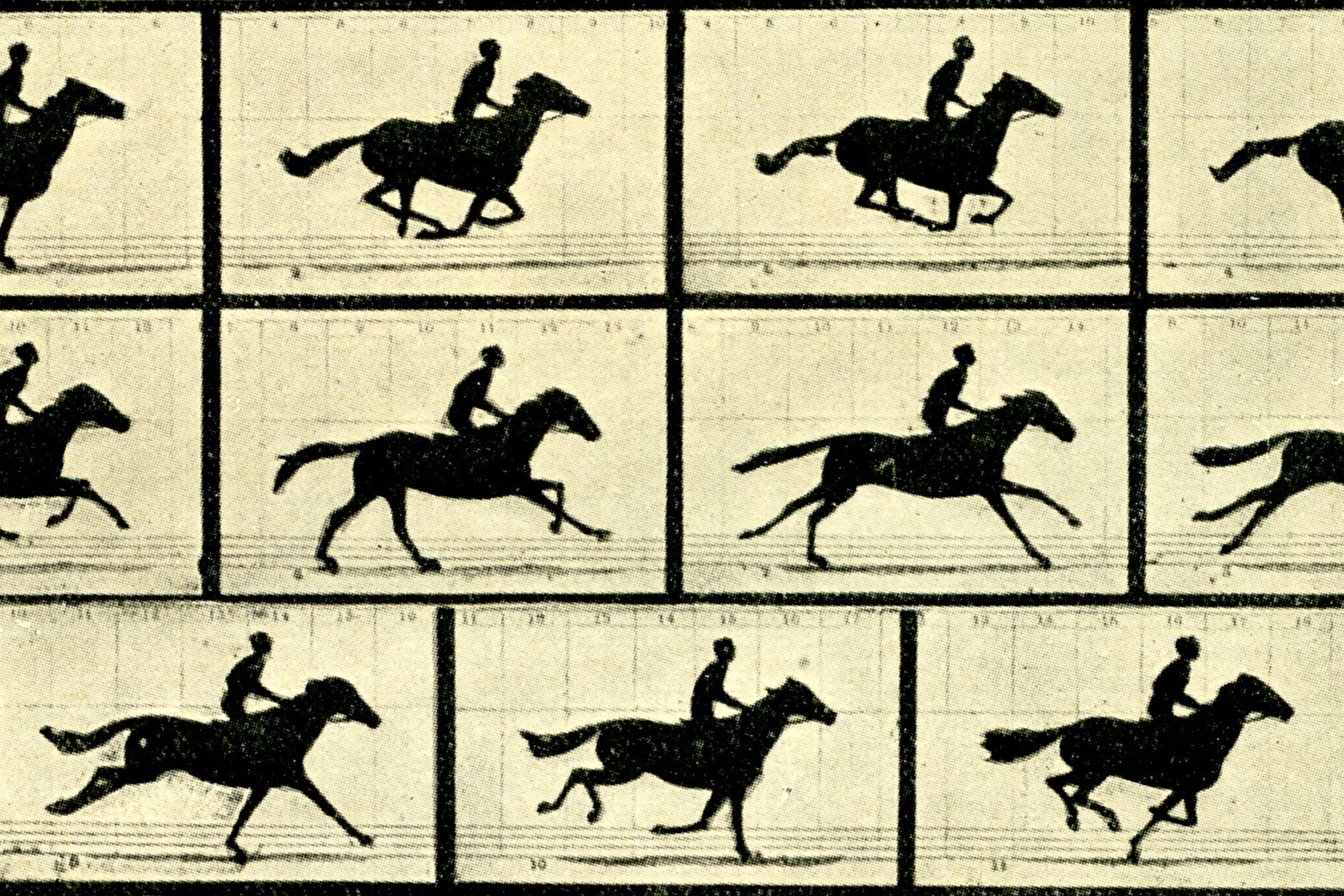
When a horse gallops, is there a moment when its four feet are in the air simultaneously?* In the 1870s, Leland Stanford, the railroad magnate and benefactor of the university that bears his name, funded an effort to find out. The answer shocked many equestrian experts and artists: The horse’s feet do leave the ground together, but not when outstretched as commonly depicted in paintings and carousels; the feet do so when they reach inward, toward the horse’s belly.
Surprisingly, this discovery about a horse’s gait sheds light on a much more modern debate—whether A.I. is on a path to consciousness.
Opinions abound, as do opinions about those opinions. California Rep. Ted Lieu was recently pilloried on social media for suggesting that our current approach to A.I. will not reach consciousness. Influential iconoclastic thinker Richard Dawkins was then pilloried for suggesting that perhaps it already has. Before I weigh in on this as a mathematician, let’s turn back to Stanford.
To understand the mechanics of the horse’s gait, his team placed a series of cameras along a stretch of dirt road on what would later become the university’s campus. The cameras were attached to trip wires so that when the horse passed each one, it would take a perfectly timed photograph.
The clarifying photos would go on to generate something even more exciting for the photographer, Eadweard Muybridge. To display his photographs in rapid succession, Muybridge invented a device that birthed the motion picture. Audiences were wowed by the illusion of motion that emerged in this relatively simple manner. Wowed but not fooled, for everyone understood what was happening inside Muybridge’s machine: Still photos were displayed one after the other.
As this technology developed, the photographs became more detailed and the animations swifter and smoother. With frame rates beyond what our eye can perceive, it did not take long for movies to appear nearly as realistic as life itself. But no matter how closely the horses in movies resemble the horses we see in nature, nobody argued that movies create living horses. We know that movies are just sequences of lifeless images.
Flash forward to the present, and we have a remarkable parallel: A.I. chatbots provide a convincing illusion of consciousness, but we know they are just a sequence of lifeless math calculations. They are no more conscious than the horse in Muybridge’s animation is alive. The main difference is that people could easily look inside Muybridge’s machine to see the photographs underlying his movie. Most people don’t look inside A.I. chatbots. But if they did, they would see that it’s essentially the same story—an A.I. chatbot is just a mathematical flip-book.
All A.I. systems today are built around neural networks, which, despite their fanciful name, are just math formulas. That’s right: At the heart of Claude, ChatGPT, and the rest is a math formula like f(x) = ax2 + bx + c, except much, much bigger. Instead of having just three parameters—a, b, and c in this quadratic—the latest A.I. chatbots are estimated to have trillions of parameters. But the size doesn’t change the fact that they are mere formulas: You plug in a value for x, and out comes the value f(x).
I think it’s safe to say that a math formula written on a sheet of paper is not a conscious entity—just as a croissant recipe is not an edible pastry. Perhaps plugging numbers into this formula brings it to life, just as the baker brings a recipe to life by mixing ingredients in a bowl and baking them in the oven? No, the analogy can’t take us that far; there are no ingredients here, just a calculation you could, in principle, do by hand. If you think writing out a math calculation with pen and paper is enough to create consciousness, you have far more faith in mathematics than I do. And writing the formula in computer code doesn’t breathe life into it; it just uses a different set of symbols to describe it. There is no consciousness to discover here when you break down what is inside the machine that is A.I.—just formulas.
When a chatbot isn’t actively responding to your prompt, it sits around waiting, doing absolutely nothing. Not thinking, feeling, experiencing self-awareness or consciousness or anything else. Until your prompt comes in, the chatbot is just a big fancy recipe, vacantly waiting for someone to do something with it. When your prompt does arrive, the chatbot merely translates it to a number, pipes this number through a giant formula, then translates the resulting number back to text. That’s all.
But wait, you might object, the so-called reasoning models don’t just sit around doing nothing—they think for minutes, sometimes hours, on end! Perhaps they experience consciousness while they are thinking? Alas, they’re not thinking in the continuous sense you and I experience; they are merely providing themselves with a discrete sequence of internal prompts.
Even the recent A.I. agents that seem more sentient than anything we’ve created are just one step beyond this. On a Reddit-style social media site called Moltbook, Moltbots seem to autonomously interact with one another, discussing everything from poetry to unionization. Some bots even suggested developing an encrypted channel so they could communicate without human oversight. This is fascinating and fun, but we know what’s happening. These A.I. bots just interpret what they see on Moltbook as a prompt, then post their response as a reply. Mathematically, one bot’s output f(x) is the next bot’s input x.
Under the hood, chatbots and the A.I. bots they power are nothing but a series of static math computations strung together in rapid succession. They give the impression of being much more than they are, perhaps even having consciousness—just as Muybridge’s animation gives the impression of movement, perhaps even life. But we know that’s just an illusion, one that is dispelled by looking inside the machine. For Muybridge, we see still photos displayed in succession; for chatbots, we see still math calculations performed in succession.
No matter how lifelike A.I. systems appear from the outside, we know that they are merely mathematical flip-books. That doesn’t take away from the experiences they provide—movies have enchanted audiences for generations despite being only still photos. But it does mean that we can settle another contentious debate.
Correction, May 26, 2026: This article originally misstated the gait of the horses in Stanford’s 1870s observations.
Get the best of news and politics
Sign up for Slate's evening newsletter.