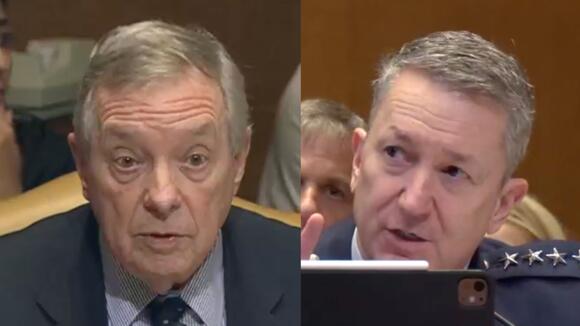
Senator Dick Durbin delivered one of the most pointed questions of Tuesday’s Senate defense budget hearing — asking Joint Chiefs Chairman Gen. Dan Caine to explain to the American people how Iran, after being heavily attacked by the United States, is still capable of blocking traffic through the Strait of Hormuz while the Pentagon asks Congress for a $1.5 trillion budget.
“As we talk about trillion dollar plus budgets for our military, it appears that a very small budget is holding us hostage in the Straits of Hormuz,” Durbin told Caine at the Senate Appropriations Subcommittee on Defense hearing, held Tuesday at the Dirksen Senate Office Building, according to the official Senate Appropriations Committee hearing record.
The Exchange — Durbin’s Question and Caine’s Answer
Durbin asked Caine directly: “Could you explain to the American people why with the vast investment we’ve made in national defense and military, how Iran, after they’ve been attacked by us, is still capable of stopping the traffic in the Straits of Hormuz?”
Caine’s response acknowledged the complexity without providing a satisfying answer. “It’s a complex situation out there with a lot of different small boats that are out there and other capabilities,” the general said. “Some of this is on the commercial traffickers. Some of this is on, again, back to the main problem, and that’s Iran holding the global economy hostage through the straits. I would encourage them to think wisely about their next moves and to take the opportunity to open the straits. They have that choice to make.”
Durbin pushed back immediately. “I guess the question in my mind is as we talk about trillion dollar plus budgets for our military, it appears that a very small budget is holding us hostage in the Straits of Hormuz.” He then yielded the floor — leaving the observation hanging in the chamber without rebuttal.
Why the Question Lands So Hard
The bluntness of Durbin’s observation cuts to a strategic paradox that has frustrated military analysts and lawmakers throughout the war. The United States has the most technologically advanced and expensively equipped military in the history of human civilization — spending more on defense than the next ten countries combined. Iran’s annual defense budget is estimated at approximately $10 billion, according to the International Institute for Strategic Studies Military Balance. And yet, Iran has effectively closed one of the world’s most critical waterways for more than ten weeks using a combination of sea mines, small fast-attack boats, shore-based anti-ship missiles, and drone swarms — all relatively cheap, asymmetric tools.
The asymmetry is not accidental. Iran has spent decades specifically developing capabilities designed to deny access to the Strait of Hormuz against a far more powerful adversary — a doctrine military analysts call Anti-Access/Area Denial, or A2/AD. The strait is only 21 miles wide at its narrowest point, making it one of the most defensible chokepoints on Earth. A country willing to place indiscriminate sea mines, threaten commercial shipping with small boat swarms, and accept international condemnation can hold the strait at a fraction of the cost it takes a superpower to try to force it open, according to the Washington Post.
The Broader Hearing Context — Bipartisan Frustration
Durbin’s exchange with Caine was one moment in a day of intense bipartisan questioning at back-to-back House and Senate subcommittee hearings, both reviewing the Trump administration’s $1.5 trillion FY2027 defense budget request and scrutinizing a war that has already cost an estimated $29 billion.
Rep. Rosa DeLauro, the ranking Democrat on the House Appropriations Committee, told Hegseth: “This administration has not presented Congress with any kind of clear or coherent strategy week to week, day to day, hour to hour. The rationale shifts, the objectives change. The end game is ill-defined when it is defined at all.” Republican Rep. Ken Calvert, the House subcommittee chair, raised concerns about the impact of the war on weapons stockpiles: “Questions persist about whether we are building the depth and reliance required for a high-end conflict.” Even members of Trump’s own party pressed Hegseth harder than in the April 29 hearing — reflecting growing Republican anxiety about the war’s trajectory and cost.
Caine’s “Delicate and Dangerous Time” Warning
Caine’s own testimony was more sober than Hegseth’s. The Joint Chiefs chairman warned lawmakers the United States is operating in a “delicate and dangerous time” and stressed that sustained investment is critical to maintaining readiness amid a high operational tempo. His acknowledgment that Iran’s small-boat tactics and layered strait denial capabilities present a genuine challenge to the world’s most expensive military was itself a notable moment of candor — one that sat uneasily alongside the administration’s simultaneous request for $500 billion in additional defense spending above current levels.
The $29 Billion Question
The war’s cost has now climbed to an estimated $29 billion — up from the $25 billion figure cited in earlier congressional testimony — and is rising daily, according to NBC News. The $1.5 trillion FY2027 budget request Hegseth was defending includes significant allocations for munitions replenishment — the Tomahawks, THAAD interceptors, Patriot missiles, and Precision Strike Missiles that have been heavily consumed during the conflict. But the strategic question Durbin raised is not simply about dollars. It is about whether the United States military’s massive technological and financial advantage translates into the ability to achieve the specific operational objective of reopening an internationally critical waterway against an adversary whose asymmetric capabilities are specifically designed for exactly this kind of denial.
Durbin’s Record on This War
Durbin has been one of the most persistent Senate critics of the Iran war since it began. He previously called Kash Patel the “most unqualified, dangerous FBI Director we’ve ever had” for being distracted by personal controversies while global threats mounted. At Tuesday’s hearing, he connected the strategic failure in the strait directly to the budget debate — making the case that throwing more money at the Pentagon does not automatically produce the ability to deter or defeat the specific, asymmetric threats America actually faces. His exchange with Caine lasted less than three minutes. The question it posed will take considerably longer to answer.
As of Tuesday afternoon, the Strait of Hormuz remained effectively closed. The ceasefire Trump had declared on “massive life support” Monday had not collapsed — but had not improved. The $29 billion war that was supposed to last two or three days, according to Sen. Kelly’s account of Trump’s initial assessment, entered its twelfth week. And the Senate Appropriations Subcommittee on Defense, chaired by Sen. Mitch McConnell, recessed without a satisfying answer to Durbin’s question about why the world’s most expensive military cannot reopen a 21-mile-wide strait.