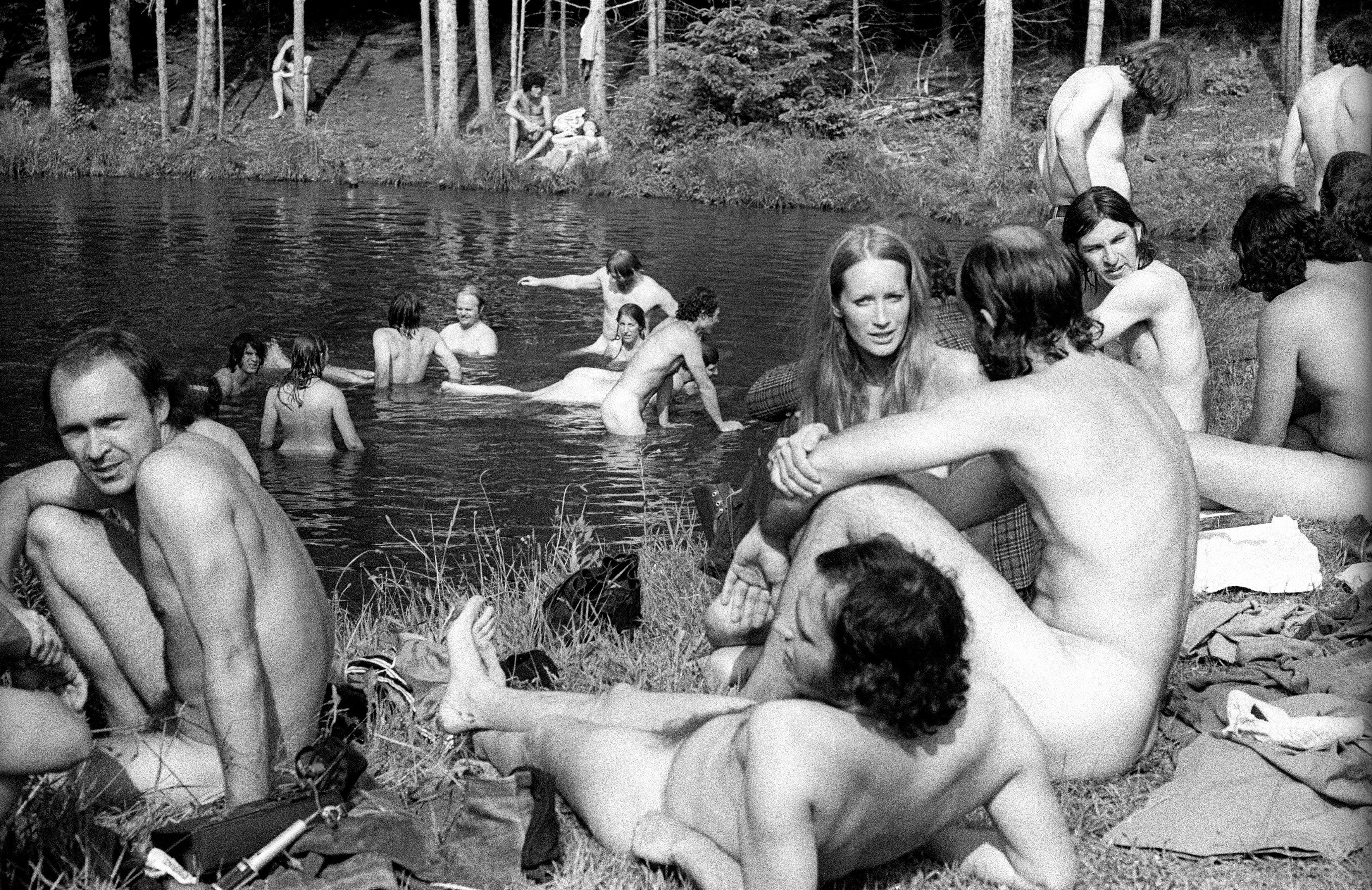
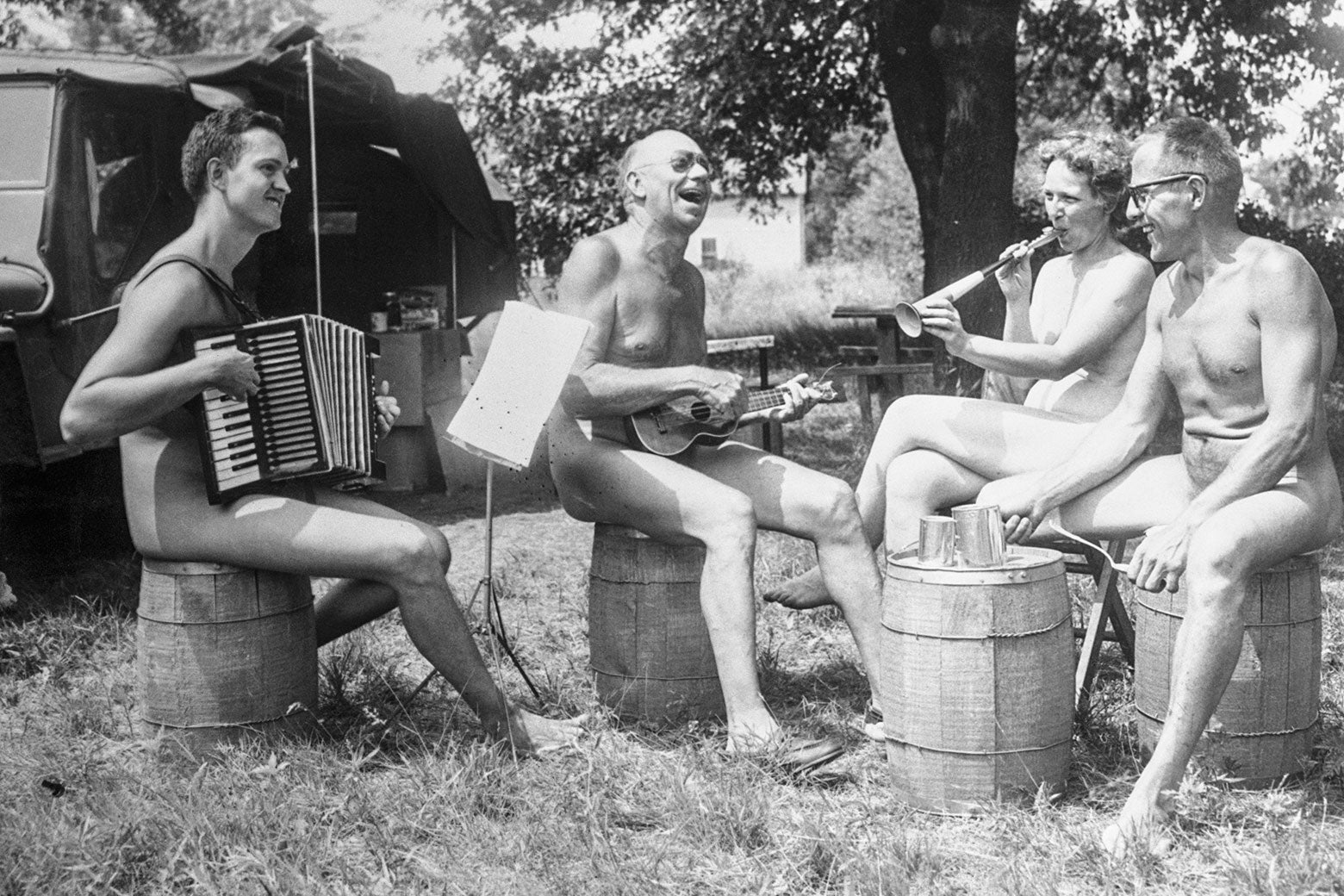
1970 in Vermont. Robert Altman/Michael Ochs Archives/Getty Images
This Is My Last Resort
No one wants to be naked in front of anyone anymore. I went to one of the only nudist corners of America still standing to find out why.
Sign up for the Slatest to get the most insightful analysis, criticism, and advice out there, delivered to your inbox daily.
They make newbies like me strip down as soon as you enter the gate at Glen Eden Sun Club, the last nudist resort in Southern California. “No exceptions,” says Rudy, my very naked welcome guide. I suppose it’s a way of weeding out the pretenders, which I’m eager to prove I’m not, so there in the parking lot, I throw my clothes into my car, place orange stickers over the lenses on my phone (per the rules), and follow Rudy’s golf cart to my spartan quarters near the pool complex.
Glen Eden’s 159 acres of pools, palms, pickleball courts, and RV hookups fall midway between Los Angeles and San Diego, walled in by a ridge of bony hills to the west and a strategically placed berm to the east. The susurrations of I-15 fill the soundscape. The resort has 1,500 members, who gravitate to its well-groomed grounds for in-the-buff swimming, hiking, volleyball, tennis, disc golf, shuffleboard, yoga, karaoke, concerts, line dancing, and, oddly, remote-controlled car racing. That’s down from the 2,000 members in the early 2000s, but still a damn sight better than most nudist resorts in the country, which have been folding like cheap pool chairs in recent years.
I’ve come to find out why. Having always thought that pulling on clothes in order to jump in a body of water was a good definition of insanity, I’ve harbored some sympathy for the nudist cause, if never any interest in “organized nudity” itself. But I’d also never realized it was faltering until I picked up on the pattern a few years ago.
First, some classic skinny-dipping holes in my home state of Vermont went “textile,” as nudists say to refer to the killjoy world of cloth-wearers. The secluded south end of Lake Willoughby, a sublime spot for a clarifying dip after a sweaty hike on Mount Hor, suddenly filled with families in their Tommy Bahamas. So did “Paradise,” the legendary hippie hole where clothes were as rare as Republicans for decades.
I didn’t take that as a sign of anything more than the general bourgeois takeover that has been plaguing Vermont for years, but it turned out to be a global trend. Maui’s Little Beach went textile, as did Belmont Beach in Australia. Rio banned nudity on Praia do Abricó and began arresting violators. So did Virgin Islands National Park. Playalinda, a beach beloved by nudists on Florida’s Cape Canaveral, may get handed over to Elon Musk and his erector set.
That’s bad enough, but the collapse of nudist clubs and resorts is even harder to parse. Coventry, right in Vermont, went down in 2022, after 60 years in business. That same year, Berkshire Vista in Massachusetts pivoted to a glamping model. Goodland in New Jersey closed in 2024 after 90 years, the same year that 90-year-old Lupin Lodge in Los Gatos, California, went on the market for $33 million. The 58 swampy acres of the Florida Naturist Park can be had for a mere $2.5 million. California has already lost DeAnza Springs and Olive Dell to the textiles, along with the Desert Sun in Palm Springs, with its famed “Bridge of Thighs” that conveyed nudists over the road, leaving only Glen Eden and Laguna del Sol in the former hippie heaven.
Most surprising of all: Germany, the nakedest country on Earth since the early 1900s, with nearly 150 nudist clubs, seems to have lost the taste for it. Membership in the national Deutscher Verband für Freikörperkultur, or the German Association for Nudism, has plunged by more than 50 percent, from 65,000 around the turn of the millennium to only 32,000 now. Alarms really started ringing in 2024, when the association canceled its anniversary celebration for “lack of interest.”
What’s going on? How can it be that in a culture dripping in digital flesh, where every fringe fixation has a following and an app to go with it, simply going starkers in the sun has lost its appeal?
My quest for answers led me to a podcast called Naked Age and a Substack called Planet Nude, which turned out to be manifestations from the same brain, Evan Nix’s. Nix also proved to be the chair of the PR committee for the American Association for Nude Recreation and the director of the Western Nudist Research Library, whatever that was. He seemed like a guy who had his finger on the quavering pulse of nakedness.
“There’s very much a story here around participation and decline,” he replied when I wrote him. “It comes up constantly in nudist circles. Membership is down across most organizations, clubs and beaches keep disappearing, and there are a lot of overlapping explanations depending on who you talk to, from real-estate pressures to social media influence to broader cultural shifts.”
For the full scoop—which turned out to be an even broader tale of generational transformation and a rising discomfort with human biology—he suggested I track him down at Glen Eden, where he’d be helping shoot a nudie film in late February. In addition to catching him between takes, I could meet a few nudist VIPs who’d be around for the shoot, and I could check out the archives of the Western Nudist Research Library, which was housed at Glen Eden.
That sounded like the gonzo grail, so I summoned my courage, rang the resort, and booked my room. Packing had never been easier.
No amount of skinny-dipping on the beaches of the world can prepare one for the weirdness of wandering naked through a domesticated landscape of pools, courts, golf carts, RVs, orange trees, and lots of pavement. It was like I’d landed in the common dream of suddenly realizing you are naked in an inappropriate setting, except this time, it was no dream. As I stroll past a maintenance crew in orange jumpsuits, a towel thrown jauntily over my shoulder, I try to look serious.
I find the film crew shooting a quick scene at the shuffleboard court. It’s a surreal tableau: naked actors, clothed crew, and a bunch of naked extras standing around or sitting on towels, waiting to fill the background with activity. (One of the cardinal rules of a nudist resort is that you always travel with your trusty towel for sitting purposes.) Nix is easy to find behind the second camera, 6-foot-5 and exuberantly bearded. He towers over us munchkin nudists like a benign god.
The intimacy coordinator, shrouded in black from head to toe, is slumped over their laptop at a table, looking resigned. “This is not a normal shoot,” they tell me. “Usually, actors have signed very particular agreements about which body parts they’ll show, and a large part of my job is making sure nothing else appears, and there’s black cloth blocking the set. But here, all the actors have agreed to full nudity. And then there’s all these other naked people standing around.” They pauses, trying to sum up the strangeness of her situation: “I mean, the director is naked.”
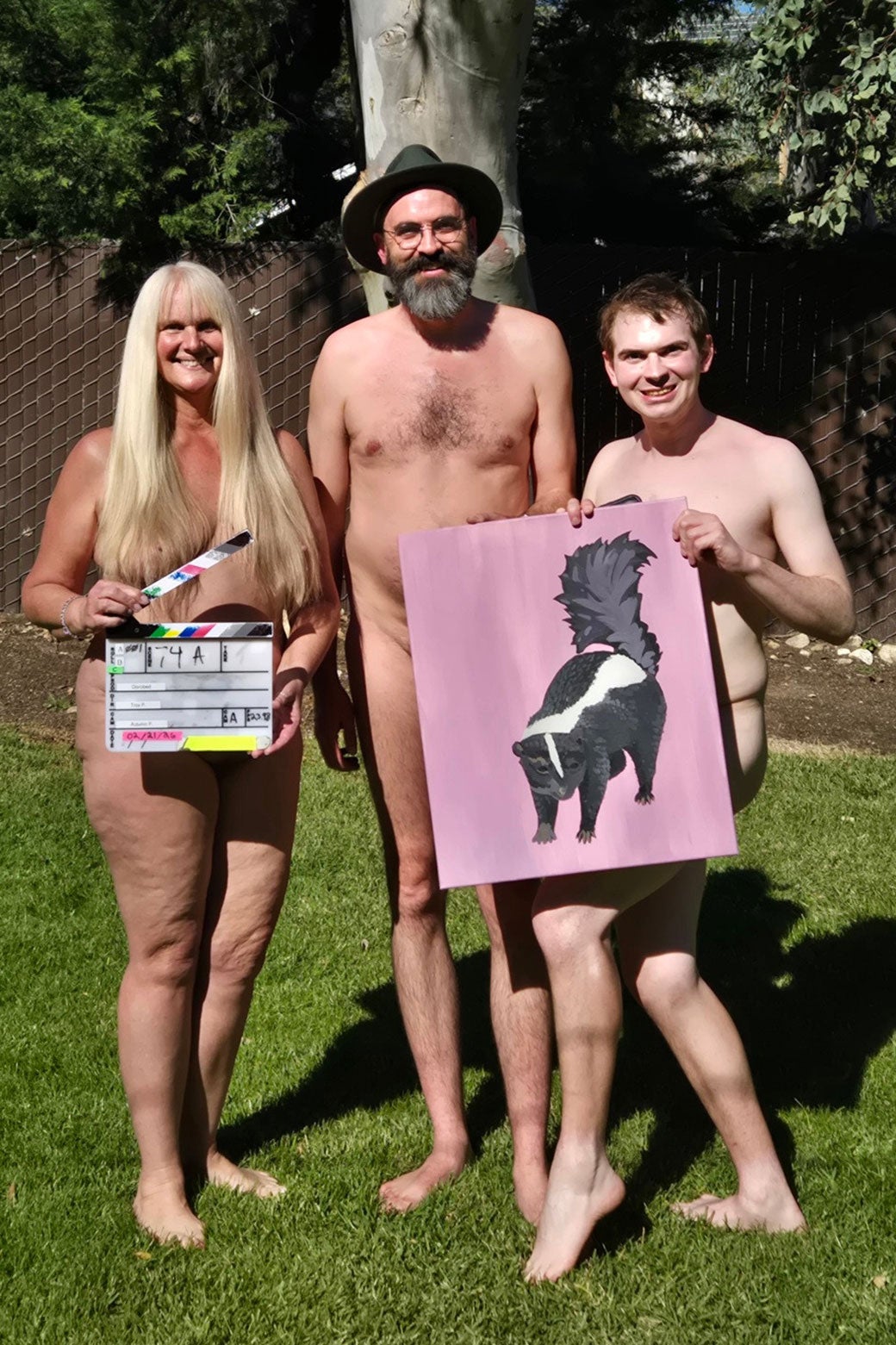
That would be Troy Peterson, a pale fellow in his early 30s who’s both director and star. A walking encyclopedia of film history, Peterson looks and sounds like a young Wallace Shawn, and when you point this out to him, he exclaims, “Inconceivable!” and delivers the famous monologue from The Princess Bride word for word.
I join the extras, and soon I’m one of them, populating the gallery watching the shuffleboard game. Between takes, they fill me in on the plot. The film is based on a 90-year-old play called Barely Proper, which the author deemed “the unplayable play” for reasons that seemed obvious in 1930. It’s essentially Meet the Parents at a nudist resort: A shy young accountant named Eric decides to surprise his fiancée, who is staying with her parents at the resort they own. It’s a nudist resort, but she’s kept that a secret from him because she knows he won’t approve. She’s even told her parents that her beau is a dedicated nudist. He turns up and tries to hide his shock and play it cool at her request, going native with the parents. Much slapstick ensues. But he’s definitely not cool with it, and eventually the whole thing comes to a head.
The robust nudity has mostly limited the play’s performances to nudist resorts, where it has been a perennial favorite. In 2019, an updated version called Disrobed debuted at the Hollywood Fringe Festival. In some of the shows, the audience was required to be nude as well.
That was what caught Peterson’s attention. “I got into nudism in a very strange way,” he tells me after the scene wraps. “I grew up in a very Catholic household, which was very devout. As a kid, I would see images of people who were largely nude, like Tarzan, Moses in Prince of Egypt, Adam and Eve, Jesus, and I’d think, Cool! Yet I was getting all these cultural indicators saying be clothed, be clothed, be clothed. The dynamic was set that nudity was bad and you couldn’t be naked anywhere. So I had this intense shame come over me in regards to nudity. I didn’t even want to take a bath, because I didn’t want to be naked in the same house as my family.”
Later, as a teenager, he got increasingly body-curious, he says: “I felt this sense of coming into my body. I wanted to be a little more free with myself, a little more open.” Being a good Catholic, he steered clear of online porn, but eventually discovered wholesome nudist pages. “They had a lot of good points about not being ashamed of your body, about being body-positive, about actually communicating with your children and not having secrets, about a values-based life. The appeal for me was that families were going to naturist resorts. These were places you could visit and have a good time, but you could still have a normal life. That way of looking at the world seemed healthier. And that’s when, ideologically, I became a nudist.”
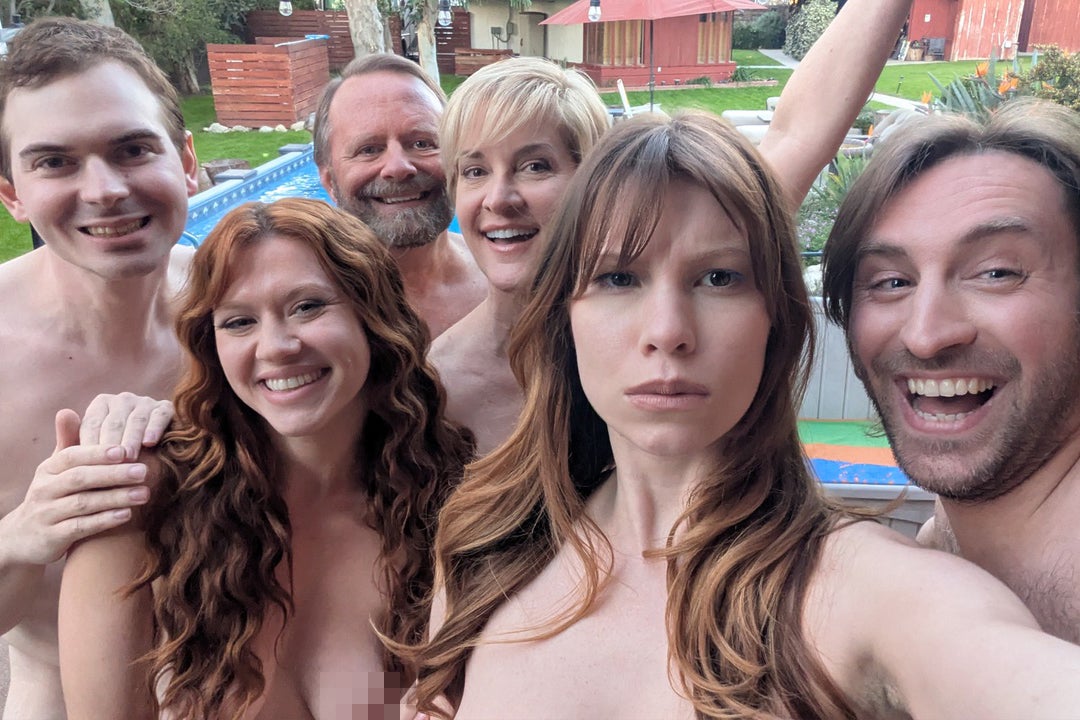
Peterson sees himself as an evangelist for nudism and body acceptance, and he sees Disrobed as a chance to inject some positive energy into the nudity space. “Just being able to be nude around each other and be honest and free and kind, it drives you to be a better person. It creates radical empathy. You can never be mad at someone when they’re naked because they’re at their most vulnerable.”
In most Hollywood films, body parts are parceled out like crack. A boob here, a bun there, but most scenes are staged to carefully avoid revealing anything. In contrast, a few nudist films have been made over the years, but they tend to have low production values and barely any script. They just roll the camera and everybody frolics. Peterson was hoping to make a different statement. “We have all the cinematic techniques. We have wide shots, we have close-ups, we have Dutch angles. We have a great cinematographer. We’re not shooting any differently than we would in a normal movie. So if you’re using the language of cinema, but everyone just happens to be naked, that’s radical. You know they’re naked, but you forget they’re naked. And then you snap back and go, wait, they’re naked, but they’re still people. They’re not bodies. They’re people.”
I keep that in mind at the karaoke session in the clubhouse that evening. The average age at Glen Eden is 64, and the room is packed with naked senior citizens exhibiting a heady mixture of radical empathy and fuck-it-all. It’s a testament to the things that decades of gravity and free radicals can do to living tissue, yet also a celebration of pure freedom. There are old couples dancing, women with long pink hair springing around in bouncy boots, disco balls spinning, and no shortage of volunteers willing to torture Michael Jackson and Cyndi Lauper. Before Gordon Lightfoot can have his day, I slip out to the Jacuzzi. As the moon rises high and the water burbles softly, I ask each person who cycles through why they care so much about peeling off.
To my surprise, most of them have never given it much thought. “Sun and wind” is the usual weak answer. Sure, the first time you dive into the water and feel it sluicing all the way down your body, the sensation makes it clear you are finally doing it the right way, but that’s a far cry from, say, Doug’s experience with the San Diego chapter of Camping Bares, a group that hikes and “canudes” on public lands (the federal government never got around to passing an anti-nudity ordinance). For him, it’s a cure for loneliness, an escape from judgment.
Tim, too. “As soon as I got here, everyone was saying hi and pulling me into this and that. I sang karaoke. Naked! And they accepted me.” Tim’s favorite part of Glen Eden is the creek that runs through the property, which is filled with thick, heavy mud. “I played in it all day today,” he says. “I rubbed it all over myself. I felt like a fucking child again.”
That makes me think of Troy’s childhood, of that moment when you’re told there is something wrong with you just the way you are. A lot of the folks at Glen Eden seem to be trying to find their way back to a pre-traumatized state of innocence.
“It’s about trust, freedom, peace, serenity,” says Catherine, a 68-year-old woman who owns a hundred-acre ranch near Sequoia National Park and has been shaking everything she’s got on the dance floor. “But it’s bigger than that. It’s about being able to show and be the real you. Taking off the clothes, the earrings, the jewelry, the makeup. It allows that beautiful inner essence to pop out that most people don’t even know is there.”
Like many Glen Edeners, Catherine told me she embraced nudism after an ugly midlife divorce. “My whole life had blown up. I was trying to crawl out of the well of darkness.” One warm spring day, on a lark, she decided to mow the lawn naked. She had so much fun on her riding mower that she immediately searched for nudist resorts in California and found Glen Eden. “I guess I’d always been a naturist, I’d just never done it, because that’s kind of unacceptable in the real world. I remember sitting in that lounge chair with my cup of tea and a huge smile on my face. I know I didn’t make my tea any different, but it was the best cup of tea I ever had. Then I was told they had a dance that night. So I was up there spinning and twirling, and laughing the whole time, because it was so weird. I realized I had lost my joy. Coming here, it bubbled up.”
The actor and musician Ian Hayes, who plays the brother of Peterson’s fiancée in the film, has a different take. “My nickname among my friends and bandmates is Nakey Boy,” he says. “I run hot. At some point in my 20s, I was just like, Why am I wearing clothes? I feel very comfortable in my body at home. But this is my first foray into social nudity, and it’s awesome. It’s just so liberating to go to work with other naked people, and the objectification and sexualization of bodies isn’t present at all. This is how we’re supposed to be.”
Sitting there in the tub in the clear California night, it all sounds pretty good to me. Who can argue? But that just deepens the mystery. If being naked together is such a no-brainer, why do we seem to be some of the last people in the country doing it?
Evan Nix gives me a tour of the Western Nudist Research Library the next day. It’s filled with back issues of nudist magazines going back to the 1940s, an unexpectedly fascinating study in the evolution of body forms and grooming trends. There’s a surprising number of books on the history and philosophy behind nudism, as well as a vast library of video materials awaiting somebody with the time to digitize them.
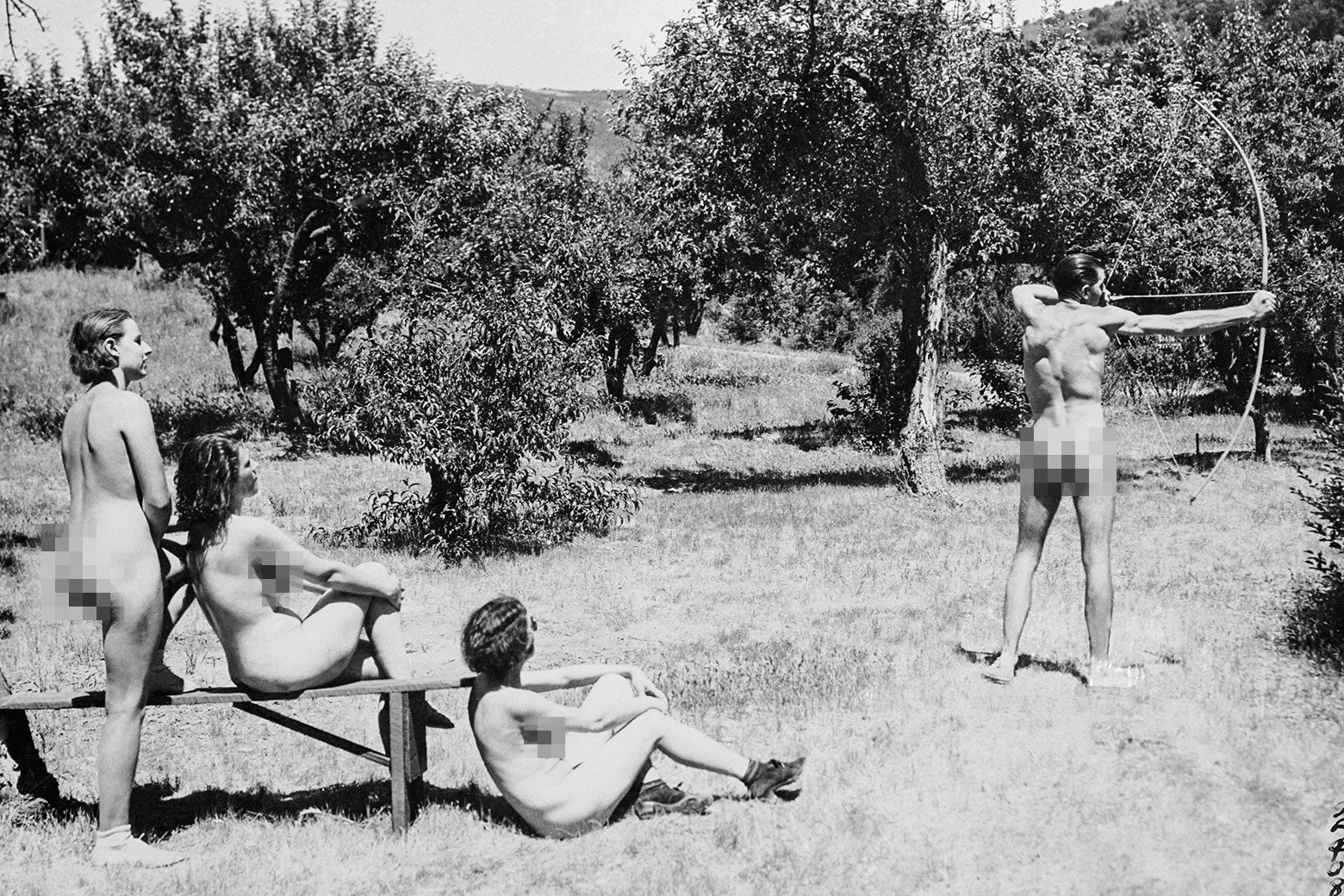
Most people assume the nudist movement started in the ’60s and ’70s as an offshoot of the free-love era, but that was actually just the latest eruption of a perennial urge that dates back to the late 1800s, when traditional agrarian societies gave way to the Industrial Revolution. As sickness and misery filled the tubercular and coal-choked cities, and World War I laid 20 million people to waste, the Machine Age began to look like a colossal mistake.
In response, millions of people, most of them young, renounced the whole thing. They fled the constrictions of Victorian and industrial culture and formed communes in the countryside where they could live free of the ills of civilization, which included politics, war, capitalism, class, marriage, industrial diets—and clothes. “Nudity Equals Truth,” went one motto.
In Germany, the country industrializing the fastest of all, the association of nakedness with health went mainstream, and freikörperkultur (“free body culture”), or FKK, became a kind of national religion. Whole families took to parks or the seaside for nude calisthenics, and many beaches and city parks set aside FKK zones. Today, the famed FKK sign marks nude zones across Europe.
Nudity took off in the U.S. as well, often seeded by German immigrants who were drawn to the clothing-free possibilities in gentle climates like California. By the 1920s, Philip Lovell, the health columnist for the Los Angeles Times, was preaching the value of flat, open roofs where one could “bask nude in the sun for hours at a time.”
“In a way it is like a drug,” the writer and nudist Stuart Chase confessed in the Nation in 1929. “The after-effects are a sense of well-being, of calmed nerves, of inner vitality.” He went on: “If the republic wants to go native and can hold to it with any fidelity, it will probably do more than any other conceivable action to balance the inhibitions and pathological cripplings induced by the machine age and the monstrous cities in which we live.”
That same year, the American League for Physical Culture was founded in New York. Its members, male and female, met at a private gymnasium on 15th Street to work out in the nude together. That brought the attention of the vice squad, for whom nudity did not equal truth. On Dec. 7, 1931, detectives climbed to a nearby rooftop and peered through a skylight at ALPC members doing calisthenics, then raided the building and arrested the ringleaders for public indecency.* The resulting trial scandalized the nation and brought organized nudity into the public eye, but the judge threw out the case, famously ruling that since the activity had taken place in a private space, it wasn’t public, and since the participants were all consenting adults, it wasn’t even indecent.
But the raids kept coming. For a certain segment of the public, nudity was the creepy camel’s nose under the tent, and the so-called sex fiends had to be stopped. In 1933, police arrested members of Chicago’s Sunlight Club who had gathered in Michigan to escape Illinois’ more draconian anti-nudity laws, and the Chicago Tribune published telephoto images of “nude cultists shown enjoying themselves.” This time, the prosecution stuck.
In 1935, police arrested 27 nudists at a private home in Denver and charged them with indecent exposure and contributing to juvenile delinquency, since there were several children present in the home. In response, the group bought 160 acres in the Colorado countryside, farther away from prying eyes, and continued as the Colorado Sunshine Club.
Through the 1930s, nudist clubs maintained a utopian, anti-industrial impulse, but that spirit got crushed by World War II and the suspicion of socialist causes that followed, says Troy Peterson. “So how does nudism adapt?” he said. “It becomes a lodge. A club. Like being part of the Elks or something.”
It worked, giving a certain segment of the post-war generation exactly what it was looking for. “There was a surge in membership,” says Nix. “America was booming, and there was a growing leisure class with automobiles. People could drive out to these rural places and visit them.” Nudist resorts sprung up in almost every state, mostly in increasingly remote places.
As in Germany, the emphasis was on families and healthy living. People who had attended nudist resorts as children often continued to do so as adults with their own families. But that changed in the latter part of the 20th century, as increasing sensitivity to child exploitation made people uncomfortable with the idea of unclothed children in public settings. By the time several individuals had been prosecuted for illicitly filming children at nude resorts, many resorts were going adults-only to avoid possible litigation, and many nudists stopped bringing their kids even if they were allowed. With the multigenerational chain broken, nudist memberships began aging fast—which made them even less appealing to younger cohorts, who aren’t looking to party with grandma and grandpa no matter what they’re wearing.
To convince the outside world of the wholesomeness of the lifestyle, the nudist community has long emphasized its nonsexual nature. But ironically, today that may actually limit its appeal. When I reached out to a few of the under-35s I knew to see how their perspective might differ from my fiftysomething take, I got an earful. “I’ve never even considered going to a nudist colony,” one woman told me. “It just seems like old-people shit. I don’t get the point. No sex, and you’re cold? As a millennial, I’d rather go to a sex dungeon.”
Indeed, even as nudism has faded, swinging—broadly, couples who have sex with other couples, often in public—has boomed. It’s now a $10 billion industry with millions of practitioners in the United States, many of them young. Some traditional nudist resorts have tried to save themselves by throwing themselves open to swingers, but that tends to alienate an old guard who doesn’t welcome humping in the hot tub. Glen Eden maintains a no-swing policy. “I can spot those guys a mile away,” Glen Eden’s general manager, Art, told me. In order to get into Glen Eden, you have to sign an agreement swearing that you will behave like a monk, and Art and his team enforce it. “I’ve kicked out a lot of people for bad behavior. You know, if you’re a man and you get an erection one time, it’s fine, that’s gonna happen. Just cover it with a towel. But if it keeps happening, you’re out of here.”
No matter how carefully resorts watch for creeps, the perception that they are lurking at every nude venue likely keeps some younger people from participating. “As a woman, trust and feelings of safety where nudity and sexuality are concerned is complicated,” another millennial told me. “For millennials and Gen Z and younger, we have so much statistical data about predators. It’s hard to ignore, even if reassurances of safety and comfort are provided.”
Others I spoke with speculated about a growing discomfort with real bodies and real physicality in the era of digital image curation. Locker rooms are being redesigned to avoid having to be naked or see anyone naked, reinforcing the message that the casual nude body is potentially offensive. Meanwhile, the number of young adults leading sexless lives is at an all-time high, essentially doubling for men in the past 10 years. The rate of teen pregnancy turned downward in 2007, the same year the iPhone was released, and has been in a death spiral ever since—good news in itself, but another sign that the smartphone generation may have lost interest in embodied experiences. When you spend a staggering nine hours per day on screens, who has the time or inclination to get physical?
But when Nix posed this question on a nudist Discord channel, the overwhelming response from under-35s was that online nudity was no substitute for real communal nakedness. Online nudity, wrote one, “fills a stopgap, but doesn’t land close to the reality of in-person.” Internet porn, wrote another, just instilled “a deep sense that this was a perversion of something better.” One 33-year-old I asked said, “Because I have at my fingertips a billion images of naked bodies, there’s a point at which they become commonplace, not special. What is special is the physical, imperfect body, the one not posed for perfection. There is something so endearing about that.”
In fact, there are plenty of signs that some members of Gen Z are willing to toss their phones and clothes into the corner when the context feels right. Nude bike rides, yoga classes, and burlesque shows have surged in popularity. Burning Man knows no inhibitions. In Germany, ground zero for imploding nacktkulture, the Naked Tea Party’s monthly dance nights, workshops, and sauna sessions (yes, always with tea) sometimes sell out weeks in advance. The crowd is young, diverse, cosmopolitan, and not looking to play shuffleboard.
And they are urban—which most nudist resorts decidedly are not. “I think one of the biggest barriers to bringing in young people is geography,” Peterson told me. “The resorts are beautiful, but they’re in the middle of nowhere.” They were built for a suburban population with plenty of cash and cars, maybe even an RV, and free weekends—a bygone world. “Young people can’t get out here. We can’t afford to come out here!”
The young nudists on Discord agreed. “Cost and access are definitely issues for me and others my age,” wrote one. “Many of us want to go to naturist events but lack the means to do so regularly.” “Most young naturists like myself are focused on survival,” said another. “Naturism is a luxury, unfortunately.”
Sadly, that leaves only aging boomers to float the boat of the remaining resorts, and that has left the finances of many nudist clubs in peril, said Mark Baird, the Disrobed producer, a money guy who is also on the board of directors of Star Ranch, a large nudist resort in Texas. “You’ve got two kinds of models of ownership for these clubs,” he told me. “Either they’re privately owned, like Cypress Cove in Florida, which is on its third generation of family ownership, or they’re member-owned, like Glen Eden. By far the most popular model is the small family-owned club. What happens is somebody’s fairly successful in their life, and they have some money and they love nudism, and there’s not a great club in their area, so they go out and buy a plot of land and start one. But as they age, and get into their 70s, they don’t want to be dealing with people. They just want to be relaxing and enjoying the grandkids. So they look around for somebody to sell to, but at that point, the place is worth $1 million or $2 million, and the underlying real estate is probably worth more. And they really don’t want it to go to a developer, because they started it to be a nudist club, but their kids aren’t interested, and there’s no one to take it over.”
So it does go to a developer, who quickly looks to maximize the investment. Out with the nudists, in with the high-end normies. The remaining nudists regroup around the handful of member-owned clubs, like Glen Eden, or nudist-zoned communities like Pasco County, Florida’s self-described “nudist capital of the world.” But as their membership continues to age, the sun is setting on them all.
My last day at Glen Eden, I find the hiking trail behind the cactus garden and follow it through an oak forest and up the ridge that guards the western flank of the resort. Thin snakes squiggle out of my way. A startled coyote melts into the brush, looking back over its shoulder to size me up.
It’s spring, and the hillsides are flushing purple and orange. I climb through fields of yellow brittlebush. Tiny white flowers carpet my feet. It feels dreamy to be climbing through the colors in the cool air, the morning sun basting your backside. D.H. Lawrence would be proud. It’s a shame so few people will ever know the feeling.
Just before the ridgeline, I hit a trail sign that says “No Nudity Past This Point.” Over the ridge lies Textile World. I turn and look out over Glen Eden to the sprawl beyond. The I-15 traffic creeps north toward a sea of houses rolling all the way to L.A.
From the heights, the resort looks like some sort of fortified settlement, the clusters of trailer homes ringed by earthen berms, just the one guarded gate near the highway for access. The forested hills to the east are being stripped bare by a squad of bulldozers making way for more homes.
I can see a few senior citizens ambling around the pickleball court and somebody doing early laps in the pool. They’re fine for the moment, but there’s no way out for them. The barbarians of capital will keep circling, tightening their grip, until they pour through the gate and redevelop every square inch into something with more return on investment than human beings who enjoy their own skin.
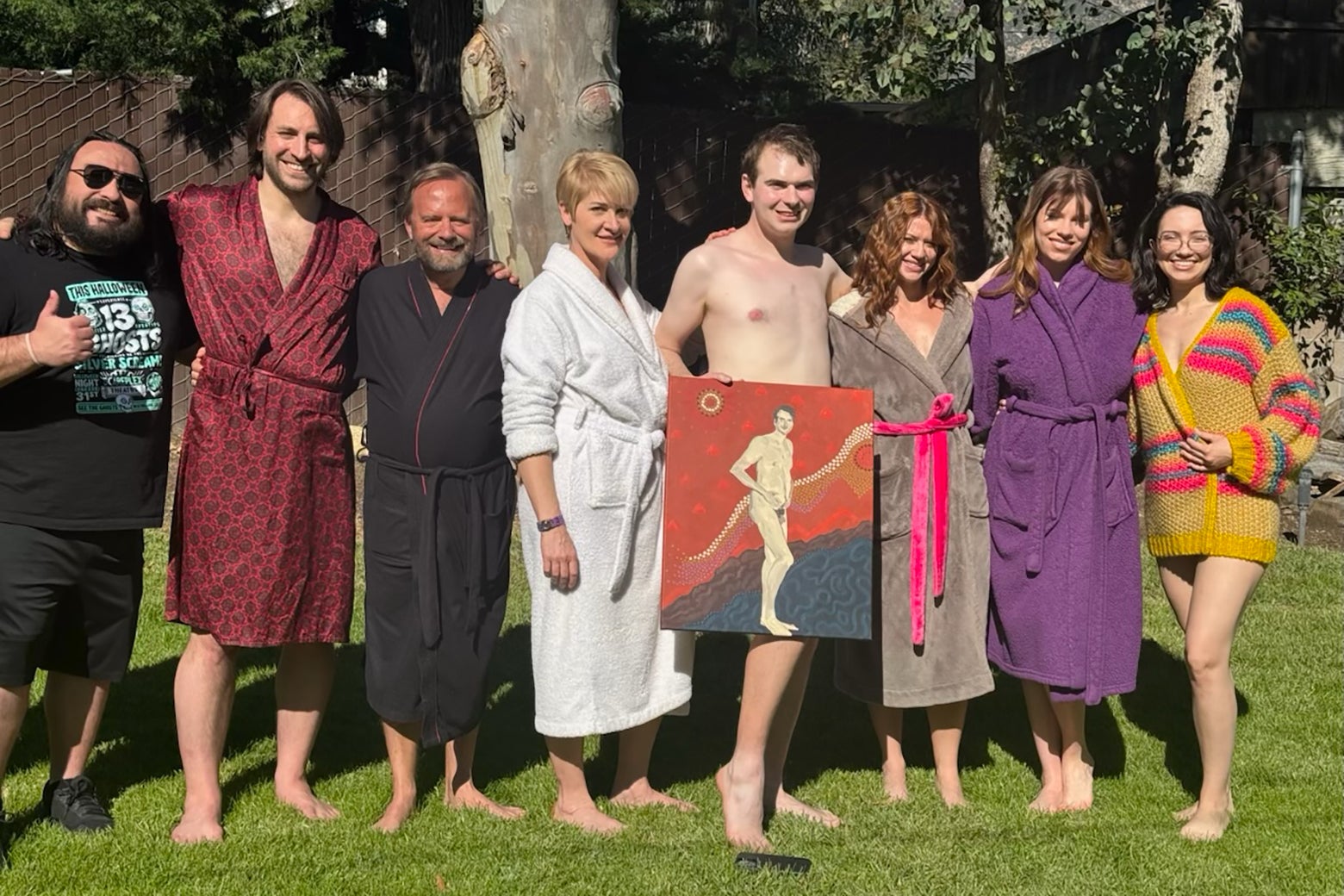
That night, we shoot the climax scene of Disrobed, which occurs at a talent show at the nudist colony. Peterson’s character, Eric, gets pulled onstage with his fiancée’s family and desperately tries to hide his junk behind a guitar. When a group photograph is called for, in front of the audience, he melts down, confesses that he’s no nudist and never will be, and leaves. The wedding is off, tears are strewn … and you’ll just have to see it to find out what happens after that.
As an extra, I get placed in the back of the room at a cabaret table between an L.A. actor and comic named Thalia and a guy named Dog who has a brushy white mustache, like an aging walrus. He looks a bit like Mr. Monopoly. Until the previous week, his claim to fame was that he can be seen in the background in the strip club in Showgirls when Elizabeth Berkley is giving Kyle MacLachlan a lap dance. That changed a few days ago, when he appeared passing a window in the season premiere of Vanderpump Rules and blew up as “The Vanderpump Rules Mustache Man” meme, with people posting photoshopped images of themselves sporting driving caps and luxurious white staches. Now he’s savoring a turn as the nude camp photographer in Disrobed and wondering where his career might take him next.
For the next four hours, we mug our way through multiple takes of broad reaction shots. We laugh as Thalia bounds onstage and delivers a raunchy joke. We applaud as Eric is pulled onstage and hides behind his guitar, pretending he knows how to play it. We wince as he makes it shriek. We watch Dog shuffle toward the stage in exaggerated slow motion, an old-school point-and-shoot in his hand. We stare in confusion, then horror, as Eric falls apart onstage.
But mostly, we dance. Ian Hayes’ character takes the guitar from Eric and plays a song at the talent show, which Hayes, a musician in real life, had written for the movie. “We are all the same,” he sings, “we were born this way. Meant to feel the sun and rain fall down.”
“No matter what they say, it brightens up my day. When we let it all hang out.”
Rock out, we’re told, and we do. Fifty unclad humans, ages 22 to 88, jump in place and spin around and pump our arms over our heads to the beat. Hey, hey, hey, disrobed! We grin and laugh at each other, because how could we not. We do it again, and again, fully embodied deep into the silky night, until we’ve done it for so long that we forget there is any other way to be.
Correction, April 30, 2026: This article originally misstated that the police raid on the American League for Physical Culture occurred on Sept. 3, 1931.