When the AI chatbot ChatGPT initially launched in late 2022, it quickly became the subject of much debate. Depending on who you ask, the technology is either going to revolutionize everything for the better or accelerate our very downfall. But no matter where you stand, you’ve probably used it once or twice—maybe even on a daily basis, asking it to proofread your emails. That convenience, however, might come at a risk. According to a new study led by MIT researcher Nataliya Kos’myna, using ChatGPT appears to have a negative impact on how we learn.
In a lengthy conversation with astrophysicist Neil deGrasse Tyson on his StarTalk podcast, Kos’myna discusses her recently published paper, “Your Brain on ChatGPT,” which focuses on an experiment involving 50 students from the greater Boston area. They were divided into three groups—one using ChatGPT, one using Google, and one using only their brains—and asked to quickly write essays on “high-level” topics like “What is happiness?”, “Is there a perfect society?”, and “Should you think before you talk?” EEG headsets monitored their “brain functional connectivity,” and follow-up questions documented their thoughts on the process. Later, the students swapped places with other groups.
“Brain functional connectivity”
This form of brain activity essentially looks at “who talks to who in the brain.” Kos’myna gave the example of deGrasse Tyson doing an interview without notes: “Really, your brain [is] on fire, so to [speak],” she said. “‘OK, what was her name again? Where was the study? What is happening?’ You need to really push through with your brain.” The study ultimately found that connectivity is “significantly higher” for the brain-only group, compared to the two others, with the ChatGPT group showing the least.
“The brain doesn’t really struggle when you use this tool, so you have much less of this functional connectivity,” she said. “But what is, I think, interesting [is that]…first of all, what we found is that the essays were very homogeneous. The vocabulary that was used was very, very similar for the [ChatGPT] group. It was not the case for the search-engine and for the brain-only group.”
Equally interesting were the students’ follow-up responses, given 60 seconds after submitting their essays. They were asked to provide a quote of any length from their writing, and 83% of participants could not offer a single line—marking a discrepancy with the other two groups. In addition, 15% of the ChatGPT users said they didn’t feel any “ownership” over the work. “I think that’s where it actually gets really tricky because if you do not feel that it’s yours but you just worked on it, does this mean that you do not care?” Kos’myna asked. “We didn’t obviously push it that far in the paper, but I think this is something that definitely might require much further investigation. If you don’t care, you don’t remember the output, you don’t care about the output, what ultimately is it for? Why were you even here, right?”
“Cognitive load”—but hopefully not overload
It ultimately all comes back to “cognitive load.” “The whole idea,” the researcher says, “is that it’s how much of the effort you would need to be on the task or to process information in the current task.” And that load, Kos’myna argues, is essential to the learning process. We need our brains to work hard, to be pushed to some degree, while also avoiding cognitive overload. “Information [that is] already delivered to you within 30 seconds or 3 seconds or 10 seconds, and you haven’t really struggled, there is not a lot of this cognitive load,” she says. “A lot of people would say, ‘Oh, that’s awesome. That’s kind of the promise of a lot of these LLMs [Large Language Models] and a lot of these tools.’ But we do not want to make it too simple, right? We do not want to take away this cognitive load…I know it sounds like, ‘Cognitive load? Don’t we want to take it away?’ No, we actually do not want to take it away.”
It’s worth spending some time exploring the actual study. In the conclusion, the authors write, “The LLM undeniably reduced the friction involved in answering participants’ questions compared to the Search Engine. However, this convenience came at a cognitive cost, diminishing users’ inclination to critically evaluate the LLM’s output or ‘opinions’ (probabilistic answers based on the training datasets). This highlights a concerning evolution of the ‘echo chamber’ effect: rather than disappearing, it has adapted to shape user exposure through algorithmically curated content.”
As numerous articles have noted in recent years, ChatGPT is likely here to stay. The question, clearly, is how we make the best use of it while keeping our cognitive load at the right level.
-

When Fredrick Njoroge Kariuki of Kenya turned 12 in 2021, he experienced incredible difficulty breathing. Doctors diagnosed him with bronchitis, explaining that his coughing and breathing issues were connected to the thick layers of exhaust fumes emitted by vehicles in the area. Five years later, the teenager teamed up with his classmate Miron Onsarigo to create an award-winning, inexpensive filter made with agricultural waste.
While air pollution is a global concern, it is particularly an issue in Kenya. A 2024 study found that Nairobi, Kenya’s capital, had 3.7 times higher levels of particulate air pollution than the World Health Organization’s guidelines. This doesn’t just contribute to illness like Kariuki’s bronchitis. Experts estimate that the country’s air pollution is responsible for 400 to 1,400 premature deaths in Nairobi each year.
The global environment issue was personal
Both teens were hardened in their resolve to tackle this air pollution problem largely caused by the matatus (shared minibuses) and boda bodas (motorcycle taxis) common in urban areas.
“The problem of air pollution was very personal to us, and that is why we started thinking about coming up with a solution,” Kariuki told Mongabay. “It was a passion before it became a project.”
“I did not choose this problem. It chose me,” Kariuki said to Daily Nation. “Growing up in Naivasha, my bronchitis got so bad that I stopped thinking of air pollution as an environmental issue and saw it as something being committed against us.”
“Seeing people get sick as a result of fumes from vehicles has become normal back home in Kisumu County. The ‘normal’ did not feel right to me. I wanted to do something about it,” added Onsarigo.
Using waste products to clean the air
With time, intelligence, and hard work, Kariuki and Onsarigo created the HewaSafi vehicle exhaust filter. The HewaSafi, which means “clean air” in Swahili, was made using locally sourced agricultural waste. The entire mechanism is made from steel mesh, copper, corn cobs, coconut shells, recycled batteries, and algae. All of these components help further filter out particles in the air straight from the exhaust pipe.
The results of the HewaSafi were impressive. The device reduced particulate matter in the air by 93.3%. The HewaSafi also reduced carbon monoxide by 42% and absorbed 21.4% of CO2 that would otherwise be released into the atmosphere.
Since the device was made using waste products, the HewaSafi manufacturing cost is around $126. By comparison, conventional filters of this sort typically cost around $390. So, not only is this filter effective, it’s cheap enough for more people to use.
A prize that leads to further opportunity
The ingenuity of these two 17-year-olds won them the 2026 Earth Prize for Africa. They received $12,500 for their regional win and global attention to the HewaSafi.
The teens hope to use the prize money and attention to further develop the HewaSafi. Using connections made through the Earth Prize, they aim to start a full line of emission control products. While they want to work with people with different budgets, their main target is to specifically cater HewaSafi filters toward public transportation vehicles.
-
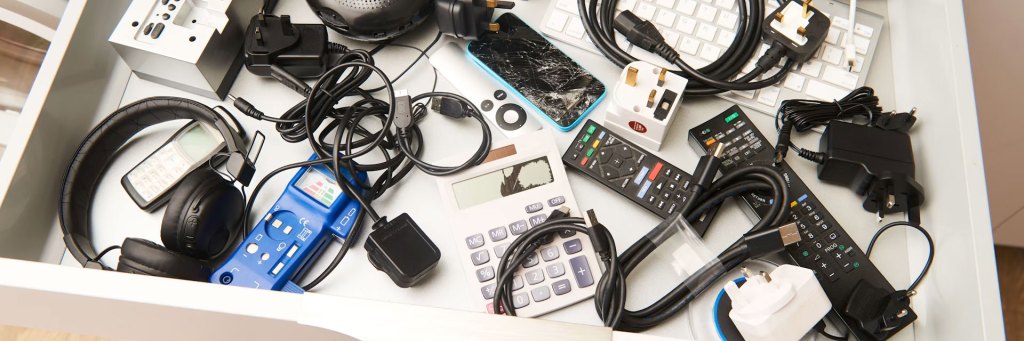
Think about the last smartphone, tablet or smartwatch you stopped using. Odds are it is not in a recycling bin or a new owner’s hands; it is sitting in a drawer.
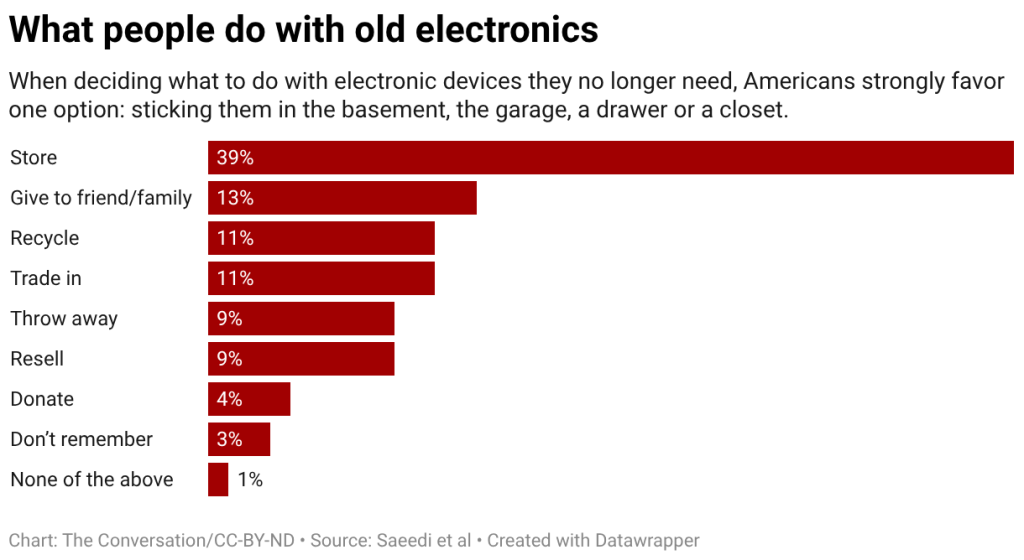
From our survey of 4,000 American consumers, we found the single most common thing people did with a device they were finished with was nothing at all: 39% simply stored it. Recycling and reselling, outcomes better for the environment, each accounted for only about 1 in 10 devices. Throwing devices in the trash claimed another 9%.
Funded by the National Science Foundation, our multidisciplinary team blended our expertise in causal inference, sustainability and cybersecurity, to work on the tangled question of what people do with their consumer electronics when they’re done using them. We used statistical models to connect what people say – that is, their stated knowledge and attitudes – to what they actually did.
Why the drawer wins
Two main forces keep devices in the drawer. The first is anxiety about data. People who worried that recycling or reselling a device would compromise their data were 14% and 9% more likely to store it instead.
The second force is simply not knowing how to. People who did not know where to recycle were 10% more likely to hold onto a device, and many also kept old gadgets as a perceived data backup.
Recycling and reselling electronics are a lot easier than a lot of people think. In the U.S., the national chain Best Buy accepts devices for recycling; reselling online is convenient with vendors such as Back Market and Gazelle.
Just be sure to wipe data before parting with a phone or computer. Also, remove the device from your account, for instance with Apple or Android. Unless you do, the device stays locked to you, and no one else can use it.
We also compared what people intended to do with what they had actually done. This led to a telling detail: Data security worries led to people storing devices at a greater rate than they said they intended to.
In other words, the fear of leaking personal data kicks in only when someone is facing the real decision of whether to hand off their device to a recycler or secondhand buyer.
Getting at why people don’t recycle
Researchers have long studied why people do or don’t recycle electronics: Convenience, awareness and incentives showed up as affecting the decision. But prior work examined recycling as the only option.
Instead of considering the issue as a yes-or-no vote on recycling, we treat it as a comparison between different options: Storing, reselling, donating, trading in, recycling and throwing away the device in the trash. When modeling this way, trade-offs became visible.
Knowing where to recycle, for instance, made recycling 47% more likely, but it also pulled people away from reselling, which is often the more environmentally friendly choice. You can explore the survey results in our interactive dashboards.
Getting people to let go
Storage is the worst of both worlds: A device sitting unused for years loses its resale value, and erasing its data only gets harder over time. The good news is that the main barriers – data concerns and not knowing where to turn – can be addressed with better information.
We are experimenting with information interventions that walk people through their options, including how to securely wipe their data. We are testing nudges with randomized, controlled trials to test what leads people to give their old electronics a second life.
It might be a good time to remember what old devices you’re holding onto and revisit your reasons for not letting go of them.
This article originally appeared on The Conversation. You can read it here.
-

Photo credit: Spencer Platt/Getty Images – Many U.S. apartments have individual heating and cooling systems that are less efficient than current technology.
People who rent their homes, or don’t have enough money to make major upgrades to their homes, have for many years been left out of a major shift in heating and cooling technology that can improve efficiency, save money and be better for the global climate: heat pumps.
Heating and cooling buildings consumes 35% of all the energy used in the United States each year. Many homes and businesses are converting their fossil fuel-powered heating and cooling systems to electric-powered heat pumps, which use electricity not to generate hot or cold air but to move heat into spaces needing warmth and out of spaces needing cooling.
Until recently, that process has required a significant amount of sizable and expensive equipment to be permanently installed in a building, which needs a professional contractor and can cost as much as US$10,000 just for the installation – in addition to the actual equipment. Often called mini-splits, these systems usually have a condenser outside the building that exchanges heat with the outdoor air and an evaporator inside that exchanges heat with the indoor air.

The New York City Housing Authority has been installing window-mounted heat pumps in apartments, like this one in Queens. AP Photo But now window heat pumps are becoming available in the U.S. Much like a window air conditioner, these self-contained devices can be installed without professional help and plugged into a wall outlet. Unlike window air conditioners, though, they can provide heat as well as cooling. They cost much less than a permanent system – between $3,000 and $4,000 – and can be moved to a new property if the owner relocates.
There aren’t many options commercially available yet, and those on the market can’t heat or cool very large spaces on their own. And they work less efficiently when heating homes in places with extremely cold outdoor temperatures. A few models are available on the market that are even cheaper, but they don’t have efficiency ratings, don’t work when outdoor temperatures are very cold, and are louder when running.
I have designed and evaluated a wide range of building energy efficiency technologies; here’s how these window heat pumps work, and why they may allow apartment dwellers and residents of older houses to easily and relatively inexpensively make significant improvements to their homes’ heating and cooling systems. Federal subsidies for this type of equipment expired in 2025, but some utility companies, states and local governments may still offer money to help pay the costs.
Moving heat from one place to another
Heat pumps use a reversible refrigeration cycle and can provide similar heating and cooling as electric-powered space heaters, furnaces and baseboard heaters, while using less than half the electricity.
The most common heat pumps transfer heat between air indoors and outdoors, but other systems can exchange heat with the ground or with bodies of water, such as lakes.
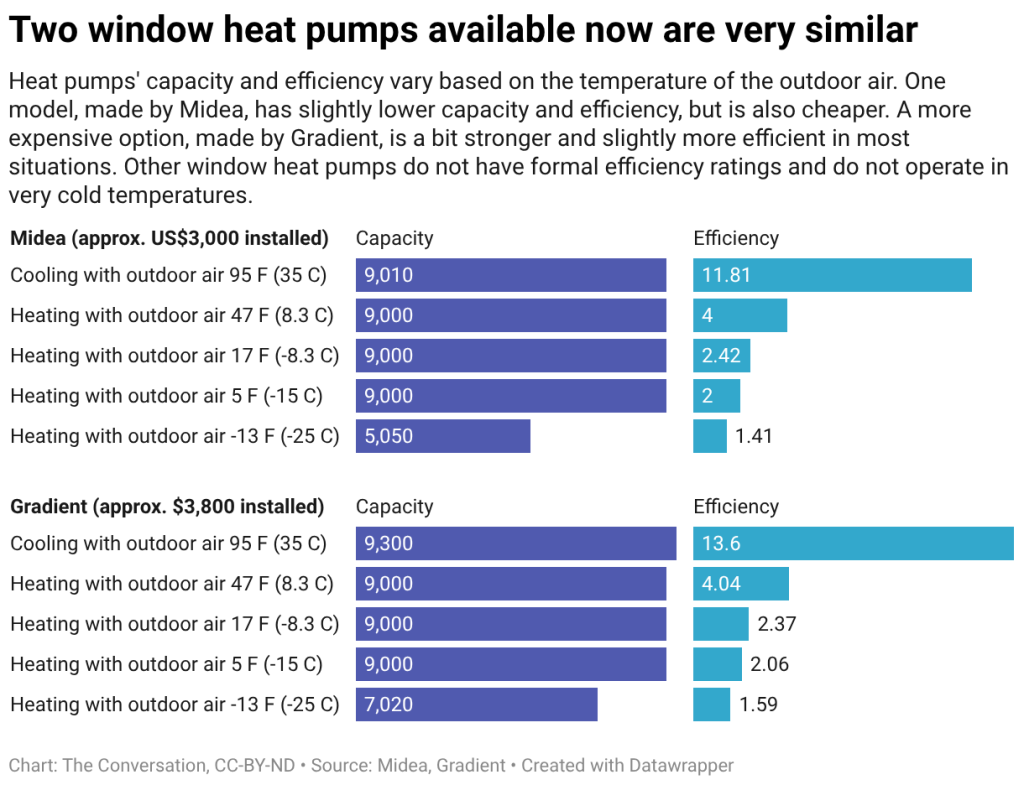
Heat pumps’ capacities are defined by the amount of heat they can transfer in a particular period of time. A heat pump serving an entire home may need a capacity of 12,000 to 60,000 British thermal units (about 12,660 to 63,300 kilojoules) – but the window units’ capacities are much lower, getting up to only about 9,000 Btu (9,500 kJ).
Performance varies based on the conditions outdoors, where the unit is either sending excess heat to cool the indoors or gathering heat to warm the indoors. In cooling mode, heat pumps are rated by their seasonal energy efficiency ratio, a figure that indicates how much cooling is achieved per unit of electricity used. The corresponding measurement for heating is called heating seasonal performance factor. In general, the larger these numbers are, the better they will perform. The U.S. Department of Energy has established minimum standards for those figures.
While these units operate even when outdoor temperatures are -13 degrees Fahrenheit (-25 degrees Celsius), their heating output is reduced to almost half of its rated capacity, and their energy efficiency falls to one-third of its rated performance at that temperature.
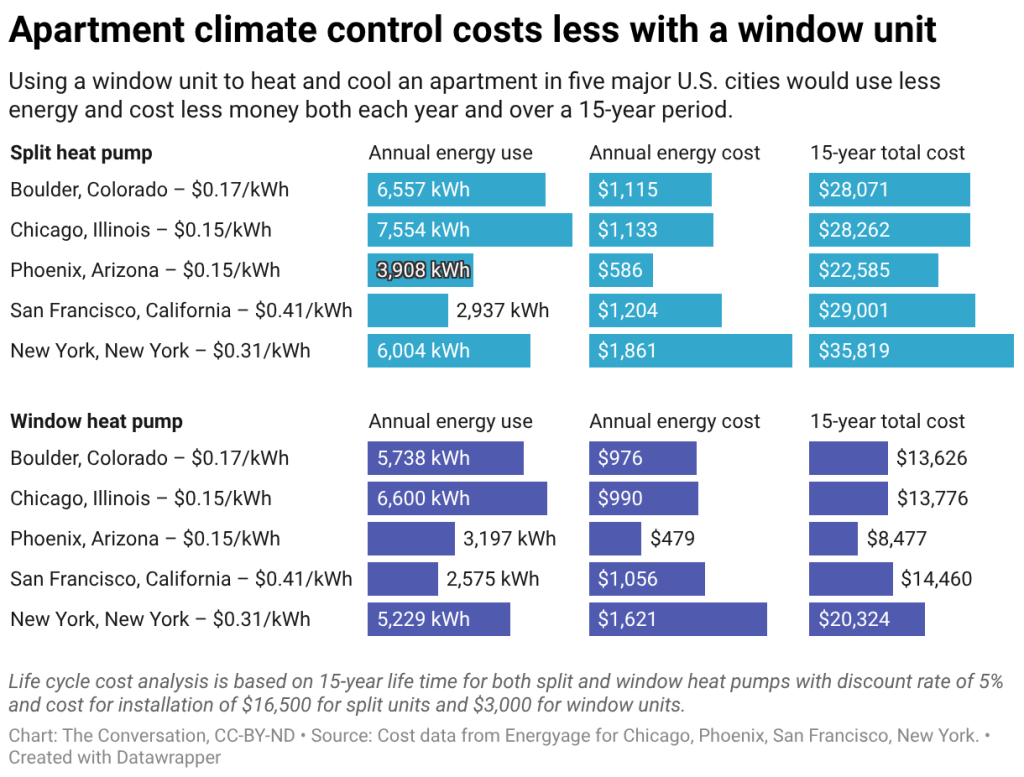
In addition to their low cost compared to conventional split heat pumps, packaged window heat pumps meet heating and cooling needs with lower energy demands and costs. But each window unit serves just one room, while a more common split unit can serve multiple rooms.
Packaged window heat pumps are easy and inexpensive to install and offer all-in-one heating and cooling options for apartments and older homes, with higher energy efficiency performance than traditional systems. Their main limitations include their low capacities and reduced energy efficiency in extremely cold climates or conditions.
This article originally appeared on The Conversation. You can read it here.
