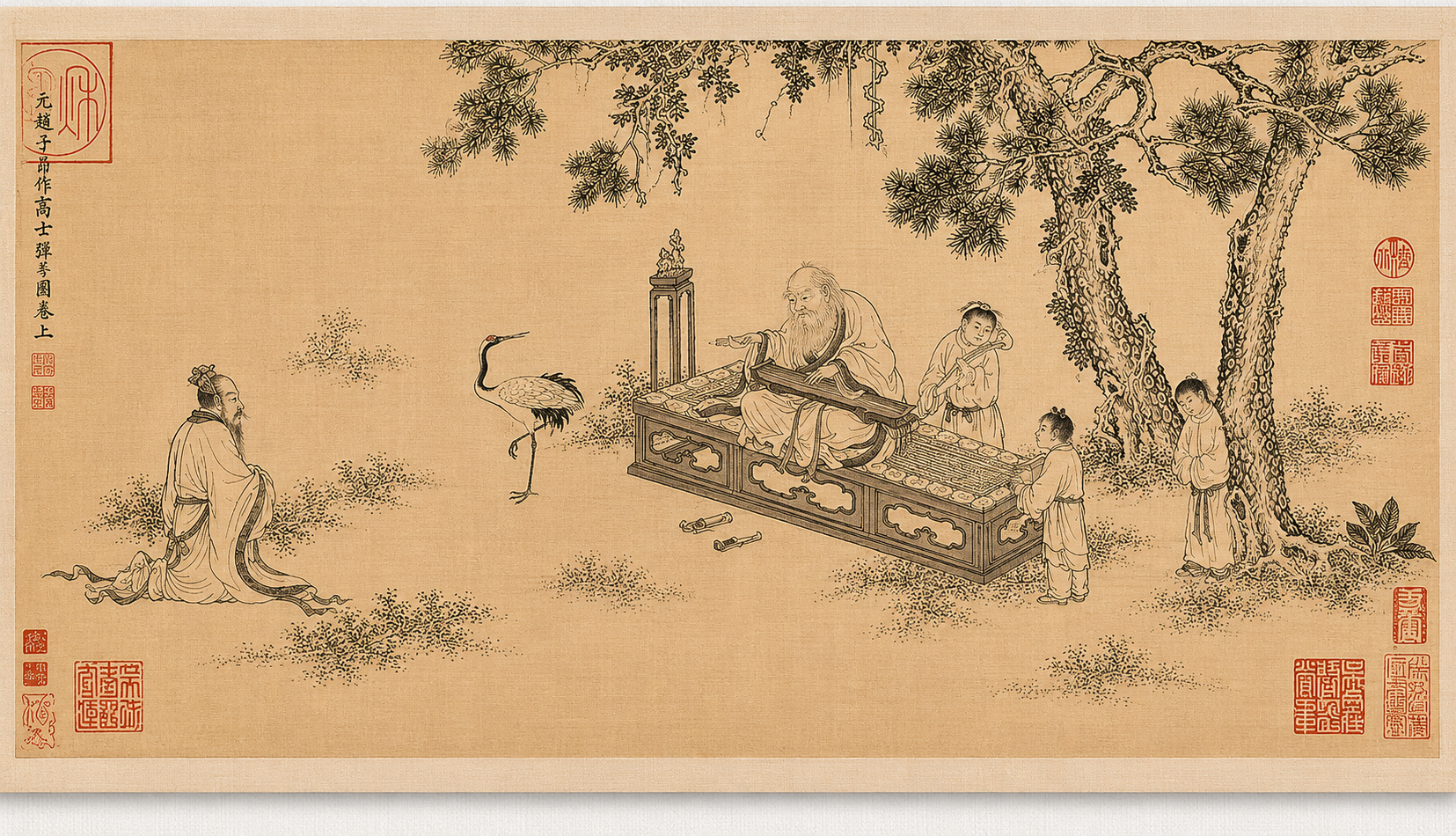
Laozi delivering the Daodejing public domain via Wikimedia Commons.

The Tao Te Ching tells us how we can embody ancient Chinese spirituality and philosophy for a calmer, better self. In an accessible translation of Laozi’s Tao Te Ching by David Bentley Hart, understand the key principles behind Taoism, perfect for long-time Taoists or if you’re new to the spirituality. By learning about the Way and the Power, see how to surrender control of other’s actions and enjoy permission to focus solely on yourself. This essay shows the importance of Taoism and Daoism to allow you to lead your own way out of the darkness.
David Bentley Hart—
There is no way of characterizing the chief import of the Tao Te Ching (or Daodejing) that will not excite some emphatic disagreement or another from someone who believes he or she has a better grasp of the text. This is perfectly fair, in part, because the book is genuinely mysterious in the understanding it offers of its two guiding concepts: the Way and the Power (or Virtue); both are invoked again and again but are defined in terms largely pictorial and practical rather than conceptual or metaphysical. Then there is the vexed question of the purpose of the text, which is made all but impossible to answer with certainty by virtue of the obvious heterogeneity of its contents; it may be ascribed by tradition to Laozi, but it is clearly a compilation and, in all likelihood, redaction and revision of aphoristic or oracular sources emanating from various places and times in Chinese antiquity. More to the point, there is an old tension between those who read the text principally as a spiritual and even mystical work and those who read it as a manual of statecraft whose recommendations of such things as humble self-effacement and a willingness to yield are just counsels of policy and strategic cunning.
The truth is that it is almost certainly both of these things: a philosophy of nature and the soul and a program of judicious governance. It is only a prejudice that tells us that a political treatise can employ a spiritual grammar only cynically and dissemblingly, or that a book of spiritual wisdom cannot venture political principles without corrupting its own moral message. That the mystical and the pragmatic are not at odds with one another is one of the chief lessons of the book, inasmuch as the Way and the Power are commended to us in its pages not only as the static structures of reality, but as the vital spiritual principles by which anything and everything—from a river seeking the ocean to a nation seeking peace—achieves its intrinsic end. There is one Way that is the proper course of all that lives and from which all things flow and one Power that animates and perfects all things, and they together are at one and the same time the dynamisms of nature, of practical endeavor, of social and political life, and of spiritual truth.
The essential question of the text, perhaps, is whether it identifies a single principle (at once metaphysical, cosmological, moral, spiritual, practical, and political) in which all the spheres of conduct and philosophy we might be in the habit of keeping separate in fact coincide. And the answer is that there most certainly is: the principle of the refusal of mastery, whether of nature or of other persons or even of one’s own self and possessions. This is the one recurrent and plangent leitmotif sounded again and again throughout the eighty-one chapters of the text. It makes even the most calculating of the book’s political and martial axioms subordinate to an ethos of selflessness, humility, and even love. The book often portrays this ethos as “feminine” and “maternal,” and even urges princes—in a time and place when all coercive power lay in the hands of men—to renounce the “masculine” and patriarchal habits of mastery in order to adopt instead attitudes of nurture, gentleness, suppression of the ego, and patient concern. At one point, it obliquely likens the wise prince to a mother bird sheltering her nest.
However one characterizes it, the virtue that the Tao Te Ching unremittingly promotes as the essential truth at once giving rise to and sustaining Heaven and Earth, suffusing all living things with Vital Spirit (chi, xi), and guiding every wisely governed society and state is that of “giving way”: “not striving,” “not contending,” accepting rather than imposing, allowing things to unfold out of their true natures rather than attempting to force them into alien and factitious shapes. I find it hard not to see an analogy to “the Way and its Power” in, say, Meister Eckhart’s principle of Gelassenheit—“letting be” or “letting go.” This is not, either in the Tao Te Ching or in Eckhart’s theology, some counsel of blessed indolence or simple withdrawal from human affairs. Rather it is a moral and spiritual imperative to allow what is at once other than oneself and yet the deepest truth within oneself to come forth into the light of being, arising from the Earth (di) and under the canopy of Heaven (tian), rather than attempting violently to craft reality according to one’s own ambitions, or even according to one’s own inflexible sense of how things ought to be. That is not a moral maxim in the sense of a single law to which one must remain obedient, or even a maxim in the more universal and abstract sense of Kant’s categorical imperative. It is instead, again, an attitude, a disposition of the soul toward all of reality whose practical working out in the course of one’s life — private or shared —will reveal itself only as one continues to adopt it in every situation. This is as it should be, given that the text announces in its very first lines that the Way that is the source of everything is in itself nameless and so beyond rigid conceptualization. Simply enough, it is indeed a way, not an abstract table of laws or taxonomy of substances, and a way is only truly understood in being followed. For what it is worth, to me this is a moral and spiritual truth that becomes more precious and luminous the more one seeks to live it out. To those who prefer a strict set of rules, it might seem infuriatingly vague. But I can attest, to the contrary, that this is not so. I undertook the translation of the Tao Te Ching during a period of considerable personal darkness, and the labor proved to be itself a path—a Way—out of that darkness and toward the light.
David Bentley Hart is a philosopher, scholar of religion, writer, and cultural commentator. His books include All Things Are Full of Gods; The Experience of God: Being, Consciousness, Bliss; and Roland in Moonlight. He is a collaborative researcher at the University of Notre Dame.