The U.S. military banned slot machines from domestic bases in 1951. But that hasn’t stopped gambling on American military bases overseas, where slot machines continue to operate through the Army Recreation Machine Program, part of the Morale, Welfare and Recreation program.
Overseas, the Pentagon has been running a gambling operation that generates about tens of millions each year.
In 2017, a Government Accountability Office report on the Department of Defense warned of the risk of gambling disorders among servicemembers. In 2024, the Data Liberation Project requested slot machine revenue. Last year, reporter and DLP volunteer Molly Longman analyzed that data and wrote about both numbers and the risk of servicemembers developing addiction for WIRED.
While the DLP’s requests produced over a dozen reports and hundreds of pages of data on the slot machines, much of that remained trapped as tabular government data stored in pages of PDFs, inaccessible for anyone who would want to plug those numbers into a spreadsheet and understand what the numbers mean.
To take up that challenge, MuckRock worked with the BU Spark! Program at Boston University, where two teams of graduate data scientists cleaned, processed and analyzed the reports covering dozens of military bases in Europe and Asia from 2018 through early 2024. The team examined financial statements, asset information and revenue information to determine the trends in revenue generated by the slot machines.
You don’t have to be a data scientist to wrangle numbers out of PDFs but BU Spark! graduate data scientists helped the Data Liberation Project do that and more, while pulling out trends and interesting questions for others to explore in the GitHub repo. In this guide, we’ll cover ways to tackle the challenges buried in hundreds of pages of data and uncover how the military has generated million dollars of revenue from slot machines across the world.
In this guide:
-
Extracting the numbers from pages and PDFs
-
Working around redactions
-
How much civilians spend at American military bases and other lasting questions
Extracting the numbers from pages and PDFs
The primary goal of the students’ work was to turn messy, inconsistent tables into clear analyzable datasets.
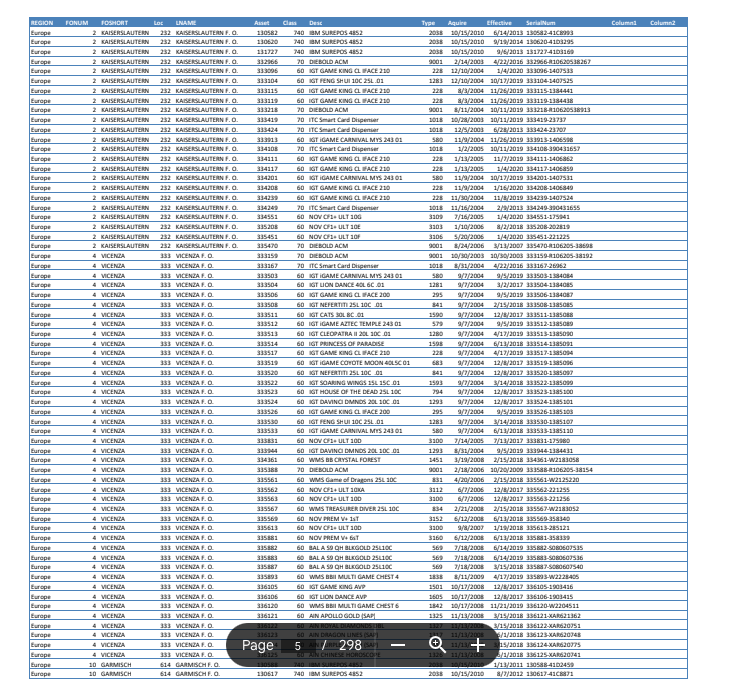
With over a dozen reports, some up to 600 pages and a variety of different formats, the task of extracting data was both programmatic and involved several elbow-grease tasks. This included:
-
Standardizing column names
-
Fixing text formatting issues
-
Converting numbers to the correct data types
-
Parsing all date fields into a uniform format
-
Removing duplicate rows created by repeated tables
-
Correcting common OCR errors
-
Rebuilding any missing totals so data is internally consistent
The students worked in two teams, testing different types of OCR and extracting tables using both MuckRock’s DocumentCloud and Python libraries.
The received dataset was in the form of PDFs containing screenshots of various tables. Both teams employed multiple tools for data preprocessing, including Adobe tools, Python libraries, DocumentCloud and Amazon Textract OCR to convert documents into machine-readable text. The teams then converted these PDFs into reusable CSV files and uploaded the data to Datasette to facilitate geospatial analysis of government revenue.
Team A split each file into categories of formats that appear to repeat throughout the reports. This enabled the teams to then carry out a cleaner analysis of the contents of the file at the individual format level. Lastly, they converted these broken down files into digestible CSVs.
Team B worked through a similar process, breaking each report into multiple formats to extract into separate CSVs. They were also able to create a dashboard that provided key analytical queries covering most of the insights from the data.
Using Textract OCR for documents with consistent table structures to enhance processing efficiency, the teams were able to generate multiple output files for each table and page. While this simplified computation, processing also required significant time. On average, pages took approximately 2-3 minutes to process.
“Trade secrets” exemption hides gambling data from the public
Some of the provided asset-report formats were not included in the final analysis. In several cases, key fields were heavily redacted, which rendered tables incomplete or unusable.
Other formats contained information that was either duplicated elsewhere or not relevant to answering questions about which bases saw the most use or revenue.
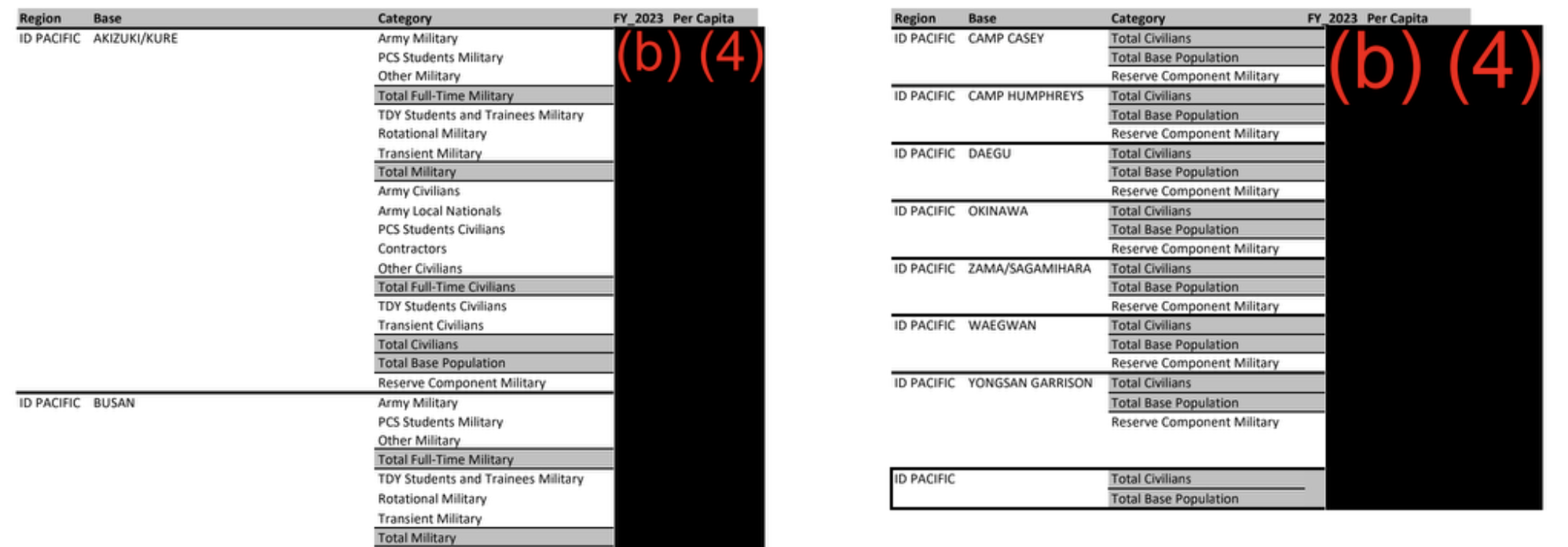
One of the most important redactions fell on a variable that seems to indicate how much revenue relates to who is gambling. It’s clear that not all of this revenue is coming from actual military members, but some are contractors and local workers on the bases in the civilian category.
The Army’s FOIA office heavily redacted per capita revenue figures using FOIA Exemption (b)(4), which protects “trade secrets and commercial or financial information obtained from a person.”
The redactions hide how much revenue is pulled from:
-
Army military personnel
-
Permanent change of station (PCS) students
-
Temporary duty and rotational personnel
-
Civilians
-
Contractors
-
Locals
How much civilians spend at American military bases and other lasting questions
The data show a complex and geographically-focused gambling revenue structure on U.S. military bases abroad. Although the exact per capita numbers are redacted, the fact that the military differentiates people who are gambling on bases into civilian and non-civilian categories indicates that there is some level of internal monitoring of gambling activity. The civilian category is one that would be worth digging into more. If this data weren’t redacted, analyzing the number and type of people gambling on bases could help in understanding the question of which military bases are most affected by gambling addiction.
The civilian category is one that would be worth digging into more.
If you’re interested in joining the Data Liberation Project and making more data available to the public, sign up for the MuckRock newsletter for updates and join MuckRock’s Slack, which hosts a dedicated Data Liberation Project channel.