The Cherokee Strip “race for land” was the largest single land run in U.S. history: on September 16, 1893, more than 100,000 people surged into the Cherokee Outlet (often called the Cherokee Strip) in present‑day northern Oklahoma to claim 6 million acres and roughly 40,000 homesteads in a chaotic, hours‑long dash that redrew the map of the American West and completed the dispossession of the Cherokee Nation from lands guaranteed to them after the Trail of Tears.ebsco+2
What the Cherokee Strip was
The “Cherokee Strip” refers to the Cherokee Outlet, a vast tract of about 6 million acres (about 24,000 km²) stretching from the Kansas border down to the Indian Territory boundary, roughly the size of three small states combined.wikipedia+1
It had been part of the Cherokee Nation’s western lands, originally secured after the forced removal of the Cherokee from the Southeast in the 1830s.history+1
The Cherokee used it as a grazing area and as a route to hunting grounds in the Rocky Mountains; by the late 1800s, cattle barons leased it for grazing, and white settlers and politicians began pressuring the government to open it to settlement.voanews+1
Why the land was opened
By the 1880s–1890s, several forces converged:
Settler demand: Westward migration and land hunger made the Outlet a target for homesteaders and “Boomers” who wanted to claim free land.voanews+1
Cattle leases and politics: The Cherokee profited from grazing leases, but federal policy under President Benjamin Harrison effectively ended those leases after October 2, 1890, cutting off tribal income and making the land more attractive to the government as a settlement zone.wikipedia
Federal pressure on the Cherokee: Despite Cherokee leaders’ insistence that the land was promised “forever” (“as long as the grass grows and the rivers run”), the U.S. government pressured the tribe to sell, and the Cherokee eventually agreed to sell the Outlet at about $1.40–$2.50 per acre.wikipedia+1
The result was a presidential proclamation that the land would be opened by a land run, not by auction or allotment, on a fixed date and time.
The day of the run
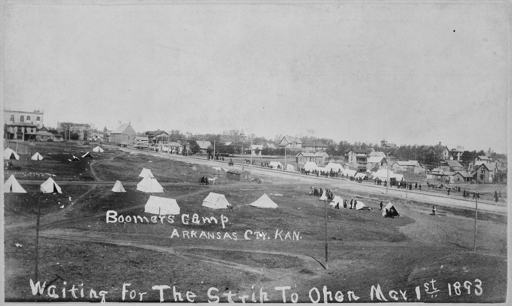
Boomers Camp in Arkansas City, Kan. on March 1, 1893, with participants waiting for the Land Run. wikipedia
The Land Run of 1893 (also called the Cherokee Outlet Opening or Cherokee Strip Land Run) took place on September 16, 1893, at noon.wikipedia+1
An estimated 100,000 participants lined up along the border, many having camped in places like “Boomers Camp” near Arkansas City, Kansas, for months.ebsco+1en.wikipedia
They arrived by horse, wagon, bicycle, train, and even on foot, some pulling small houses on wheels.voanews+1
At noon, a signal (traditionally a pistol shot; oral tradition says a nervous soldier fired at 11:55 a.m., starting the race prematurely) unleashed a mad dash.wikipedia+1
The rush was described as “the largest single competitive event in world history” because tens of thousands raced simultaneously for finite parcels.voanews
By sunset, about 40,000 homesteads and town lots had been claimed, even though demand far exceeded supply; most participants did not get land.ebsco+1
How the run worked
The federal government set up four General Land Offices in Perry, Enid, Woodward, and Alva to process claims, and stationed infantry at those sites and cavalry at various camps to try to keep order.wikipedia
Each eligible person could claim a 160‑acre homestead (a quarter section) if they met residency and improvement requirements, similar to the Homestead Act pattern.
Townsites were also laid out, with individual lots available for purchase.
Despite military presence, so-called “Sooners”—people who sneaked in before noon—succeeded in grabbing some of the best eastern parcels and townsite locations; this cheating gave Oklahoma its nickname “the Sooner State” and the University of Oklahoma’s football team its name, the “Sooners”.voanews+1
Who participated
The rush drew people from across the United States and many foreign countries:
Immigrants, including German Americans like Louis Mueller, and others who had heard rumors of free land.youtube
Former “Boomers” who had previously advocated for opening Indian lands, as well as ordinary farmers, ranchers, and speculators.voanews
Many were desperate or landless, viewing the run as a last chance for economic independence.
Yet because the number of claims was limited, the majority of the 100,000+ participants left empty‑handed.
Immediate results
Within days and weeks:
New counties were created in the Outlet: Kay, Grant, Woods, Woodward, Garfield, Noble, and Pawnee (originally labeled K–Q).wikipedia
Towns sprang up rapidly around the land offices and rail lines; some were overbuilt and later declined.
Many claims were quickly abandoned within the year because the land was unsuitable for farming or because claimants could not afford to improve it.wikipedia
The Cherokee Outlet became part of Oklahoma Territory, and the territory later contributed to the formation of the state of Oklahoma in 1907.ebsco+1
Impact on the Cherokee Nation
For the Cherokee, the 1893 run was another devastating step in a long pattern of dispossession:
The land had been guaranteed to the Cherokee after the Trail of Tears, yet the federal government pressured them into selling it under duress.facebook
The run turned lands once used for grazing, hunting, and community life into settler farms and towns, often within hours of the signal.facebook
Many Cherokee families, already weakened by earlier removals and broken treaties, lost their economic base and were left without land to support themselves.facebook
In Indigenous history, September 16, 1893, is remembered not as a triumph of opportunity but as a final blow to Cherokee sovereignty over their western lands.facebook
Why it matters in American history
The Cherokee Strip land run is significant for several reasons:
It was the largest and most dramatic of Oklahoma’s five land runs, symbolizing the culmination of federal policies that prioritized white settlement over tribal rights.ebsco+1
It illustrates how the U.S. government used land runs as a mechanism to redistribute Indigenous territory to settlers, accelerating westward expansion and statehood for Oklahoma.wikipedia+1
It left a lasting cultural legacy: the terms “Boomer” and “Sooner,” Oklahoma’s nickname, and popular stories of chaos, violence, and sabotage during the rush.voanews+1
Where to learn more
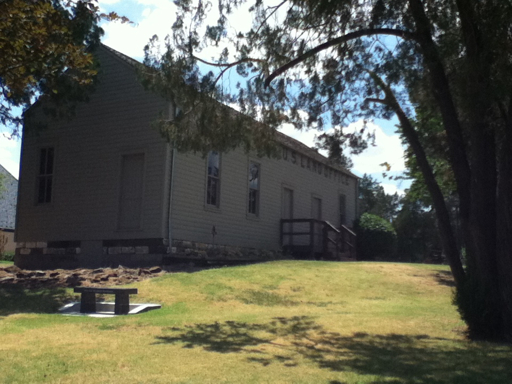
The Garfield County land office is now located in the Humphrey Heritage Village at the Cherokee Strip Regional Heritage Center in Enid, Oklahoma. wikipedia
Physical and digital resources:
Cherokee Strip Land Rush Museum in Arkansas City, Kansas, near the Oklahoma border, displays artifacts, maps, and stories of the run.voanews
The Cherokee Strip Regional Heritage Center in Enid, Oklahoma, preserves buildings like the Garfield County land office and interprets the history of the Outlet.en.wikipedia
Scholarly articles and books on Oklahoma history, the Cherokee Nation, and 19th‑century land policy discuss the run in depth, often in the context of the Trail of Tears and the closure of the frontier.
If you’d like, I can next outline how this event fits into the broader story of Indian removal, the Homestead Act era, and the creation of Oklahoma as a state.