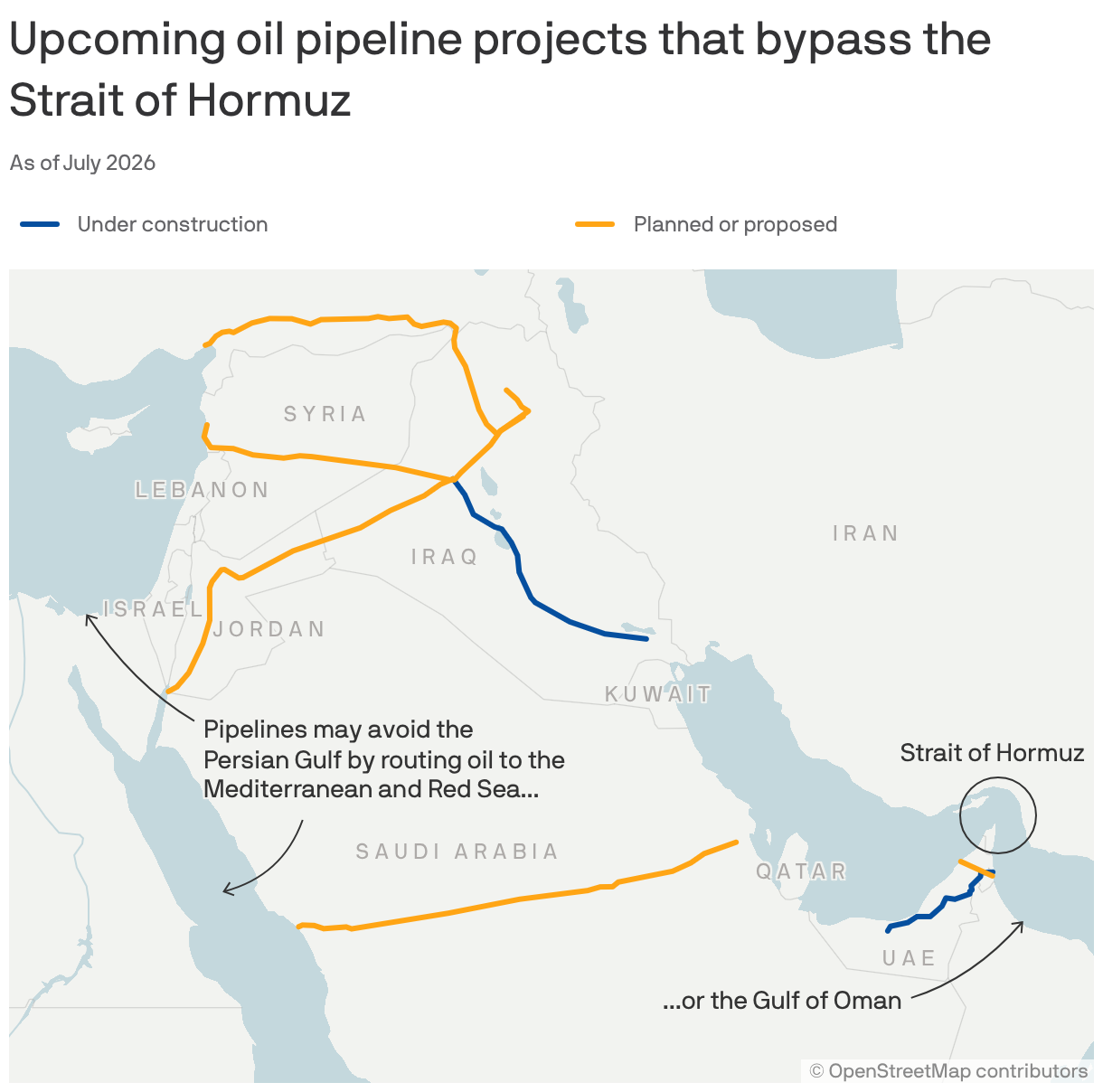
The oil market's top players aren't waiting around to see who winds up with control over the Strait of Hormuz — countries and companies are scrambling to bypass the waterway.
Why it matters: The Iran war threw a spotlight on the strait as the longtime center of the global energy trade, and the industry now has a huge incentive to reduce its dependence, regardless of the war's outcome.
- "The 2026 U.S.-Iran war and Strait of Hormuz disruption may ultimately be remembered less for triggering an immediate oil crisis than for accelerating global efforts to reduce dependence on the world's most important energy chokepoint," Bloomberg Intelligence analysts wrote in a report.
The latest: The ceasefire agreement between the U.S. and Iran is quickly unraveling.
- On Monday, President Trump said the U.S. would reinstate its blockade of Iran in the strait and proposed charging other countries 20% of the value of cargo shipped through it.
- The threat may not actually materialize — the International Maritime Organization says there's no legal basis for a toll — but it certainly gives producers even more incentive to figure out alternative shipment methods.
Follow the money: Trump's remarks helped send oil up by more than 9%. The price of a barrel of benchmark Brent crude oil is at $86.57 — it fell below $70 after the ceasefire was announced.
- Still, this is far below the levels reached in the first weeks of the conflict.
What to watch: Commodity analysts at Goldman Sachs looked at seven pipeline and export-infrastructure projects that are under construction, planned or considered potentially feasible.
- By the end of next year, that capacity — plus existing pipelines — could insulate more than 45% of the pre-war level of Persian Gulf producers' exports from any potential future Hormuz shocks, they estimated in a note out Sunday night.
- By the end of 2028, the number rises to more than 60%.
Zoom in: Two projects are already under construction: the West-East pipeline in the UAE and the Basra-Haditha Pipeline in Iraq.
- And a Dubai-based port operator is in talks to develop a new port on the coast of the UAE to reduce the country's dependence on the strait, the Financial Times reported Monday.
Zoom out: Construction for these pipelines is expected to be relatively quick — shockingly so for those used to the U.S. pace of infrastructure development.
- Goldman looked at nine other pipeline projects, mainly in the Gulf, and the median time to complete was 2.5 years. Plus, the analysts found that projects prompted by supply disruptions tended to move faster.
Reality check: For now, the world still needs the strait. The Bloomberg Intelligence analysts noted that 7 million to 9 million barrels of crude and refined products per day would remain exposed to its risks even after a rerouting buildout.
- Qatar's liquefied natural gas exports have no realistic alternative, and Kuwait and Iraq remain heavily dependent on the strait.
The big picture: Roughly 20% of the world's oil flowed through the waterway at the outset of the war, and analysts forecast dire outcomes for the energy market with its disruption.
- Those proved overly apocalyptic, to say the least. To paraphrase Jeff Goldblum's character in "Jurassic Park," oil found a way.
- This wasn't due to the new buildout but to China's reduction in oil imports, the historic release of oil reserves and existing bypass capabilities — and shadow exports of oil through the strait.
Between the lines: Again and again in recent years, markets have proved far more resilient and dynamic in response to major shocks than analysts and economists had predicted.
The bottom line: The outcome of the war remains uncertain, but the global trade in oil is sure to be reshaped as a result.