Key Points
- Trump announced a plan to import 300,000 metric tons of discounted foreign ground beef.
- Trump refused to reveal the source countries, causing backlash from American ranchers and trade groups.
- Cattle industry warns market intervention harms producers; transparency about beef origins demanded.
President Donald Trump announced Friday that he has struck a deal to flood the U.S. market with hundreds of thousands of metric tons of foreign ground beef at prices dramatically below the current market.
But when a reporter asked the most basic question about the arrangement — where exactly is all this beef coming from? — Trump refused to say.
“On the beef deal, which countries did you make the deal with?” a reporter asked Trump Friday afternoon.
“I don’t want to say,” Trump responded.
Welcome to Trump’s mystery meat deal.
Earlier Friday, Trump announced on Truth Social that, for the next 90 days, the United States would allow up to 300,000 metric tons of imported product for ground beef into the country without the usual out-of-quota tariff.
“We have a commitment that this beef will be sold at 25 percent below current market prices,” Trump wrote, claiming the plan would “reduce prices for Americans while giving space for our Great American Beef Herd to grow again.”
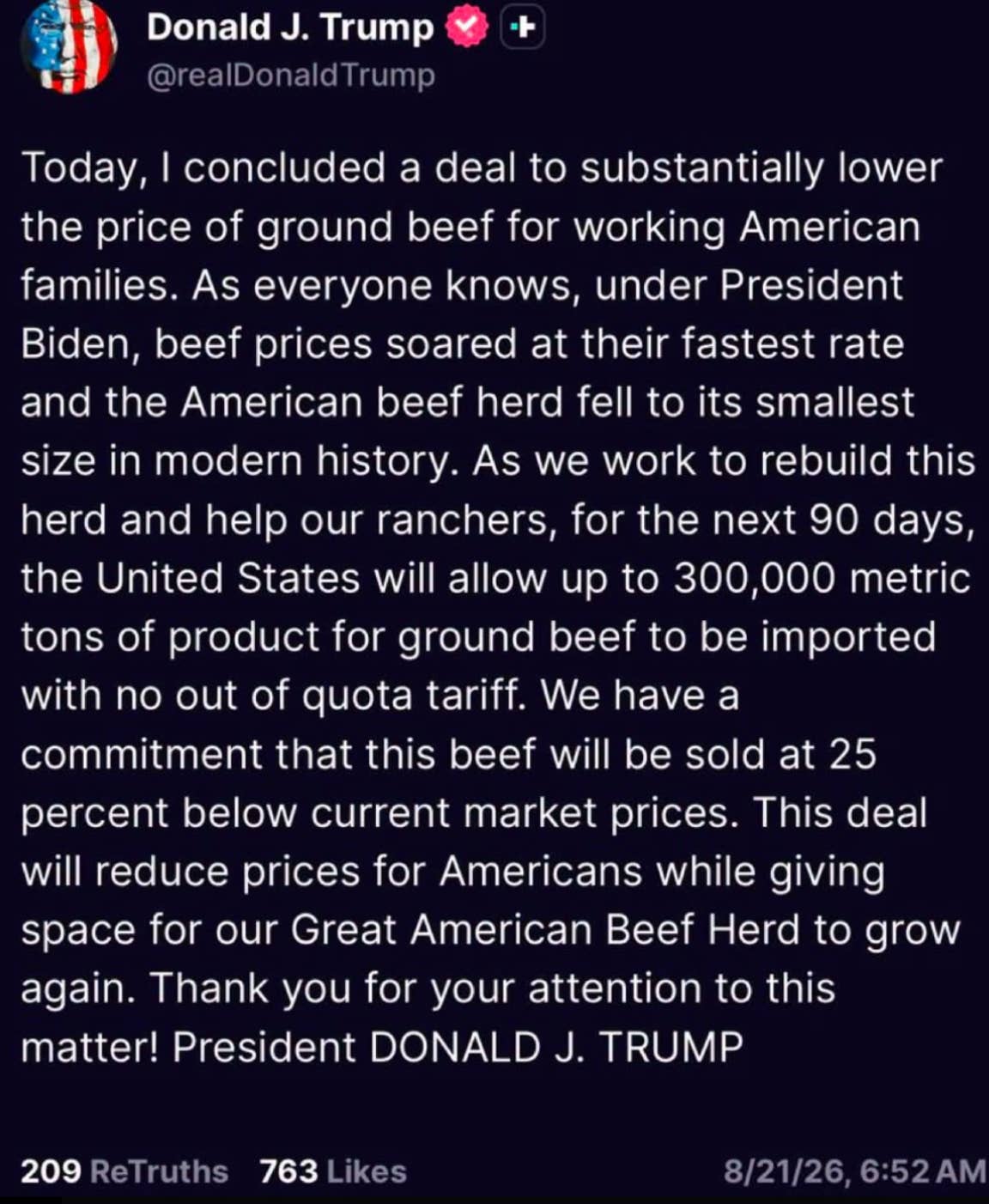
Trump did not identify who supposedly made that commitment, which countries would supply the beef, or how the administration intends to ensure foreign beef is sold at a specific discount once it enters the U.S. market. The White House has said an executive order implementing the plan is expected within two weeks.
The secrecy is especially striking given that the plan could directly affect the livelihoods of American cattle producers.
The National Cattlemen’s Beef Association, the country’s largest cattle industry trade group, blasted Trump’s announcement almost immediately.
“Flooding the market with government-subsidized, below-market beef is not the way to rebuild the American cattle herd,” NCBA CEO Colin Woodall said.
The organization said cattle markets had already “turned sharply lower” Friday morning following Trump’s announcement, hurting farmers and ranchers at a particularly sensitive moment as producers make decisions about whether to expand their herds.
“Today’s announcement and other market interventions throw cold water on the prospect of herd expansion and sacrifices long-term stability for short term messaging,” Woodall said.
Cattle futures fell to eight-month lows following Trump’s announcement.
The backlash is hardly the first time Trump has angered American ranchers by proposing foreign beef imports as a quick fix for grocery prices.
Trump Has Been Down This Road Before
In October 2025, Trump publicly floated importing more beef from Argentina as a way to bring down American beef prices.
“We would buy some beef from Argentina,” Trump said at the time, arguing that doing so could lower prices and help Argentina, whose president, Javier Milei, is a political ally of Trump.
American cattle producers were furious.
NCBA warned at the time that expanding Argentine access to the American market would “harm American cattlemen and women” and interfere with the market.
Two days later, after Trump announced plans to increase Argentine imports, the organization escalated its criticism.
“President Trump Undercuts America’s Cattle Producers,” NCBA declared in the headline of its statement.
The group warned that attempts to manipulate the market risked “damaging the livelihoods of American cattlemen and women, while doing little to impact the price consumers are paying at the grocery store.”
The United States Cattlemen’s Association sounded a similar alarm, warning Trump that expanding Argentine beef imports could threaten domestic producers.
“Expanding beef imports from Argentina would risk the very foundation of U.S. cattle production and the heart of rural America,” the organization wrote. “U.S. producers will lose in any deal with Argentina.”
The episode was particularly sensitive because Trump’s administration had also extended major financial support to Argentina while American farmers were struggling with the effects of his trade policies. Reuters reported at the time that ranchers feared the additional imports could destabilize the domestic cattle market just as producers were benefiting from strong demand.
Trump ultimately followed through.
In February, Trump authorized an additional 80,000 metric tons of Argentine lean beef imports for 2026, distributed through four quarterly tranches.
Even then, cattle producers emphasized that Americans should be able to know where their beef comes from.
“U.S. cattle producers — and U.S. consumers — deserve to know where their beef comes from,” United States Cattlemen’s Association President Justin Tupper said following the Argentina agreement, while calling transparency over imports “non-negotiable.”
Now Trump is proposing an influx nearly four times the size of that Argentine quota increase, compressed into just 90 days, while declining to tell the American public which countries will provide it.
“I Don’t Want to Say”
The mystery surrounding the deal raises questions that Trump’s announcement does not answer.
Who agreed to sell the United States this beef at 25 percent below current market prices? Is Argentina involved again? Is the beef coming from one country or several? What concessions, if any, did the United States make in return? And why does Trump believe the identity of America’s new beef suppliers should remain secret?
Trump offered no explanation Friday.
His announcement comes as beef prices remain elevated and the U.S. cattle herd continues to recover from years of drought and high input costs. Analysts have also questioned whether a temporary import surge can meaningfully address those underlying supply problems and noted it does not address the structural factors responsible for the shortage.
Trump, meanwhile, is presenting the plan as both a way to lower prices and a way to help American ranchers rebuild their herds.
The ranchers themselves are saying the opposite.
And for now, Americans being promised cheaper foreign beef are being asked to accept one unusual condition:
They aren’t allowed to know where it’s coming from.
About the author