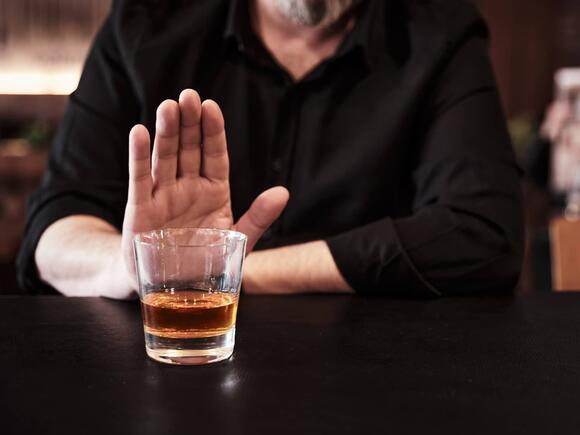
We’ve all been there: waking up after a night heavy drinking filled with regret and bad decision. That hanxiety is real. While the instinct after a rough morning is often to swear off alcohol forever, understanding what actually happens when you hit pause on drinking can turn a moment of regret into a lasting reset. So what actually happens when you quit alcohol?
Will the first few days be rough?
That depends entirely on how much you've been drinking. Alcohol boosts the calming neurotransmitter GABA and blunts the excitatory glutamate system. Drink heavily for long enough and your brain adapts by turning GABA signaling down and glutamate signaling up. Pull the alcohol out and you're left with a nervous system stuck in overdrive. Clinical withdrawal data lays out the timeline: minor symptoms such as anxiety, tremor, sweating, a racing heart, and nausea tend to begin around 6 hours after the last drink and peak near 24 to 48 hours. Withdrawal seizures can appear anywhere from 6 to 48 hours out. Delirium tremens, the most severe form, usually starts 48 to 72 hours after the last drink and can last up to about two weeks. Roughly half of people with alcohol dependence develop some withdrawal, and about 5 percent develop delirium tremens, which can be fatal without treatment.
SAFETY FIRST: If you drink heavily every day, do not quit cold turkey on your own. Severe alcohol withdrawal is one of the few drug withdrawals that can kill you, and medically supervised detox is the standard of care. If you are a light or occasional drinker, this is not your risk profile and stopping is safe. |
What happens to your sleep?
Alcohol is a poor sleep aid dressed up as a good one. Because it is sedating, it shortens the time it takes to fall asleep, which is exactly why people reach for a nightcap. But once your liver clears it, usually in the second half of the night, sleep fragments and REM gets disrupted. When you stop, the paradox is that sleep can get worse first. A sleep review reports that insomnia affects 36 to 72% of people with alcohol dependence and can persist for weeks to months in early abstinence. For heavier drinkers this is a real hump to get over. The payoff comes later: long-term abstinence reverses many of these problems, and most moderate drinkers notice deeper, steadier sleep within a few weeks once the early disruption passes.
How fast does your body actually change?
Faster than you would guess for the metabolic markers. The cleanest human data come from a 2018 controlled study of ninety-four moderate to heavy drinkers who gave up alcohol for one month. After four weeks, the abstainers showed insulin resistance down about 25 percent, systolic blood pressure down around 5 mmHg, and two cancer-related growth factors, VEGF and EGF, down by roughly 40 and 70 percent. The drinkers who continued showed essentially no change. Their liver fat fell too. The liver is the organ that metabolizes alcohol, and it starts offloading fat and calming inflammation within weeks of your last drink.
Two caveats keep this honest. These were not people with established liver disease, and the study ran for one month. Deeper damage takes longer, and some of it does not fully reverse. But the direction and speed of the early metabolic response are not in doubt.
Will you lose weight?
Often, and for reasons that have little to do with willpower. Alcohol carries about 7 calories per gram, nearly as much as pure fat, and they are empty calories that ride in alongside whatever you eat while you drink. Alcohol also lowers your restraint, which is why the drinks so often arrive with fries. In the Royal Free controlled study, one month with no alcohol produced measurable weight loss, on the order of 1.5 kilograms (a little over 3 pounds), while the group that kept drinking did not budge. Some of the earliest drop is water rather than fat, since alcohol and the salty food around it drive bloating and fluid retention. But the arithmetic is real: remove a nightly drink or two and you cut a few hundred calories a day without changing a single meal.
What happens to your mood?
Here is the part most people do not expect. Alcohol is a depressant in the pharmacological sense, not just the figurative one, and heavy use reliably drags mood down and pushes anxiety up. Stop, and for many people the fog lifts on its own. In a prospective study that followed drinkers through early abstinence, depressive symptoms fell sharply over the first month, and none of the participants who looked depressed at the start still met the bar for a major depressive episode six to eight weeks later. Dry-month participants report the milder version of this: measurable gains in wellbeing that their still-drinking peers do not share. The clinical rule of thumb is watchful waiting. If your mood is still flat after several weeks with no alcohol, that is the signal that you may be dealing with an independent depression that needs its own treatment, rather than an alcohol-driven one that clears on its own.
Does your brain bounce back?
Faster than you would think, at least structurally. Chronic heavy drinking shrinks brain tissue, hitting the frontal lobes, cerebellum, and insula hardest, the regions you lean on for judgment, coordination, and self-control. The encouraging part is how quickly some of it reverses. In an imaging study that scanned alcohol-dependent patients within a day of their last drink and again two weeks later, gray matter volume had already partially rebounded across several regions in just fourteen days. Recovery is uneven: motor and coordination areas come back first, while the higher-order regions behind attention and complex thinking take longer, often months. For a moderate drinker the shifts are subtler, but the direction is the same, and it usually shows up as sharper focus and a clearer head within the first few weeks.
Isn’t a drink or two a day good for your heart?
For decades the story was that moderate drinkers outlive both heavy drinkers and teetotalers, the famous J-shaped curve, and red wine picked up a health halo along the way. The problem is that the curve is largely an artifact of how the studies were built. Many of them labeled former heavy drinkers who had already quit, often because they had gotten sick, as "non-drinkers," which made the abstainer group look unhealthy by comparison. That is the abstainer bias, sometimes called the sick-quitter effect. A 2023 meta-analysis of 107 studies and nearly 5 million people corrected for these flaws and found no significant reduction in all-cause mortality at low intake, with risk climbing as intake rose and rising at lower thresholds for women than for men. The World Health Organization now states plainly that there is no safe level of alcohol for health. If your reason for keeping a nightly drink is your heart, the evidence has moved out from under it.
Will you just drink more when the month ends?
The most persistent objection to a dry month is that you will overcorrect the moment it ends. The data say otherwise. In a study of 857 UK adults doing Dry January, rebound drinking was uncommon. Instead, participants reported healthier drinking patterns and greater confidence in their ability to turn down a drink, what researchers call drink-refusal self-efficacy, six months later. A follow-up compared participants with ordinary drinkers who did not take part and found the gains in well-being and drinking behavior showed up only in the people who did the challenge. Taking a month off does not just give your liver a break. It resets your baseline.
The timeline at a glance
| Timeframe | What tends to happen | Strength of evidence |
|---|---|---|
6 to 72 hours | Withdrawal window for heavy drinkers: tremor, anxiety, sweating, and in severe cases seizures or delirium tremens | Strong (clinical) |
First 1 to 2 weeks | Sleep often gets worse (insomnia) before it improves; brain gray matter begins partial recovery | Strong for dependent drinkers |
2 to 4 weeks | Liver fat and inflammation fall; alcohol-driven low mood and anxiety usually lift; sleep consolidates | Moderate to strong |
About 1 month | Insulin resistance, blood pressure, weight, and cancer-related growth factors improve | Strong (controlled study) |
Months to years | DNA and cellular damage partly reverses; cancer risk declines; higher-order cognition keeps recovering | Strong (mechanistic and epidemiologic) |
6 months | Lower and more controlled drinking, greater confidence refusing a drink, improved wellbeing | Moderate (behavioral) |