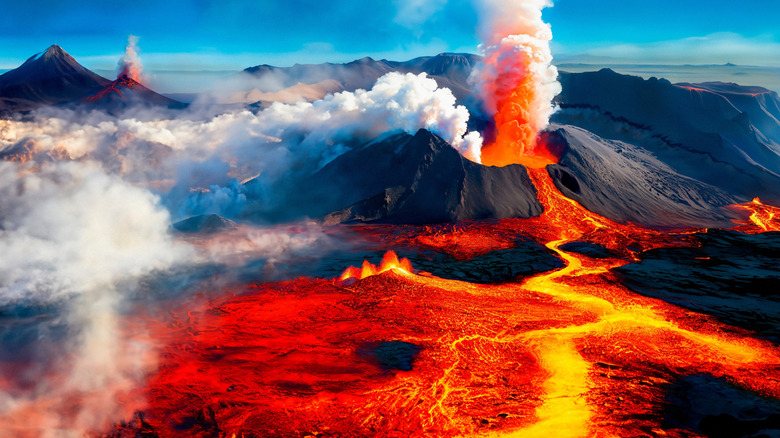
Volcanic eruption with lots of lava and billowing smoke

Steve Allen/Shutterstock

Numerous volcanoes have erupted in the last 100 years. In fact, about 50 to 70 volcanoes erupt around the world each year. The eruption at Mount St. Helens in Washington State was the deadliest and most destructive volcanic eruption in U.S. history. However, it wasn't the worst of all time. According to historians and scientists, the worst volcanic eruption ever recorded in human history was that of Mount Tambora.

Located on Sumbawa island in Indonesia, Mount Tambora is an active volcano that experienced some seismic activity from 2011 to 2013. There were also a couple of small eruptions in 1880 and 1967, but these incidents were nothing compared to the calamity caused by its April 1815 explosion. In a paper published in Progress in Physical Geography: Earth and Environment, scientists estimate that the eruption expelled about 157 billion tons of molten rock, raining large stones across the island.

Another study in the Journal of Volcanology and Geothermal Research found that the blast exerted energy equivalent to more than 66 trillion pounds of TNT. Because of that force, whirlwinds developed and destroyed villages. Over 95% by mass emerged as pyroclastic flows, and 40% by mass of those flows turned into ash. All of that was followed by plinian eruptions — intense and violent blasts of gas and volcanic materials — and the caldera collapsing. In the end, the event lasted more than four months.

The Mount Tambora eruption was the deadliest, most widespread catastrophic event

Because of that, the Tambora eruption has a Volcanic Explosivity Index (VEI) 7 rating, which is massive considering that the scale only goes to VEI 8. Plus, more than 71,000 people died during the eruptions and aftermath (possibly surpassing 90,000 deaths), making it the deadliest volcanic event of them all. By comparison, the Mount St. Helens eruption has a VEI 5 rating and killed 57 people.

Many of the island deaths were due to the pyroclastic flows, but some of them were because of the tsunami that the eruption triggered. However, the effects of the Tambora eruption extended far beyond Sumbawa island and even Indonesia. Along with the volcanic material and ash that the volcano spewed into the air, it released about 60 million tons of elemental sulfur into the stratosphere. All of that mutated into a haze that blanketed the globe, absorbing heat and blocking the sun throughout 1816.

On average, worldwide temperatures dropped by more than 5 degrees Fahrenheit. Weather patterns also shifted, with storms becoming more frequent and snow falling in summer in Eastern North America and Western Europe. In fact, that's why summer 1816 was referred to as the year without a summer. The lack of sun led to crop failures, which resulted in tens of thousands of the estimated deaths from famine and disease — such as epidemic typhus. Combined, the events and effects make it Earth's most destructive volcanic incident in the past 10,000 years.
Top 5 Most Dangerous Supervolcanoes In The World

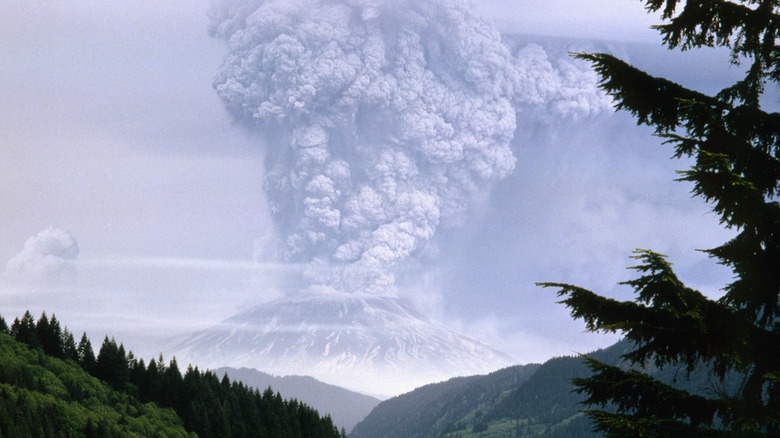
A volcano in the distance spews ash and smoke miles into the atmosphere with green hills and trees in the foreground

Steve Terrill/Getty Images

It's easy to forget that human civilization rests upon dynamic geological layers that churn, creep, and lock beneath the Earth's surface. Solid as the ground may feel, it conceals immense forces capable of moving continents and razing mountain ranges — processes that have fuelled some of the most explosive events in our planet's history. Volcanoes, for example, have long captured our imagination, with documentaries like Werner Herzog's "Into the Inferno" serving as evidence of our continued fascination with them in the modern era.

Yet as destructive as volcanoes can be, they pale in comparison to supervolcanoes — colossal geothermal formations capable of ejecting over 240 cubic miles of material in a single eruption. To be classified as a supervolcano, an eruption must register at level 8 on the Volcanic Explosivity Index (VEI) — a system akin to the Richter scale for earthquakes. So powerful are these eruptions that the official qualitative scientific term for them is literally "Apocalyptic," according to the U.S. National Park Service.

Supervolcanoes are what people mean when they say that Wyoming has a terrible secret located beneath Yellowstone Park, whose caldera last erupted roughly 630,000 years ago and was 1,000 times more potent than the 1980 St. Helens eruption that laid waste to hundreds of square miles. Rare though they are, geologists are constantly on the lookout for signs of the next big eruption. Italy's Campi Flegrei Caldera, part of a supervolcano complex nearly 9 miles wide whose last big eruption triggered a volcanic winter across Europe 36,000 years ago, has shown signs of increased activity in recent years, for example. Here, we look at some of the most dangerous supervolcanoes on the planet to see just how they could reshape our world.

Toba: The supervolcano that shaped history

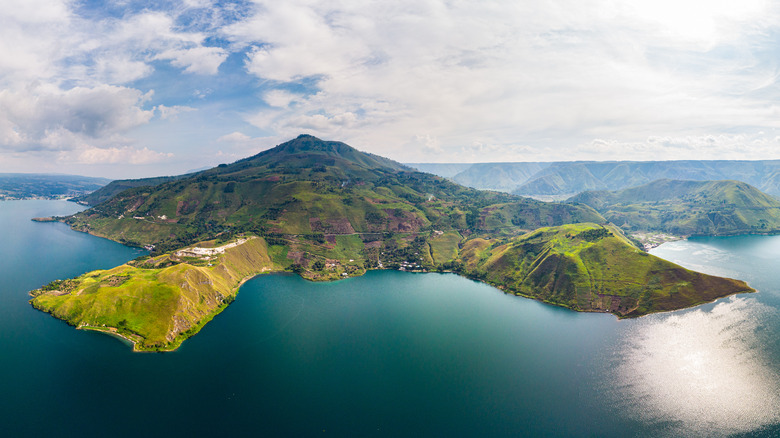
A aerial view of a lake ringed by green hills and valleys

Fbxx/Getty Images

Situated on the island of Sumatra, Indonesia, the Toba Caldera is the site of the largest volcanic eruption in the past 2.5 million years. Approximately 74,000 years ago, the Toba supervolcano ejected an estimated 670 cubic miles of material into the atmosphere, blanketing large swaths of Asia in 6 inches of volcanic ash. Evidence taken from ice cores indicates that global average temperatures dropped by 5 to 9 degrees Fahrenheit as a result of the explosion. Other studies have revealed that human populations in places as far away as Ethiopia were forced to adapt to altered climate conditions. While debated in the scientific community, it's possible that Toba quickened the approach of the Earth's last ice age.

Today, the massive caldera left behind by the eruption is filled by Lake Toba, the world's largest volcanic lake at 62 miles long by 18 miles wide. Active but dormant, predictions for Toba's next eruption are difficult to pin down. Some researchers believe the next super eruption may not occur for the next 600,000 years, though smaller geological events could happen meanwhile.

Troublingly, other studies, like the one from Curtin University Associate Professor Martin Danišík, indicate that eruptions might be able to occur in the absence of liquid magma — the gold-standard sign of the potential for future eruptions. That means that Toba could erupt again without a clear geological prelude, an unsettling prospect for anyone.

Taupo: New Zealand's sleeping giant

A snow-covered mountain in the distance with a lake, hills, trees, and houses in the foreground

Mb Photography/Getty Images

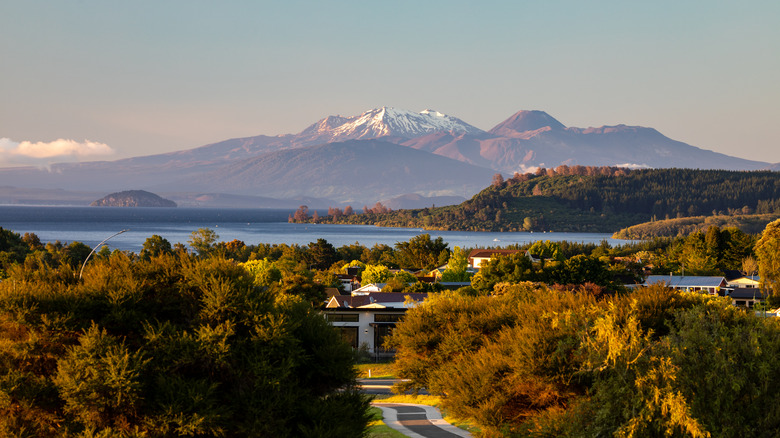
The Taupo Volcano, located in the center of New Zealand's North Island, is one of the most active and dangerous supervolcanoes on Earth. Its most notable eruption, which is also the most recent supervolcano eruption on the planet, took place around 27,000 years ago and is known as the Oruanui eruption. The event released so much volcanic material that the ground collapsed into the earth, slowly filling with water to create present-day Lake Taupo. The second-largest known volcanic event to occur in the last 100,000 years, the Oruanui eruption spewed 9 times the volume of water in Lake Taupo today, covering nearby regions in several feet of ash.

The most recent eruption at Taupo, simply known as the Taupo (or Hatepe) eruption, took place in 232 A.D. Smaller in size than the Oruani eruption but still exceptionally violent, the Taupo eruption ejected about 8.5 cubic miles of ash and pumice, and its debris cloud stretched 31 miles into the atmosphere. The entirety of New Zealand was covered in ash, while the landscape surrounding the volcano was buried in hundreds of feet of pyroclastic flow — a mix of lava, ash, pumice, and volcanic gases.

Taupo remains something of a wildcard. Largely dormant in modern times, increased geological activity under the lake, starting in May 2022, briefly gave scientists cause for concern. A year later, things calmed down to normal levels. By that time, researchers had recorded 1,800 earthquakes beneath the volcano during its period of unrest. Still, the likelihood of another super eruption is exceedingly rare, as seismic activity would need to be much greater than what has been recorded over the last 150 years.

Aira Caldera: Japan's fiery supervolcano

A volcano across a lake with a buildings in sunset light in the foreground

Chiara Salvadori/Getty Images

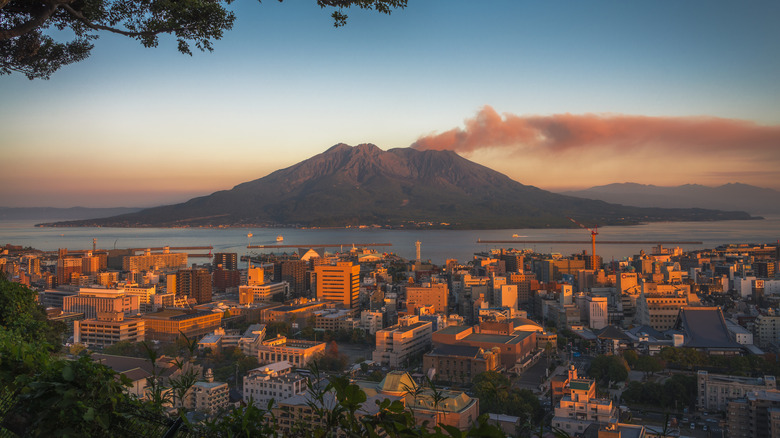
Japan's Aira Caldera is a volcanic complex that was formed roughly 22,000 years ago by a massive eruption that expelled about 96 cubic miles of magma. Like Lake Taupo in New Zealand, this event resulted in a major depression in the earth that preceded the formation of Kagoshima Bay. Today, that body of water looks up at one of the world's most active volcanoes, Sakurajima, which is the modern geological hotspot in the caldera. Sakurajima has been consistently active since the 1950s, most recently showing ongoing eruptive activity starting at the end of 2024, and poses an ongoing risk to the surrounding population.

Aira Caldera, which surrounds Sakurajima, is typically impressive in size, spanning 10 by 14 miles. While Sakurajima's eruptions are generally as small as they are frequent, the region's geological activity means there is always the possibility of a large-scale eruption of the kind that formed the caldera over 20,000 years ago. Scientists at the Sakurajima Volcano Research Center continue to monitor and study both the caldera and Sakurajima volcano to gain a better understanding of just when that might happen.

Italy's Campi Flegrei

A body of water ringed by hills and a seaside town

Francesco Riccardo Iacomino/Getty Images

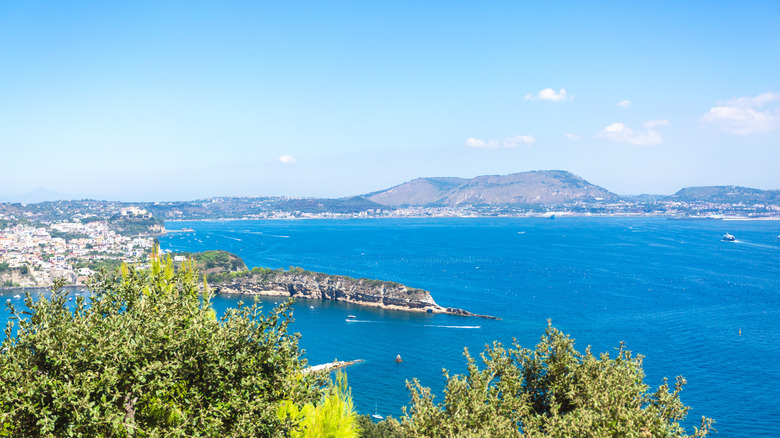
Not far from Mount Vesuvius lies Campi Flegrei, also known as the Phlegraean Fields. One of the world's most dangerous supervolcanoes, the Campi Flegrei caldera spans over 8 miles in diameter across the Gulf of Pozzuoli on the outskirts of Naples. Beginning in 2005, the caldera has exhibited signs of inflation, with seismic activity in the region occurring with increasing frequency since December 2022 — including 150 earthquakes that were recorded over the course of a single day in May 2024.

Scientists have no modern-era eruptions to compare a potential future event to, adding to a sense of unease about such increased activity. What we do know is that 40,000 years ago, the caldera produced the most powerful and destructive eruption that Europe has seen in the last 200,000 years, blanketing the continent in ash and imposing a volcanic winter. That eruption even coincided with the Neanderthal's long, slow descent into extinction, causing some scientists to wonder if the two events are related. 

What makes Campi Flegrei particularly dangerous is the fact that millions of people live in close proximity to the caldera, a symptom of out-of-control real estate development fueled by the area's natural beauty. Were a significant eruption or earthquake to occur, officials believe that a safe and effective evacuation could be an exceedingly challenging thing to achieve.

Yellowstone's supervolcano caldera

A multi-colored pool of steaming water and mud with dark green trees and blue skies in the background

safiya.sayyad/Shutterstock

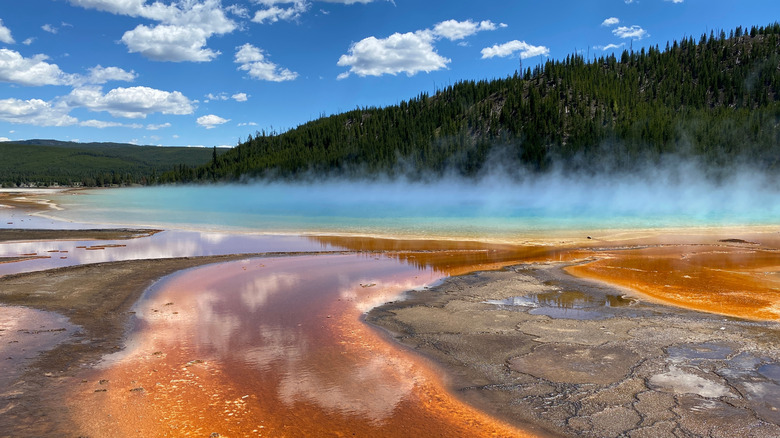
The United States has its fair share of notable volcanoes. And while Washington State has the most destructive volcanic eruption in U.S. history, the Yellowstone Caldera's record of eruptions dwarfs that of Mount St. Helens. One of the world's most well-known supervolcanoes, the volcanic system that shaped the 50-mile-long caldera has produced three gargantuan eruptions in the last 2 million years (it's also the geothermal reason behind the Yellowstone Biscuit Basin explosion). The site's initial 2.1 million-year-old blast expelled 600 cubic miles of magma — which caused the ground to collapse into the magma chamber below, leaving an impression in the earth the size of Rhode Island.

Yellowstone's most recent supervolcano eruption occurred 631,000 years ago, forming the caldera as it currently exists. Somewhat disturbingly, each of the system's eruptions that resulted in a new caldera was hundreds of times larger than the explosion at Mount St. Helens in 1980. Each blanketed large swaths of the continent in ash and likely resulted in a significant lowering of temperatures globally.

Beneath Yellowstone sit two magma chambers. Previous estimates put the amount of magmatic melt in the smaller chamber at 5% to 15% melt and 2% for the larger chamber — far below the amount thought needed to precede a massive eruption event. However, new research published in Earth and Planetary Science Letters indicates the upper chamber contains 28% melt. Still, scientists note that Yellowstone's supervolcano isn't overdue for an eruption. Volcanoes don't follow set schedules, and even if you account for the average of 725,000 years between eruptions in its history, that puts the caldera's next big showing at 100,000 years into the future.