Ben-Gurion University scientists say plant material, enriched with nutrients to attract oil-guzzling bacteria, can absorb 100 times its own mass in crude oil or fuel in just seconds
By Sue Surkes
You will receive email alerts from this author. Manage alert preferences on your profile page
You will no longer receive email alerts from this author. Manage alert preferences on your profile page
Sue Surkes is The Times of Israel's environment reporter
Scientists at southern Israel’s Ben-Gurion University have engineered a high-tech sponge made from plant fibers that can both mop up an oil spill and feed the bacteria that feast on oil and break it down, the university said.
The usual methods for tackling oil spills are to skim and soak up the black mess or wait for nature’s microscopic cleaners to digest it.
But oil-eating bacteria operate slowly in open water because they lack essential nutrients such as nitrogen and phosphorus.
In the past, scientists tried dumping liquid fertilizers into oil-slicked waters to feed the bacteria. While it helped accelerate cleanup, the liquid fertilizer quickly diluted into ocean currents, lost its effectiveness, and sometimes caused unintended environmental consequences, such as triggering massive algae blooms.
The new research, led by Prof. Ariel Kushmaro and headed by Dr. Danit Lisa Karsagi Biron in the Environmental Biotechnology Laboratory, combines physical strength with sped-up biology.
Sign up for the Tech Israel Daily and never miss Israel's top tech stories
By signing up, you agree to the terms
The scientists created a spongy material made from cellulose fibers enriched with nutrients, then freeze-dried and baked at high heat (pyrolysis) to create a porous aerogel that acts like an ultra-light sponge. It repels water while locking onto petroleum compounds and can absorb roughly 100 times its own mass in crude oil or fuel in just seconds.
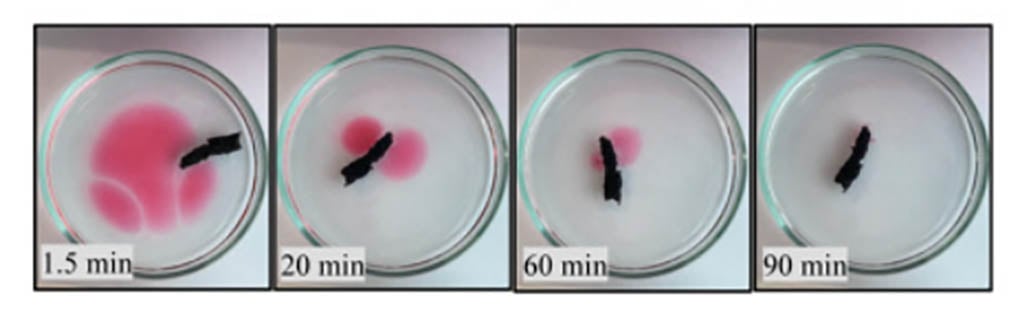
Once the oil is trapped, the aerogel transforms into a micro-ecosystem. The baked-in nutrients give local oil-degrading bacteria a comfortable platform from which to guzzle their favorite food source. Instead of floating away or washing out, the nutrients remain on the sponge. Bacteria swarm the fibers, form dense colonies, and rapidly break down the trapped pollutants, then devour the sponge itself.
“These findings demonstrate the potential of the method we developed as a versatile and sustainable platform for treating oil spills in aquatic and marine environments,” a university statement quoted Kushmaro as saying. “By combining physical adsorption with biodegradation, the technology offers a promising and innovative alternative to conventional approaches, addressing both immediate containment and long-term environmental recovery.”
The research team also included Hanna Barak, Barak Halpern, Esti Kramarski-Winter, Lee Sheli, Noa Azri, Prof. Shmuel Hayoun, and the late Prof. Alex Sivan, all from Ben-Gurion University.
The research is published last month in Chemical Engineering Journal Advances and the product is currently undergoing patent protection through BGN Technologies, the university’s technology commercialization company.
Help us report truthfully on social media

As a multimedia journalist, my job is to take the quality, fact-based journalism produced by The Times of Israel newsroom and make it accessible across every platform — from Instagram posts to podcasts to short-form videos.
This is how many, especially young people, consume news these days. But misinformation is rampant on social media. Our team at ToI produces accurate, responsible short-form reporting on Israel and the Jewish world.
If you believe in the importance of factual social media journalism, please consider joining our reader support group, The Times of Israel Community. Your financial support is essential to sustain responsible multimedia reporting.
— Gabriella Jacobs, multimedia journalist
Support our work Support our work Already a member? Sign in to stop seeing this
If you’d like to comment, join
The Times of Israel Community.