
As The Last Dolls opens in London, Bob Carlos Clarke’s daughter Scarlett reflects on the obsession, perfectionism and darker impulses that shaped the late photographer’s immaculate erotic images
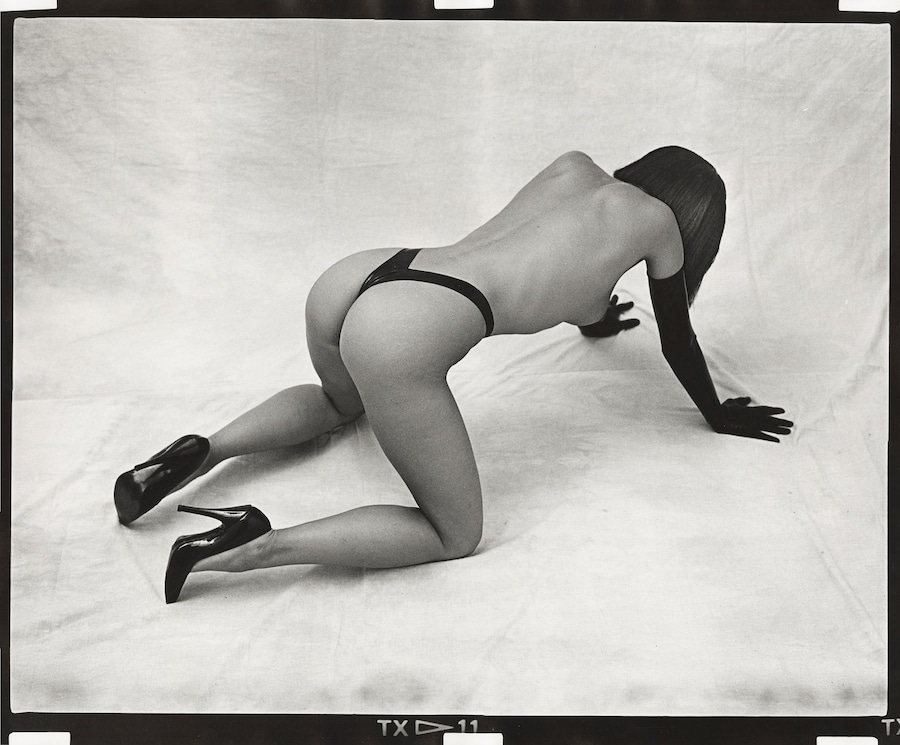
Looking through the work on display in The Last Dolls, an upcoming exhibition of photography by Bob Carlos Clarke, there’s an overwhelming sense of obsession emanating from his meticulous images. It’s almost but not quite their defining characteristic. Remembered primarily for his arresting nudes – often shot in striking black and white – it’s not just the obvious desire (and fear) he has for his subjects that suggests obsessional devotion, it’s the flawlessness of his images. Be it the pristine flesh or the slick sheen of their latex-wear, the statuesque bodies in his erotic images could almost be carved from marble, they’re immaculate.
It was his obsession with women – one woman in particular, whom he offered to photograph and ended up briefly marrying – that first drew him to pick up the camera. He quickly realised it was a good way to gain access to women and to seduce them. Obsession is the name of his 1981 monograph as well as a word he himself often used to describe his practice and his motivations. It’s also a term that recurs when I talk to Scarlett Carlos Clarke about her late father, who was, she says, “driven by an almost obsessive pursuit of perfection”. Scarlett continues, “My Dad was an obsessive printer who spent long hours in the darkroom experimenting extensively with colour, montage and darkroom processes. He bought up the only remaining supplies of Kodalith paper which he then used to create these distinctive montages.” Now, in an era when less polished images with bright flash and camera shake are in vogue, the perfectionism of the British photographer’s fetishistic portraits seems even more arresting.
Often drawing comparisons with the artist Allen Jones (the two became friends at the Royal College of Art) or referred to as “the British Helmut Newton”, Carlos Clarke attracted a similarly negative feminist critique. Undoubtedly, he objectified his ‘dolls’ – often literally, with on/off switches and wind-up keys. Yet there is something formidable about the women in his pictures. They never seem entirely passive, even as they’re on all fours. As a viewer, you don’t necessarily feel you have total power over the subject and you get the sense that he, as the photographer, wasn’t in total command either. “He was drawn towards wild, slightly dangerous characters and he had little interest in conventional casting through agencies,” Scarlett says. “Usually his subject needed to possess a particular intensity or unpredictability to excite him.”

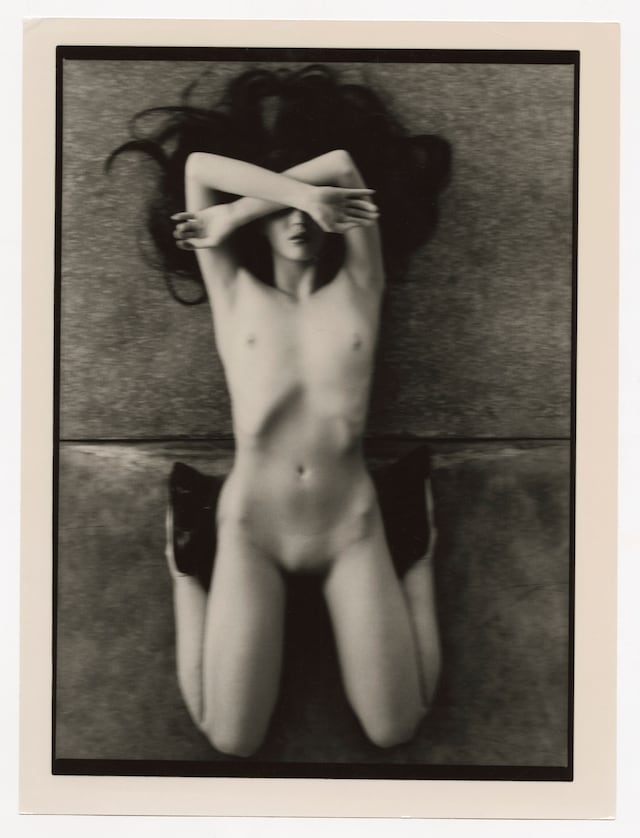
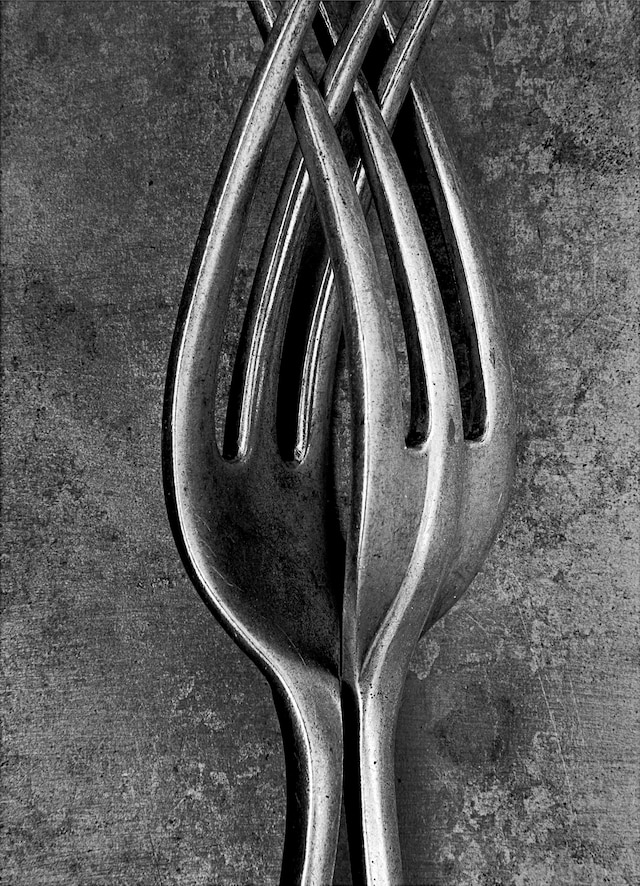
In 2009, Philippe Garner, photography expert and longtime friend of the artist, told the Guardian in 2009, “Many people who may come to the pictures for the first time will say, ‘God, they’re sexy pictures!’ Well, yes, but keep looking, other things will emerge.” There is certainly a complex darkness emerging from Carlos Clarke’s work. The Last Dolls displays his nudes alongside still life photographs composed of found objects, many of which he found at low tide on the Thames. In these pictures, the metal prongs of forks entwine like bodies while an iron and a kitchen knife form a dangerous union, both glistening in pristine stainless steel. The proximity of these domestic but dangerous implements to so much tender flesh adds an extra menace or peril. Yet that’s not the only ‘other thing’ that emerges.
It’s difficult not to allow the known facts of an artist’s life to permeate and colour how we react to their work. It’s commonly reported – often as if it’s one of the salient facts about his life – that Carlos Clarke’s brief but intense career came to an end in 2006 when he jumped in front of an oncoming train, aged 55. It’s a harrowing and violent image, entwined with the idea of dogged obsession.

Alongside suffering from manic depression, he had aesthetic views on mortality and a fatalistic fascination with the mythology of doomed artists who died before they got old. In his book Shooting Sex (2002), he wrote that “for the purposes of deification, an early and appropriate death is essential”. He struggled with professional anxiety. “I think he could see how the work was sometimes dismissed just because the subject matter was erotic,” Scarlett says. “Having known both the work and him as intimately as Phillipe Garder did, I think he recognised something deeper within it – a sense of inner turmoil, restlessness and an almost relentless striving for some form of perfection.”
Yet, despite his desire for recognition and legacy, Bob Carlos Clarke was also a rebel and an iconoclast. I ask Scarlett where she sees his work residing in the annals of British photography and she concludes, “If he was here now he’d say, ‘Just burn it all’.”
The Last Dolls by Bob Carlos Clarke runs from 5-26 September at Atlas Gallery, 49 Dorset Street, London W1U 7NF in partnership with The Little Black Gallery