
The confrontational street photographer’s London gallerist, Marcus Bury, shares a glimpse into the practice of an artist who blazed the trail
The late William Klein’s reputation still precedes him. He broke out beyond the art and photography worlds into household-name status with frenetic street photography – grainy black and white images of youths in New York, one famously staring down his lens, pistol cocked – and the likes of his 1960s Vogue shoot featuring models in prim black-and-white frocks walking a zebra crossing in Rome. He helped define the graphic monochrome aesthetic of that decade; works so genuinely ingrained into popular culture they earn the overused title ‘iconic’. And like other luminaries in this space, his character makes up as much of the legend as the images themselves.
Marcus Bury – a gallerist who first began working with the photographer in the 90s, and, as part of husband and wife-run London-based gallery HackelBury, continues to work with Klein’s estate – describes him as “confrontational”, a label that could be applied to both his work and his ways. “A lot of people are frightened of William because, like his photographs, he was very in-your-face,” Bury says. “He liked challenging people. He was fairly relentless. He liked insulting people; it was one of the things he enjoyed. It was like, ‘How much pushback are you going to give?’”
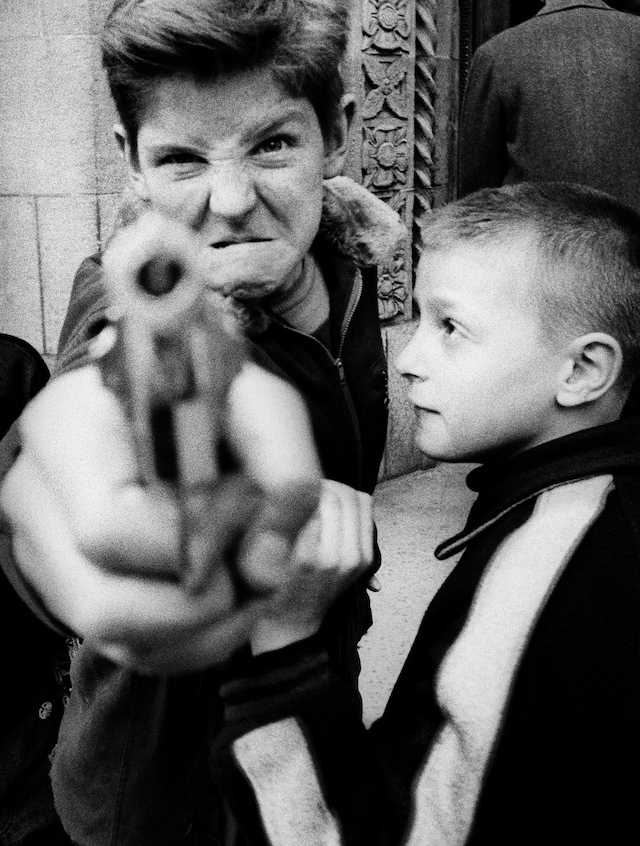
But, “he wasn’t making fun of people,” Bury insists – a line that street photographers who have walked the trail Klein blazed have found themselves negotiating, whether that’s Martin Parr’s controversial lens on class, or Bruce Gilden’s aggressively close street portraits. Klein, says Bury, was less an observer than in the fray: “He had the ability to really promote chaos as well as joining in with the chaos,” he says. It’s a characterisation that aligns with some of Klein’s most famous images, such as the pugnacious street portrait Gun 1, New York, 1955, where a young boy, face grimacing, points a gun directly into Klein’s lens, matching its energy in a quick-draw duel of sorts.
If the camera was Klein’s weapon of choice, a close second was his lawyer, whom Bury describes the photographer as having “on speed dial”. “Klein successfully sued a whole lot of big names, and was very protective of his work,” the gallerist adds. Such a taskmaster was Klein that when Bury first suggested a show at his London gallery, Klein said he’d do it on the condition he secured a museum show. More than a decade later, at the opening for his blockbuster show at the Tate Modern in a dual headliner with Japanese photographer Daidō Moriyama, Bury remembers “the lawyer, myself and William were in the basement and he had a 40-page legal document and I had to sign every single page.”

He could be funny and quick-witted too: At one edition of Paris Photo, when Klein was well into his eighties, Bury remembers a fan bringing along a pile of records to sign – Klein’s work has famously appeared on record sleeves for the likes of Serge Gainsbourg and Faith No More, among others. “William signed this large pile of records, and he came to one record which was an image by Richard Avedon. Without looking up, he just signed Richard Avedon. Then it was just like, ‘next.’”
Klein’s humour verged into satire in his 1966 film Who Are You, Polly Maggoo? (Qui êtes-vous, Polly Maggoo?), an anarchic mockumentary send-up of fashion and celebrity media. Though American Vogue launched his career – legendary art director Alexander Liberman discovered Klein’s work in Paris and set him up in New York, facilitating Klein’s street photography in that city – Klein did not hold back from poking fun at the eccentricities of the fashion industry in the film, which included one suspiciously Diana Vreeland-esque character. “He challenged the fashion industry, and that’s when he lost his job at Vogue because he took it a step too far,” says Bury. “He mocked her heavily in the film … He quite enjoyed shocking people.”
Klein’s attitude towards his own fashion photography further revealed his feelings about the industry. On a visit to Klein’s Paris studio, Bury discovered a locked cupboard that the studio manager hadn’t opened in about 20 years, at Klein’s instruction. Bury suggested they open it while the photographer was out to lunch. There he found older work that Klein felt off-kilter with how he perceived his own oeuvre, most notably one body of work titled Fashion and Light.

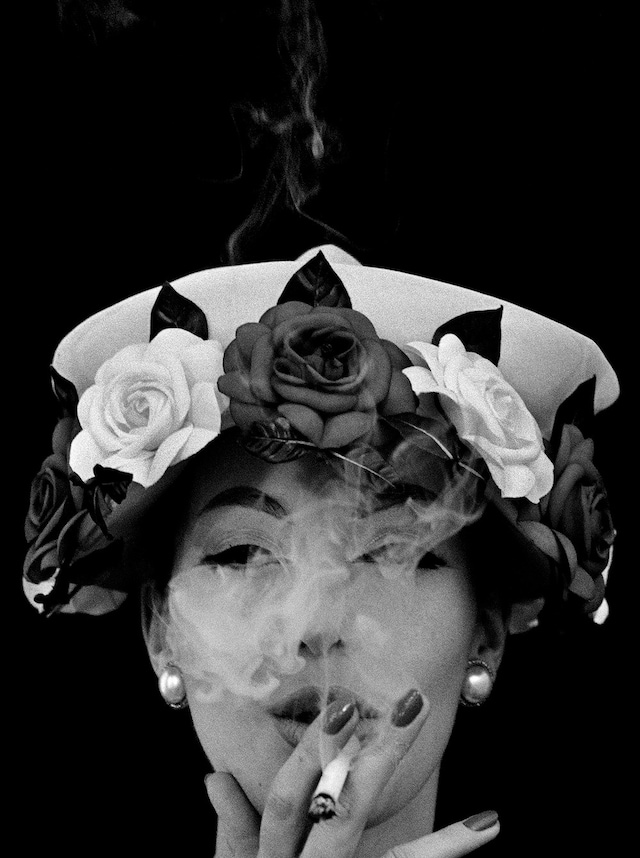
“William was quite curt with us,” says Bury. “He goes, ‘No one’s allowed into that cupboard.’ But I was like, ‘William, there are these really great images.’” Bury convinced him to have one print made – they blew it up and had it framed on black powder-coated aluminium with black plexi around it – “so it’s sort of floating in a black space.” Klein eventually signed off on ten strong images.
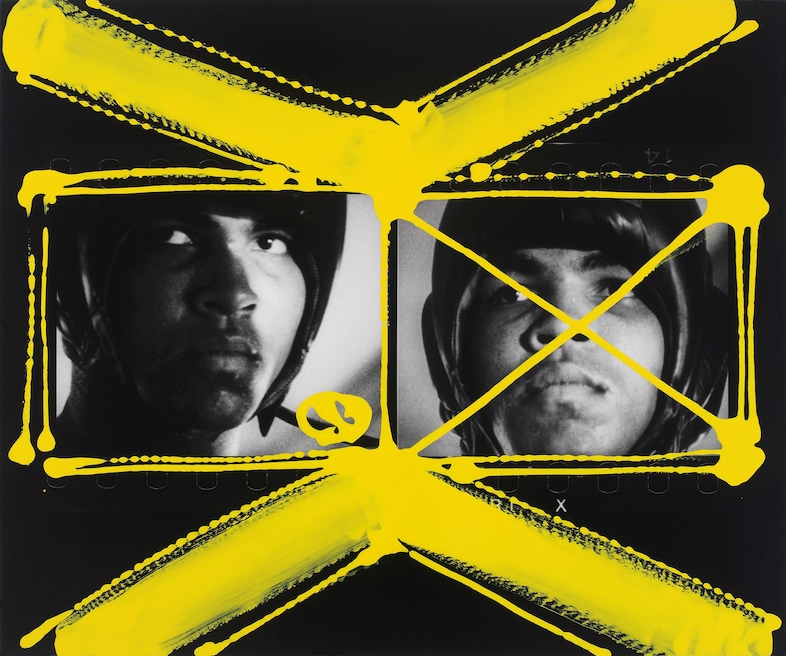
“William was very much involved in all aspects [of how his work was handled],” explains Bury. “He didn’t hand over anything apart from printing photographs” – which were produced by the same master-printer who made Magnum Photos co-founder Henri Cartier-Bresson’s prints. But the contact sheets, painted with red marks, were all Klein, a signature that married his background as a painter and – with their sequential shots – his work as a filmmaker. All three were brought together at the Tate Modern show, which included works from Klein’s initial career as a painter, restored and getting their first outing in more than 50 years, alongside his satirical and political films, including his final film Messiah (Le Messie, 1999). That last film paired Handel’s classic sacred oratorio with global, modern-day imagery of human struggle, joy, and routine.
“He has a choir in prison singing the Messiah, and then he’s got a police unit on the outside of prison singing the Messiah,” explains Bury. “It’s quite an amazing piece of cinema in that it’s quite contemporary. It’s almost like an artwork.” At times both darkly satirical and transcendently beautiful, it deals with themes of consumerism and faith, and feels aptly existential for his ultimate moving-image offering.

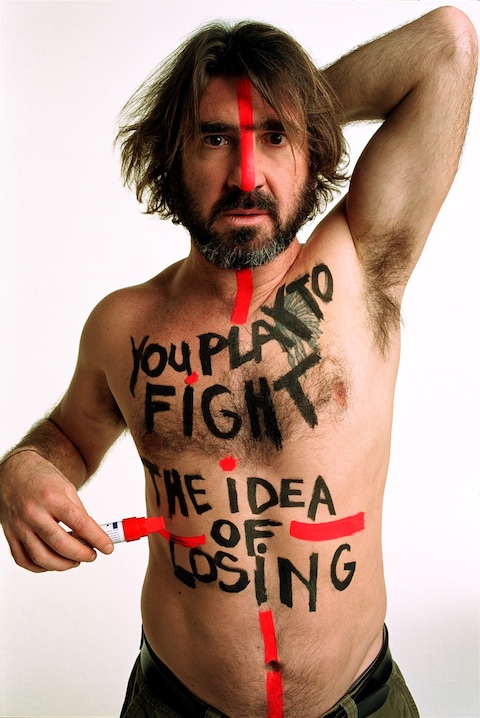
One of Bury’s all-time favourite Klein images makes the red marker a physical subject of the photograph itself in a boldly combative 2004 portrait of footballer Eric Cantona. Shirtless and confronting the camera, Cantona appears with a red marker pen in his hand, drawing a St George’s Cross from his forehead to below his belly button. In black marker the words, ‘You play to fight the idea of losing’ are scrawled across his chest.
“It’s very William Klein,” says Bury. “I don’t know anyone else who’s got a portrait quite as strong as that. It challenges you. It’s like, what are you going to do? It’s in your face. I think it's quite a remarkable image.”
Klein felt an affinity with sports stars, and became friends with a number of them, including Muhammad Ali back when he was still going by Cassius Clay, later making a film about him; tennis star Björn Borg, who he also made a film about; and Venus Williams, later a friend. The photographer boxed as a middleweight for his regiment while serving in the US Army in Europe, and played tennis recreationally throughout his life, always drawn to one-to-one sports that force participants into direct confrontation, mirroring his own relationship with his subjects as a photographer. And within those sports, it was the characters with fearless reputations he seemed drawn to the most.

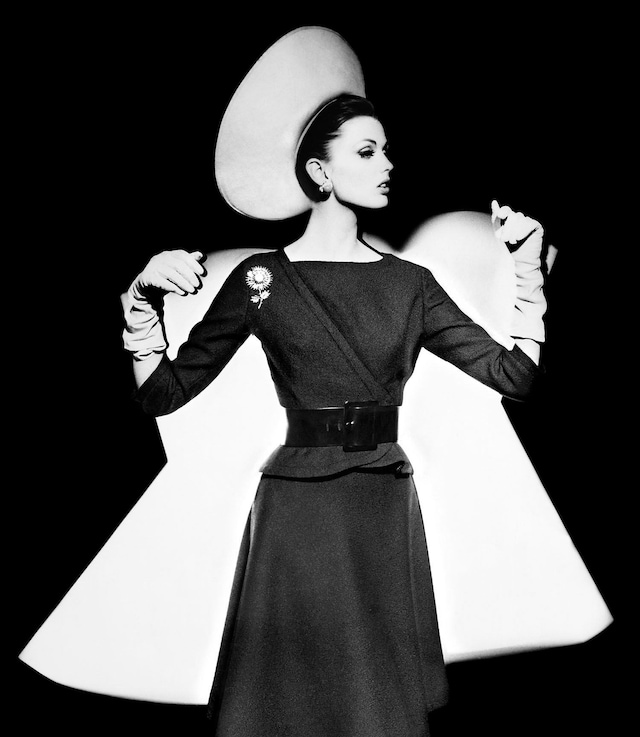
Marking what would have been his 100th birthday, a forthcoming posthumous William Klein show at HackelBury in London represents a career-spanning overview, including some of that cupboard material: Klein’s fashion work alongside his abstract experiments “painting with light”, which Bury explains “refer to each other because they were made in a similar way.”
Though recognisable street photography is among the works, and as his gallerist attests, Klein “was always pleased when his work sold,” the photographer preferred it when people bought his more adventurous pictures. “Because it meant that they understood the depth of his work.”
William Klein 100 is at HackelBury Fine Art from 9 September 2026 – 2 February 2027.